- Plants
- ›Vascular Plants
- ›flowering plants
- ›Dicots
- ›Woodsorrels, Quandongs, and Allies
- ›quandong family
- ›Elaeocarpus
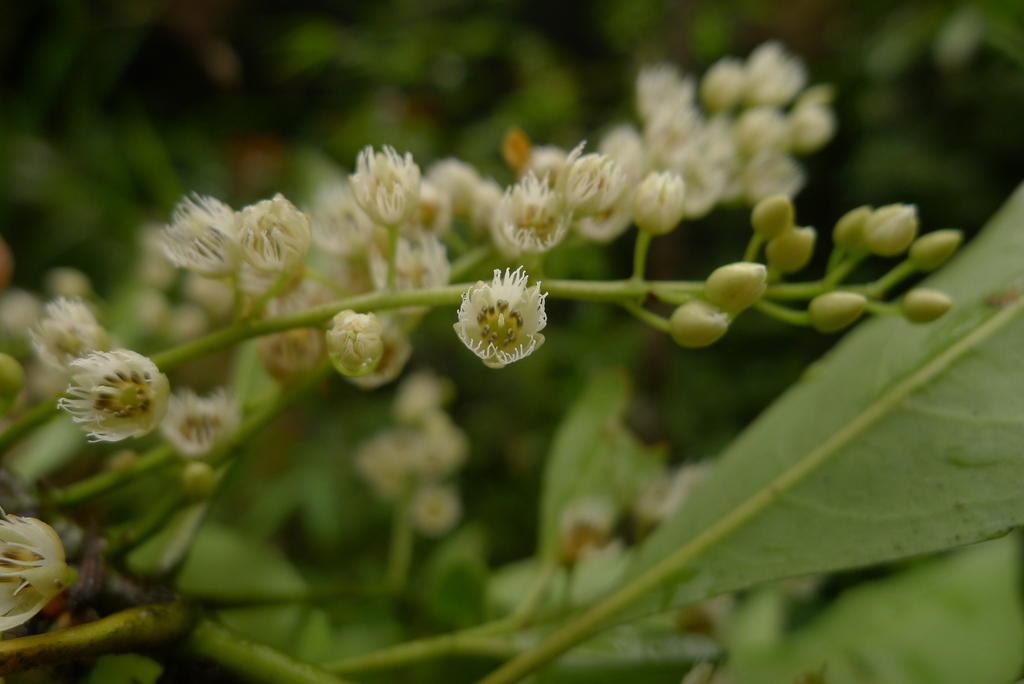
Elaeocarpus sylvestris
Elaeocarpus sylvestris, the woodland elaeocarpus, is a species of flowering plant in the family Elaeocarpaceae.
From the article Elaeocarpus sylvestris on Wikipedia (CC BY-SA), quoted section by section
Description
The tree grows up to 15 m (49 ft) and is found in evergreen forests at altitudes comprised between 300 and 2,000 m (980 and 6,560 ft). The evergreen shiny leaves are oblanceolate. The greeny-white flowers are grouped in racemes and are followed by black olive-like fruit in autumn.
Range & habitat
The woodland elaeocarpus is native to South-Central and Southeast China, Hainan, and Vietnam.
Wikipedia: “Distribution”
What it does
The larvae of the moth Leucoblepsis excisa feed on the leaves of E. sylvestris. In urban forests of Kamakura, Kanagawa, Japan, the Formosan squirrel (Callosciurus erythraeus taiwanensis) is a pest to the tree because of its gnawing habit. Woodland elaeocarpus in susceptible to Elaeocarpus yellows, a disease discovered in 1999 and a type of Phytoplasma disease, which causes a chlorosis (Japanese: 萎黄病 iō-byō) of the plant. Oxytetracycline has been used to fight the pathogen.
Wikipedia: “Ecology”
At the table
The fruits of the woodland elaeocarpus are edible. The oil from the seeds may be processed into soap or lubricants. The bark may be used as a source for dye. The wood does not resist water, so it is not considered good timber, but it is used for growing shiitake mushrooms. It is also used for planting along streets and in parks.
Wikipedia: “Uses”
In human culture
The horutonoki (Elaeocarpus sylvestris var. ellipticus) is the tree symbol of Japanese city Urasoe, Okinawa. Wild Dampalsu trees (Elaeocarpus sylvestris var. ellipticus) in Cheonjiyeon Waterfall are South Korean Natural Monument no. 163.
Wikipedia: “Symbolism”
Where it lives
Recorded sightings
—
geo-referenced records in GBIF, from museums, herbaria and field observers.
Drag the globe to turn it. Dots are where records exist, not a range map; darker means more records.
In the stacks
Searching the stacks…
Every page naming Elaeocarpus sylvestris in the Biodiversity Heritage Library →
This page is assembled live from iNaturalist, GBIF, Wikipedia, the Source Library and the Internet Archive. It is not yet part of the hand-edited codex. iNaturalist taxon 525692.