- Plants
- ›Vascular Plants
- ›flowering plants
- ›Dicots
- ›proteas, lotuses, planes, and allies
- ›Protea family
- ›Paired Proteas
- ›Banksieae
- ›Banksiinae
- ›Banksia
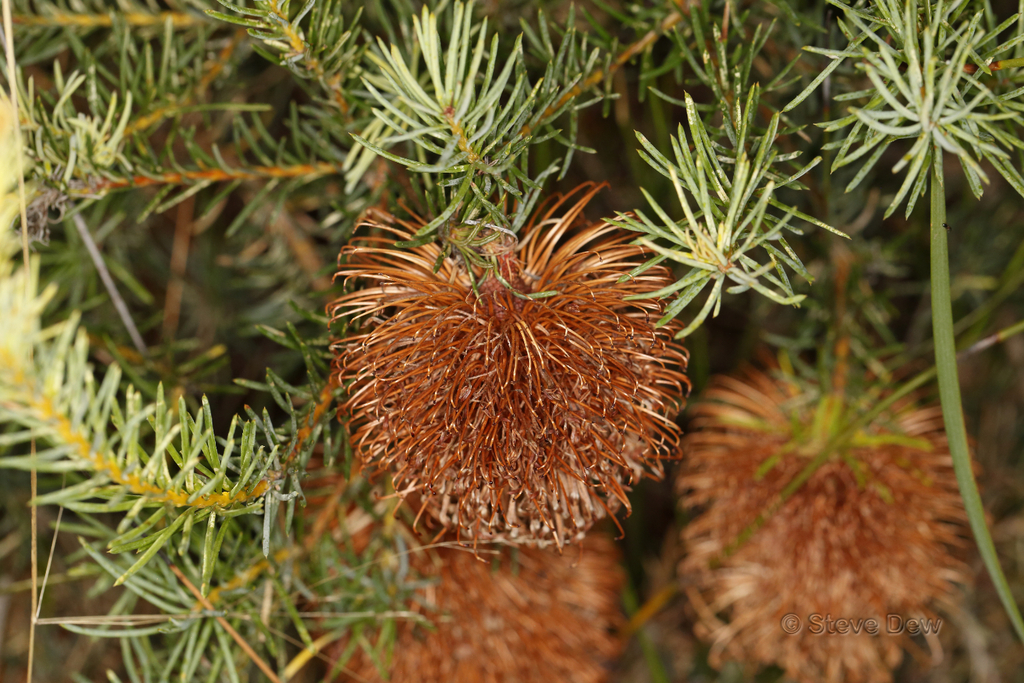
Nodding Banksia
Banksia nutans
Banksia nutans, commonly known as nodding banksia, is a species of shrub native to the south coast of Western Australia in the genus Banksia. Growing to a metre (3 ft) tall, it has pale blue-green fine-leaved foliage and unusual purple-brown inflorescences which hang upside down rather than grow upright like most other banksias.
It is one of many banksias first described by the botanist Robert Brown in the early 19th century. It is not commonly seen in cultivation. Readily grown in areas with Mediterranean climates, its sensitivity to dieback makes it short-lived in climates of summer humidity such as Sydney.
From the article Banksia nutans on Wikipedia (CC BY-SA), quoted section by section
Description
It grows as a shrub up to one metre tall, without a lignotuber. Its bark peels in thin red and grey flakes. Leaves are 10 to 2 centimetres long and 0.5 to 1.5 millimetres long, on a petiole two to three millimetres long. Flowers are pinkish-purple in bud, purplish-brown after anthesis, and smell of onion. They occur in flower spikes from four to seven centimetres long; unusually for Banksia species they are not upright but hang down. After flowering, old flowers persist on the infructescences, giving them a hairy appearance.
Range & habitat
B. nutans grows along the south coast of Western Australia between Albany and Cape Pasley. There are two main centres of distribution: between Albany and Hopetoun and between Scaddan and Cape Pasley. The intervening area has been largely cleared for agriculture, and B. nutans is not known to occur there. There are also some outlying populations: populations of B. nutans var. cernuella have been recorded in the vicinity of Arthur River, and the Western Australian Herbarium has recorded B. nutans var. nutans from around Norseman. The species grows in depressions, especially amongst consolidated coastal dunes, in white or grey sand, or in gravel. The majority of populations occur within the Esperance Plains biogeographic region, a region predominantly vegetated by mallee-heath and proteaceous shrub, with a warm Mediterranean climate.
Wikipedia: “Distribution and habitat”
What it does
As it lacks a lignotuber, this species is killed by fire. However, fire also triggers the release of seed from the follicles, so populations regenerate well after fire. Seeds do not require any treatment and take 17 to 54 days to germinate. A 1985-86 field study in the Fitzgerald River National Park found it to be the main summertime food source for the nectar-feeding honey possum (Tarsipes rostratus). An assessment of the potential impact of climate change on this species found that its range is likely to contract between 30% and 80% by 2080, depending on the severity of the change.
Wikipedia: “Ecology”
Where it lives
Recorded sightings
—
geo-referenced records in GBIF, from museums, herbaria and field observers.
Drag the globe to turn it. Dots are where records exist, not a range map; darker means more records.
In the stacks
Searching the stacks…
Every page naming Banksia nutans in the Biodiversity Heritage Library →
This page is assembled live from iNaturalist, GBIF, Wikipedia, the Source Library and the Internet Archive. It is not yet part of the hand-edited codex. iNaturalist taxon 525074.