- Plants
- ›Vascular Plants
- ›flowering plants
- ›Dicots
- ›Mints, Plantains, Olives, and Allies
- ›olive family
- ›Olea
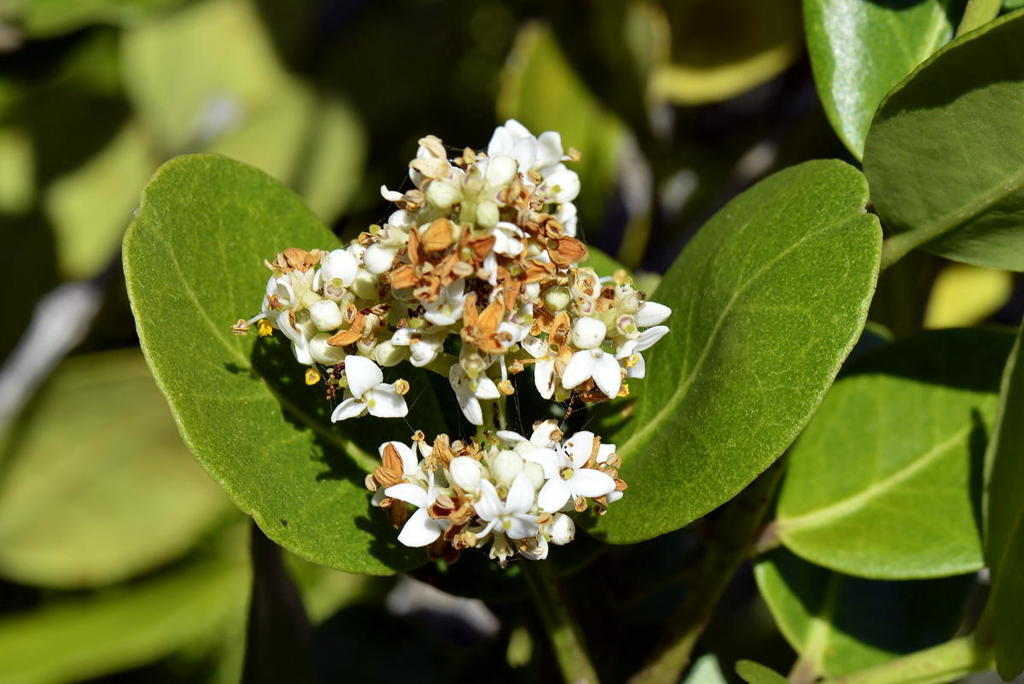
Black Ironwood
Olea capensis
Olea capensis, the black ironwood, is an African tree species in the olive family Oleaceae. It is widespread in sub-Saharan Africa: from the east in Somalia, Ethiopia and Sudan, south to the tip of South Africa, and west to Cameroon, Sierra Leone and the islands of the Gulf of Guinea, as well as Madagascar and the Comoros. It occurs in bush, littoral scrub and evergreen forest.
Other common names in English include ironwood, ironwood olive, East African olive and Elgon olive.
From the article Olea capensis on Wikipedia (CC BY-SA), quoted section by section
Description
The black ironwood is a bushy shrub, or a small to medium-sized tree, up to 10 metres (33 ft) in height, occasionally reaching 40 metres (130 ft).
Bark: light grey, becoming dark grey and vertically fissured with age; a characteristic blackish gum is exuded from bark wounds. Leaves: light to dark green and glossy above and paler green below; petiole often purplish, 0.3–1.7 cm long; lanceolate-oblong to almost circular, 3–10 x 1.5–5 cm. Flowers: white or cream and sweetly scented, small and in many flowered axillary or terminal heads, bisexual, 3–15 cm long. Fruit: when ripe they are somewhat succulent purplish drupes; ovoid up to 2 x 1 cm.
Subspecies. The species has been divided into 3 subspecies:
Olea capensis subsp. macrocarpa: flowers in lax heads, fruits oblong to elliptic. Olea capensis subsp. capensis: flowers in dense heads, leaves very variable, apex often rounded, and fruits almost spherical to oblong elliptic. Olea capensis subsp. enervis: leaves usually broadly elliptic, apex tapering.
At the table
Olea capensis has masses of sweetly scented bisexual flowers that produce large edible fruits.
Wikipedia: “Food”
Where it lives
Recorded sightings
—
geo-referenced records in GBIF, from museums, herbaria and field observers.
Drag the globe to turn it. Dots are where records exist, not a range map; darker means more records.
In the stacks
Searching the stacks…
Every page naming Olea capensis in the Biodiversity Heritage Library →
This page is assembled live from iNaturalist, GBIF, Wikipedia, the Source Library and the Internet Archive. It is not yet part of the hand-edited codex. iNaturalist taxon 524917.