- Plants
- ›Vascular Plants
- ›flowering plants
- ›Dicots
- ›Roses, Elms, Figs, and Allies
- ›rose family
- ›brambles, roses, strawberries, and allies
- ›strawberries, cinquefoils, and allies
- ›cinquefoil subtribe
- ›Argentina
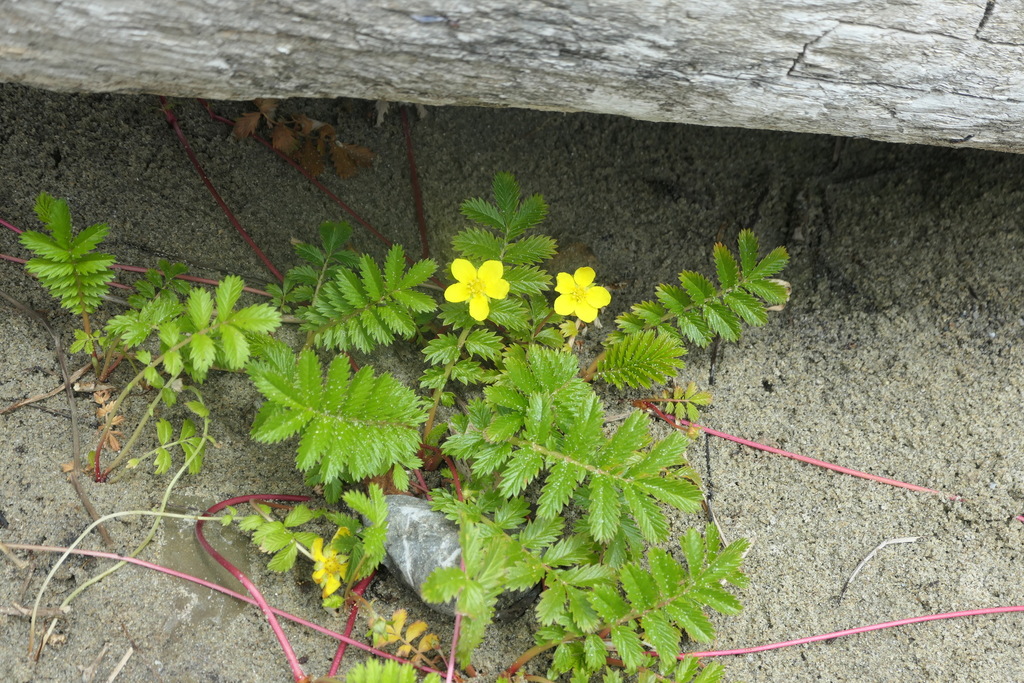
Pacific silverweed
Argentina pacifica
Argentina pacifica, sometimes called pacific silverweed, silverweed cinquefoil, or simply silverweed, is a low-growing perennial (6") with pinnately compound green leaves with silvery undersides. It is a member of the species aggregate known as Argentina anserina or Potentilla anserina. The yellow, saucer-shaped flowers appear late spring through summer. Pacific silverweed spreads very quickly and makes a lovely groundcover in moist areas. They need sun and regular water.
From the article Argentina pacifica on Wikipedia (CC BY-SA), quoted section by section
Description
It is a low-growing (15 cm or 6 in) perennial plant. It has pinnately compound green leaves with silvery undersides. The yellow, saucer-shaped flowers appear from late spring through summer.
Range & habitat
Pacific silverweed spreads very quickly in moist areas. Preferring salt marshes, river estuaries and shorelines, they are often seen growing alongside springbank clover. They need sun and regular water.
Wikipedia: “Distribution and habitat”
At the table
Pacific silverweed is important in Pacific Northwest coastal indigenous cultures of North America and Canada. These Indigenous people dig for its edible roots. As an important vegetable, families maintained rights to access patches through potlatch. New plants can grow from small root fragments, and with some attention families could guarantee patches persisted for generations, perhaps over thousands of years. Northwest Coast peoples used to dig them in spring with yew-wood shovels before pit-cooking them or boiling them with eulachon grease. Cooked roots have a slightly bitter sweet-potato flavour. Northwest Coast peoples also washed them or mashed them into cakes and dried them for winter.
== References ==
Wikipedia: “Uses”
Where it lives
Recorded sightings
—
geo-referenced records in GBIF, from museums, herbaria and field observers.
Drag the globe to turn it. Dots are where records exist, not a range map; darker means more records.
In the stacks
Searching the stacks…
Every page naming Argentina pacifica in the Biodiversity Heritage Library →
This page is assembled live from iNaturalist, GBIF, Wikipedia, the Source Library and the Internet Archive. It is not yet part of the hand-edited codex. iNaturalist taxon 524900.