- Plants
- ›Vascular Plants
- ›flowering plants
- ›Dicots
- ›pinks, cactuses, and allies
- ›Amaranth family
- ›Amaranthoideae
- ›Amaranthus
- ›Amaranthus hybridus
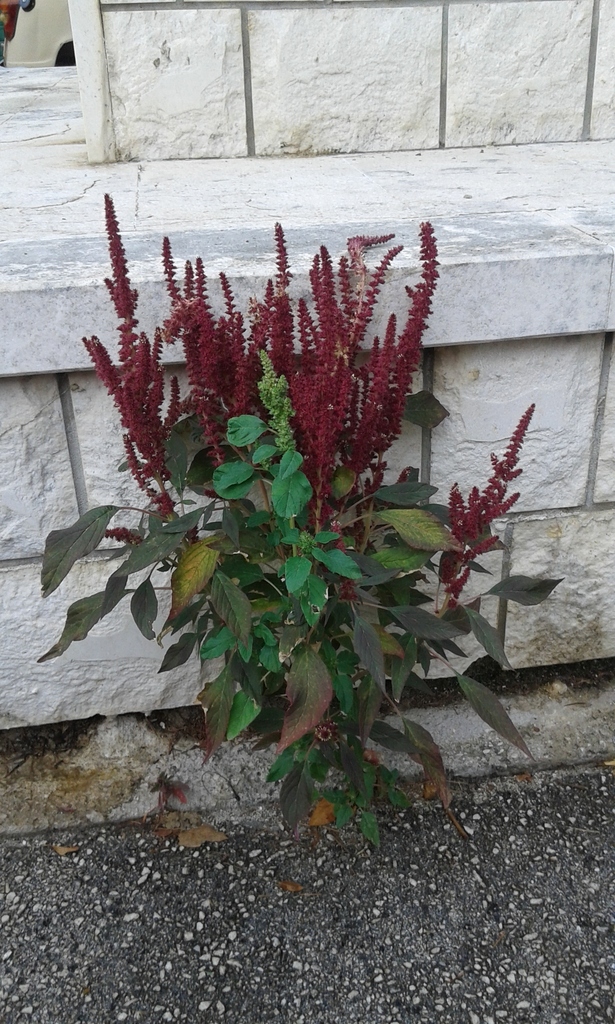
Red amaranth
Amaranthus cruentus
Amaranthus cruentus is a flowering plant species that yields the nutritious staple amaranth grain. It is one of three Amaranthus species cultivated as a grain source, the other two being Amaranthus hypochondriacus and Amaranthus caudatus. In Mexico, it is called huautli (Spanish pronunciation: and alegría ( and in English it has several common names, including blood amaranth, red amaranth, purple amaranth, prince's feather, and Mexican grain amaranth. In Maharashtra, it is called as shravani maath ("श्रावणी...
From the article Amaranthus cruentus on Wikipedia (CC BY-SA), quoted section by section
Description
Amaranthus cruentus is a tall annual herb topped with clusters of dark pink flowers. The plant can grow up to 2 m (6 ft) in height, and blooms in summer to fall. It is believed to have originated from Amaranthus hybridus, with which it shares many morphological features. The plant is usually green in color, but a purple variant was once grown for use in Inca rituals. height up to 13 feet are found in Wayanad, Kerala.
At the table
This species was in use as a food source in North America and Central America as early as 4000 BC. The seeds are eaten as a cereal grain. They are black in the wild plant, and white in the domesticated form. They are ground into flour, popped like popcorn, cooked into a porridge, or made into a confectionery called alegría. The leaves can be cooked like spinach, and the seeds can be germinated into nutritious sprouts. While A. cruentus is no longer a staple food in North and Central America, it is still grown and sold as a health food. It is an important crop for subsistence farmers in Africa. In Chhattisgarh, red amaranth is used to make Lal Bhaji, a stir-fried dish. In Maharashtra, during the month of Shravan, a stir-fried vegetable with just grated coconut is served during festivals. The stem is used in a curry made with Vaal hyacinth bean. Among the Zuni people, the feathery part of a plant is ground into a fine meal and used to color ceremonial bread red. The crushed leaves and blossoms are also moistened and rubbed on cheeks as rouge. In the Kinnaur District of Himachal Pradesh (India), the grain is used to make kheer and served mostly as dessert during marriage ceremonies. The flour is also used to make deep-fried chapatis (pole).
Wikipedia: “Uses”
How it is grown
A. cruentus is cultivated as an ornamental plant, valued for its feather-like flowering plumes. It is usually grown from seed as a half-hardy annual, that is sown under glass in early spring and planted out in summer. Numerous cultivars have been developed, of which the following have gained the Royal Horticultural Society's Award of Garden Merit:
'Autumn Palette Group' (earth colours – rust, cream, brown) 'Oeschberg' (crimson flowers) 'Velvet Curtains' (deep red/crimson)
Wikipedia: “Cultivation”
Where it lives
Recorded sightings
—
geo-referenced records in GBIF, from museums, herbaria and field observers.
Drag the globe to turn it. Dots are where records exist, not a range map; darker means more records.
In the stacks
Searching the stacks…
Every page naming Amaranthus cruentus in the Biodiversity Heritage Library →
This page is assembled live from iNaturalist, GBIF, Wikipedia, the Source Library and the Internet Archive. It is not yet part of the hand-edited codex. iNaturalist taxon 52328.