- Plants
- ›Vascular Plants
- ›flowering plants
- ›Dicots
- ›Heathers, Balsams, Primroses, and Allies
- ›phlox family
- ›Ipomopsis
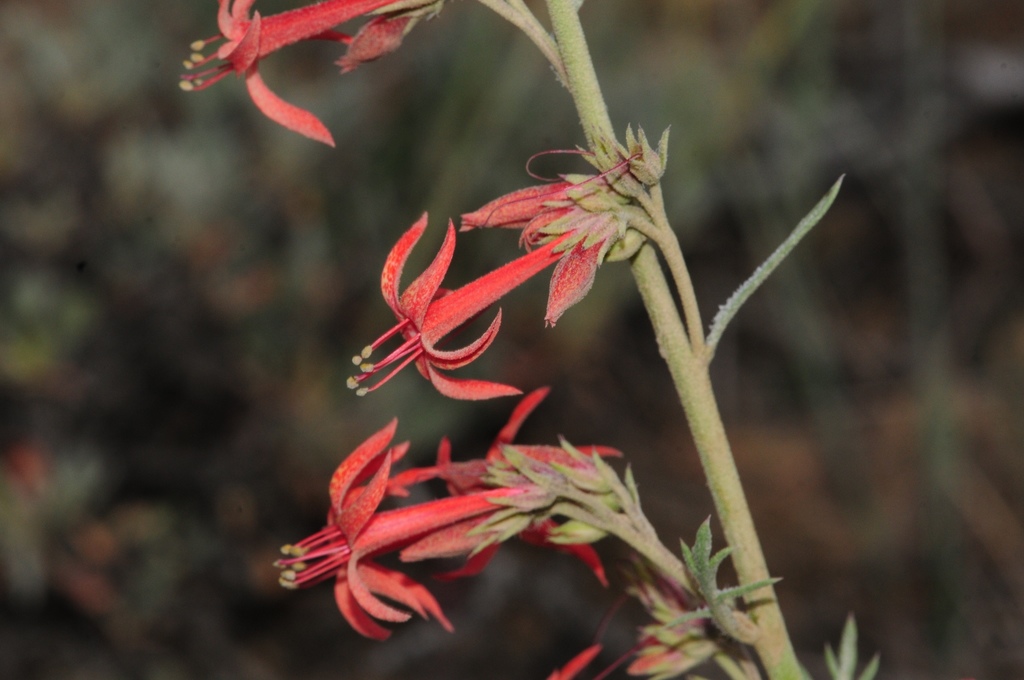
Scarlet Gilia
Ipomopsis aggregata
Ipomopsis aggregata is a species of flowering plant in the phlox family (Polemoniaceae), commonly known as scarlet trumpet, scarlet gilia, or skyrocket because of its scarlet red flowers with lobes curving back as if blown back by rocketing through the air.
From the article Ipomopsis aggregata on Wikipedia (CC BY-SA), quoted section by section
Description
Scarlet skyrockets are herbaceous plants that grow a flowering stem that is typically 20 to 100 centimeters (8–39 in) tall. They have characteristic red, trumpet-shaped flowers and basal leaves stemming from a single erect stem. Trumpet flowers can range from white, red, orange-red, and pink. Pink flowers are especially common in high mesa areas of Colorado, such as the Flat Tops, Grand Mesa, or the Uncompahgre Plateau. Yellow flowers have been reported for plant but are extremely rare. Fernlike leaves are low to the ground, helping encourage warmth in colder areas, and have silver specks and a fine white pubescence. A well-known delicacy in nature, I. aggregata is well adapted to herbivory, as it can regrow multiple flowering stalks once lost. Although herbivory initially reduces seed and fruit count of the plant, intermediate herbivory and its stimulating factors could lead to the plant growing larger over time. The many flowers, usually around 84 per plant, open in a series over four to seven weeks. Scarlet skyrockets are generally a monocarpic plant, with plants dying after setting seed, but can very rarely go on to flower a second time. Field studies in Colorado found that plants are generally three to seven years old when they produce flowers.
Chemistry. Patuletin glycosides can be found in I. aggregata as well as eupalitin and eupatolitin.
Range & habitat
Ipomopsis aggregata is native to western North America, growing mainly in mountains in the west-central to western regions and ranging from British Columbia to Mexico. In Mexico subspecies carmenensis grows in the state of Coahuila while subspecies formosissima grows in Baja California, Chihuahua, Coahuila, Durango, Nuevo León, San Luis Potosí, and Sonora. In the United States it is a common species from the Rocky Mountains westwards. Though it is not found in the western counties of Washington or the northwest of Oregon. Similarly, it grows in the northern parts of California and the Sierra Nevada, but not in southern California, the Central Valley, or most of the Coast Ranges. It does grows in Texas, but only in the Trans-Pecos and Hutchinson, Roberts, and Lipscomb counties in the Texas panhandle. It is reported to be native to Oklahoma, but the Natural Resources Conservation Service does not report a specific location for the species. In Canada it only is native to southern British Columbia.
Wikipedia: “Distribution and habitat”
What it does
Ipomopsis aggregata most often visited and pollinated by and hummingbirds, with the rufous hummingbirds and calliope hummingbirds frequently seen attending the flowers in the Sierra Nevadas and broad-tailed hummingbirds the most frequent in the Rocky Mountains. In addition to hummingbirds the white-lined sphinx moth (Hyles lineata) occasionally feed from the flowers, but do not pollinate them. Other smaller moths are known too feed on the flowers near Fairplay Colorado at night and might be pollinators. Pollen collecting bees visit the flowers fairly frequently including Perdita giliae and bumblebees (Bombus). Basal leaves overwinter, even in subalpine areas of the Rocky Mountains. The plant blooms in late spring to early summer, and into fall if weather conditions are favorable. Optimal growing conditions include little water, part shade, and sandy soil. Although defined as hermaphroditic, Ipomopsis aggregata has shown sex allocation in flowering months, with phenotypic sex reaching a proportion of 0.77 female components to male. Elk and mule deer commonly feed on I. aggregata.
Current research. The plant is currently being used to better understand pollination factors. Researchers used fluorescent particles on flowers to create pollen analogs to track pollinating hummingbirds. This ultimately gains insight into cross pollination techniques carried out by pollinating bodies. …
Wikipedia: “Ecology”
At the table
In the traditional medicine of the Sahaptin people tribes boiled scarlet skyrocket is boiled to produce a drink for kidney health.
Wikipedia: “Uses”
Where it lives
Recorded sightings
—
geo-referenced records in GBIF, from museums, herbaria and field observers.
Drag the globe to turn it. Dots are where records exist, not a range map; darker means more records.
In the stacks
Searching the stacks…
Every page naming Ipomopsis aggregata in the Biodiversity Heritage Library →
This page is assembled live from iNaturalist, GBIF, Wikipedia, the Source Library and the Internet Archive. It is not yet part of the hand-edited codex. iNaturalist taxon 52136.