- Plants
- ›Vascular Plants
- ›flowering plants
- ›Dicots
- ›Heathers, Balsams, Primroses, and Allies
- ›heath family
- ›monotropes
- ›Pterospora
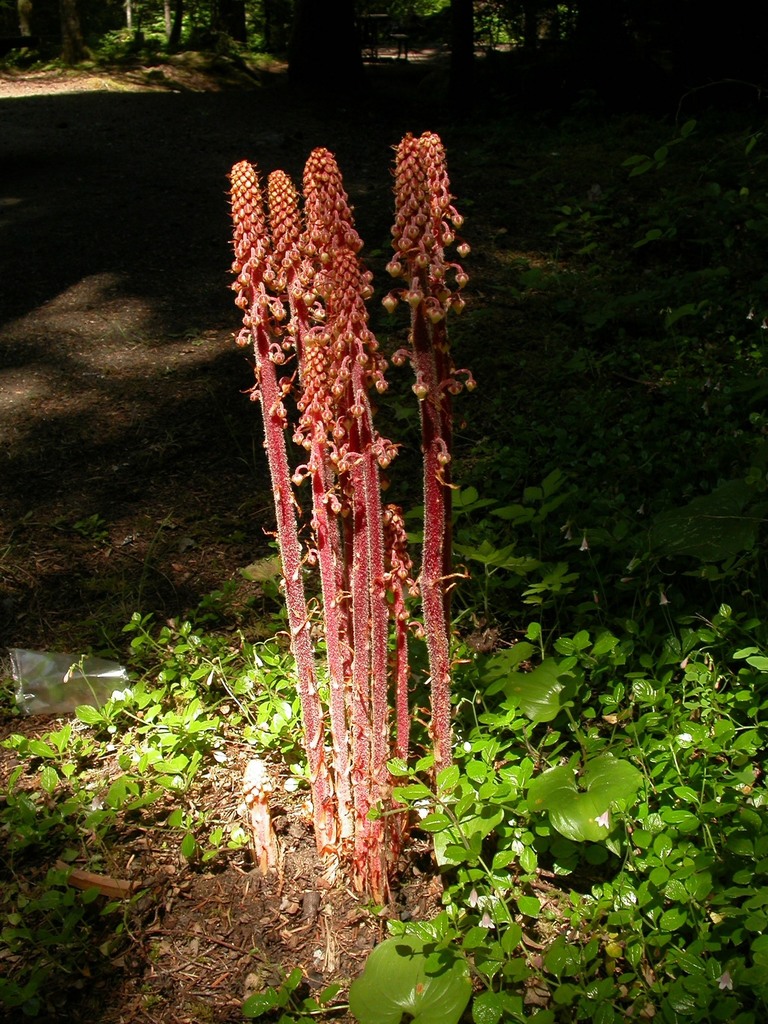
woodland pinedrops
Pterospora andromedea
Pterospora, commonly known as pinedrops, woodland pinedrops, Albany beechdrops, or giant bird's nest, is a North American genus in the subfamily Monotropoideae of the heath family, and includes only the species Pterospora andromedea. It grows as a mycoheterotroph (relying on fungi rather than photosynthesis for nutrients) in coniferous or mixed forests. It is widespread across much of Canada as well as the western and northeastern United States to Mexico. Along with Monotropa it is one of the more frequently encountered genera of the Monotropoideae.
From the article Pterospora on Wikipedia (CC BY-SA), quoted section by section
Description
The visible portion of Pterospora andromedea is a fleshy, unbranched, reddish to yellowish flower spike (raceme) 15–170 cm (6–67 in) in height, though it has been reported to occasionally attain a height of 2 meters (6.6 feet). The above-ground stalks (inflorescences) resemble an emerging asparagus spear in shape and are usually found in small clusters between June and August. The inflorescences are hairy and noticeably sticky to the touch. This is caused by the presence of hairs which exude a sticky substance (glandular hairs). The inflorescences are covered by leaves that have been reduced to scale-like structures known as bracts that are 2–3.5 centimeters long and 0.5–1 centimeter wide. The lower portion of the flowering stem is tightly covered in bracts and they become more widely spaced higher on the stalk.
The upper portion of the inflorescence has a series of white, yellowish, or rusty urn-shaped flowers that face downward. Each flower may have five sepals surrounding the base of the flower, which measure 4–6 millimeters long and are 2—3 millimeters wide. The fused petals (the corolla) measure 6–9 millimeters in length. The fruit is a capsule with five lobes that are 7–10 millimeters wide. Inside the capsules there are large numbers of very small seeds with, thin papery wings that are much wider than the seeds themselves. …
Range & habitat
Pterospora andromedea is native to North America from Alaska to central Mexico. It has two populations, the larger in western North America and the other in the east, separated by the Great Plains. In Canada it is found in the western provinces of British Columbia, Alberta, and Saskatchewan and in the eastern provinces of New Brunswick, Ontario, Prince Edward Island, and Québec. In the western United States it is found widely in Arizona, California, Colorado, Idaho, Montana, Nevada, New Mexico, Oregon, South Dakota, Utah, Washington state, and Wyoming. It has also been reported in Sioux County, Nebraska and without county level distributions in Texas. America's eastern population is found in Michigan, New Hampshire, New York, Vermont, Wisconsin, and possibly in Pennsylvania. It grows or has grown in many Mexican states including Chihuahua, Coahuila, Durango, Hidalgo, Mexico City, Mexico State, Morelos, Nuevo Leon, Oaxaca, Puebla, Sonora, Tlaxcala, and Veracruz. It is also very rarely found in the highest elevations of Sierra de San Pedro Mártir in Baja California. In the western United States it is mainly found under conifer trees in areas with deep accumulations of needles and dry to moderately moist soils, but may also be found under some oak trees. …
Wikipedia: “Range and habitat”
What it does
P. andromedea, like all members of Monotropoideae, is a mycoheterotroph. This is a form of carbon acquisition that is parasitic on fungal organisms and epiparastic of photosynthetic plants which are symbionts to the fungal host. Because P. andromedea is achlorophyllous this relationship is an obligate symbiosis for it, but is not ubiquitous in the fungal host. All monotropoideae are host specific to a select few fungal counterparts which in turn makes them specific to the photosynthetic organism associated with their fungal host. In the case of P. andromedea fungal host specificity leans heavily towards Rhizopogon salebrosus in the western distribution and Rhizopogon kretzerae in the eastern distribution but broadly seems to be ubiquitous symbionts with Rhizopogon subgenus Amylopogon. Rhizopogon species also exhibit high host specificity and sub-genus Amylopogon is primarily associated with the Pinus genus. Fungal exoenzymatic activity has been shown to be required for seed germination of P. andromedea however the requisite enzymes are not exclusively produced within subgenus Amylopogon indicating that seed colonization by fungi outside of the observed host specificity is possible however ecologically restricted by some currently unknown mechanism. Though often described as a parasitic relationship, there is some evidence that it may be a mutualistic partnership.
Wikipedia: “Fungal interactions”
At the table
The seed stalks are occasionally collected to be used as long lasting ornaments in dry floral arrangements. Though the flowers are considered desirable by plant collectors, the very specific requirements of its fungal host make this plant practically impossible to transplant.
Wikipedia: “Uses”
Where it lives
Recorded sightings
—
geo-referenced records in GBIF, from museums, herbaria and field observers.
Drag the globe to turn it. Dots are where records exist, not a range map; darker means more records.
In the stacks
Searching the stacks…
Every page naming Pterospora andromedea in the Biodiversity Heritage Library →
This page is assembled live from iNaturalist, GBIF, Wikipedia, the Source Library and the Internet Archive. It is not yet part of the hand-edited codex. iNaturalist taxon 52118.