- Plants
- ›Vascular Plants
- ›flowering plants
- ›Dicots
- ›proteas, lotuses, planes, and allies
- ›Protea family
- ›Paired Proteas
- ›Banksieae
- ›Banksiinae
- ›Banksia
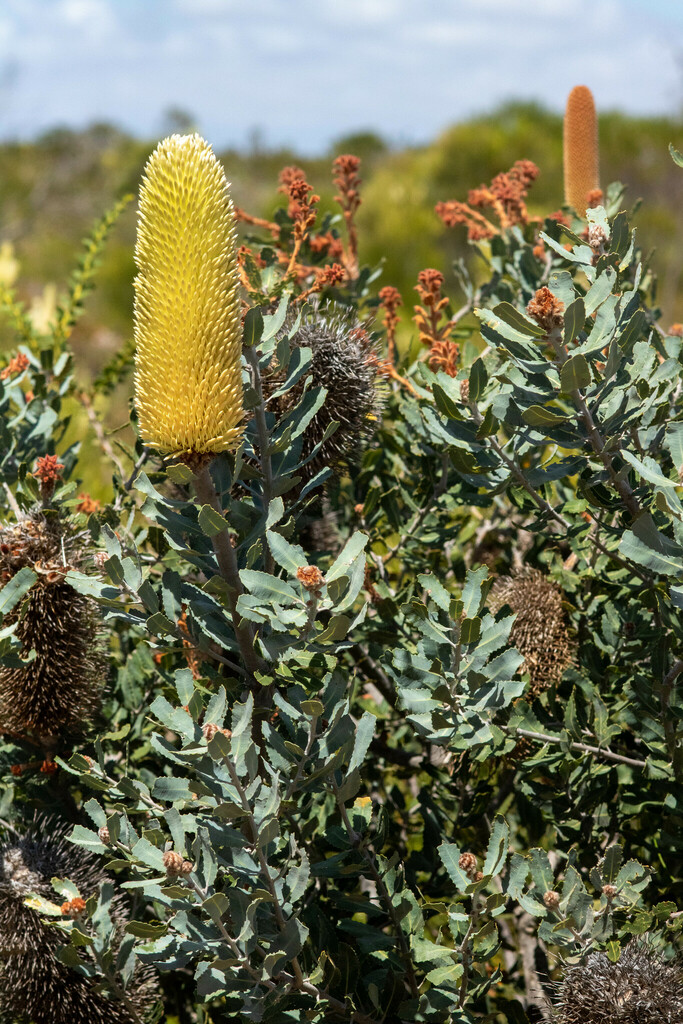
sceptre banksia
Banksia sceptrum
Banksia sceptrum, commonly known as the sceptre banksia, is a plant that grows in Western Australia near the central west coast from Geraldton north through Kalbarri to Hamelin Pool. It extends inland almost to Mullewa. First collected and grown by early settler James Drummond in Western Australia, it was described by Swiss botanist Carl Meissner in 1855.
In nature, B. sceptrum grows in deep yellow or pale red sand in tall shrubland, commonly on dunes, being found as a shrub to 5 metres (16 ft) high, though often smaller in exposed areas. It is killed by fire and regenerates by seed, the woody follicles opening with fire. B. sceptrum is one of the most striking yellow-flowered banksias of all. Its tall bright yellow spikes, known as inflorescences, are terminal and well displayed. Flowering is in summer, mainly December and January, though flowers are occasionally seen at other times.
From the article Banksia sceptrum on Wikipedia (CC BY-SA), quoted section by section
Description
Banksia sceptrum generally grows as a shrub up to 2–4 m (6+1⁄2–13 ft) high, though sometimes it reaches 5 m (16+1⁄2 ft). It is many-branched and can reach 4 m (13 ft) in diameter. The stocky trunk has smooth or mildly tessellated pale grey bark. New growth has been recorded in spring and autumn, and may possibly occur over the summer. New branchlets are covered in fine greenish-brown fur and become smooth and pale grey after around two years. The leaves are roughly oblong-shaped with truncate or emarginate ends and measure 4–9 cm (1+1⁄2–3+1⁄2 in) long and 1–3 cm (3⁄8–1+1⁄8 in) wide. They are on 5–8 mm (1⁄4–3⁄8 in) long petioles. The flat leaf margins have short blunt teeth. The upper and lower surfaces of the leaf are covered in dense fur, but become smooth with age. The tall flower spikes, known as inflorescences, arise at the ends of vertical branches over November to January, and can be striking in appearance. They take 6–7 months to develop—longer than other members of the genus. Between 7 and 21 cm (3 and 8+1⁄2 in) high and 8–10 cm (3+1⁄4–4 in) wide, they are bright yellow and highly prominent. Flower opening (anthesis) takes place over 1–2 weeks, and proceeds up the flower spike. The ageing flowers turn grey and remain on the spike as the woody oval follicles develop. The infructescence—an old spike bearing follicles—is bulky with a 6–8 cm (2+1⁄4–3+1⁄4 in) diameter. …
Range & habitat
Banksia sceptrum is found from Hamelin Pool south to around 60 km (37 mi) east of Geraldton and near Mullewa and east to Wandana Nature Reserve. The annual rainfall is 300–400 mm (12–16 in). The soils it grows on are deep yellow or pale red sands, often on dunes. It is also found on flat areas. Found in tall shrubland, it grows in association with B. ashbyi, mallee gums, sandplain cypress (Actinostrobus arenarius) and sandplain woody pear (Xylomelum angustifolium).
Wikipedia: “Distribution and habitat”
What it does
Like many plants in Australia's southwest, Banksia sceptrum is adapted to an environment in which bushfire events are relatively frequent. Most Banksia species can be placed in one of two broad groups according to their response to fire: reseeders are killed by fire, but fire also triggers the release of their canopy seed bank, thus promoting recruitment of the next generation; resprouters survive fire, resprouting from a lignotuber or, more rarely, epicormic buds protected by thick bark. Banksia sceptrum is a reseeder—killed by bushfire and regenerating by seed. The follicles on the old flower spikes remain closed until burnt by fire, after which they open and release the seed. New plants take three to five years to flower again. If bushfires are too frequent—occurring less than four years apart—they risk eradicating local populations of reseeders. B. sceptrum has been shown to be highly susceptible to dieback from the soil-borne water mould Phytophthora cinnamomi, like many Western Australian banksias. An assessment of the potential impact of climate change on this species found that its range is unlikely to contract and may actually grow, depending on how effectively it migrates into newly habitable areas.
Wikipedia: “Ecology”
How it is grown
B. sceptrum is principally used in the cut flower industry, with the immature spikes being commonly sold in florists around Australia. It is occasionally grown in gardens as its bright flower spikes are prominent, but requires a Mediterranean climate (dry summer) and good drainage as it is sensitive to dieback. Seeds do not require any treatment, and take 26 to 47 days to germinate. A dwarf form is in cultivation.
Wikipedia: “Cultivation”
Where it lives
Recorded sightings
—
geo-referenced records in GBIF, from museums, herbaria and field observers.
Drag the globe to turn it. Dots are where records exist, not a range map; darker means more records.
In the stacks
Searching the stacks…
Every page naming Banksia sceptrum in the Biodiversity Heritage Library →
This page is assembled live from iNaturalist, GBIF, Wikipedia, the Source Library and the Internet Archive. It is not yet part of the hand-edited codex. iNaturalist taxon 518346.