- Plants
- ›Vascular Plants
- ›flowering plants
- ›Dicots
- ›saxifrages, stonecrops, and allies
- ›stonecrop family
- ›Sempervivoideae
- ›Semperviveae
- ›Sempervivum
- ›Sempervivum
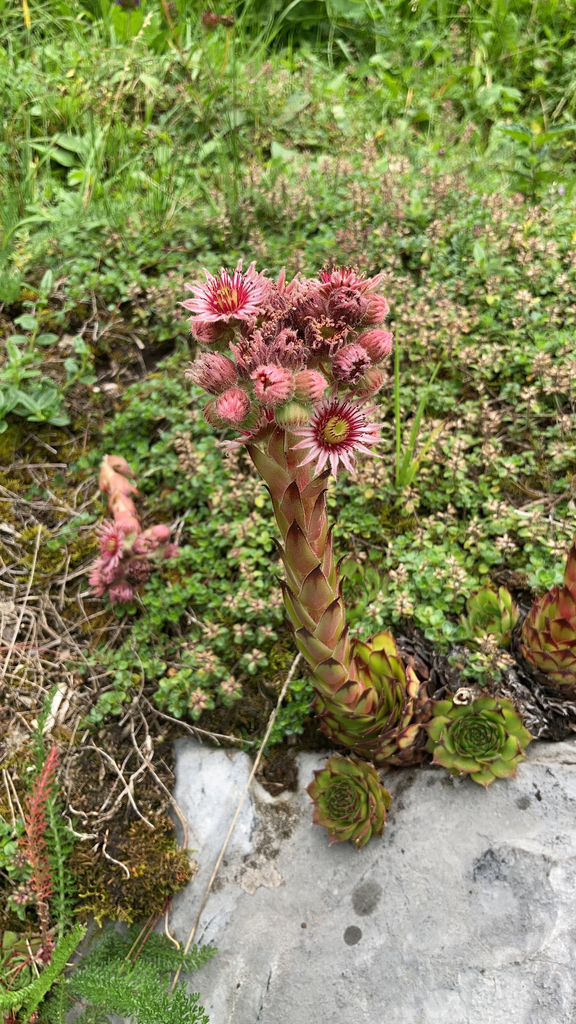
Houseleek
Sempervivum tectorum
Sempervivum tectorum, the common houseleek, is a species of flowering plant in the family Crassulaceae, native to the mountains of southern Europe, cultivated in the whole of Europe for its appearance and a Roman-era tradition claiming that it protects buildings against lightning strikes.
From the article Sempervivum tectorum on Wikipedia (CC BY-SA), quoted section by section
Description
Growing to 15 cm (6 in) tall by 50 cm (20 in) broad, it is a rosette-forming succulent evergreen perennial, spreading by offsets. It has grey-green, tufted, sessile leaves, 4–10 cm (2–4 in) in diameter, which are often suffused with rose-red. In summer it bears clusters of reddish-purple flowers, in multiples of 8–16, on hairy erect flat-topped stems. The species is highly variable, in part because hundreds of cultivars have been propagated, sold, and traded for nearly 200 years. Sempervivum tectorum was described in 1753 by Linnaeus, who noted that its leaves are ciliate, that is, fringed with hairs.
In medicine
The plant has been traditionally thought to protect against thunderstorms, and grown on house roofs for that reason, which is why it is called House Leek. Many of its popular names in different languages reflect an association with the Roman thunder-god Jupiter, notably the Latin barba Jovis (Jupiter's beard), referred to in the Floridus traditionally attributed to Aemilius Macer, and its French derivative joubarbe, which has in turn given rise to jubard and jo-barb in English; or with the Norse thunder-god Thor as in German Donnerbart. It is also called simply thunder-plant. Anglo-Saxon þunorwyrt may have either meaning. However, the association with Jupiter has also been derived from a resemblance between the flowers and the god's beard; in modern times, it has also been called St. George's beard.
Other common names, such as Anglo-Saxon singrēne, Modern English sigrim, sil-green, etc. and aye-green, refer to its longevity. William Fernie tells a tale in support of this:
History relates that a botanist tried hard for eighteen months to dry a plant of the House Leek for his herbarium, but failed in this object. He afterwards restored it to its first site when it grew again as if nothing had interfered with its ordinary life. It has been believed to protect more generally against decay and against witchcraft. …
Wikipedia: “Folklore and herbalism”
How it is grown
Sempervivum tectorum is one of several houseleek species to be cultivated. It is valued as groundcover for hot, dry places. It has gained the Royal Horticultural Society's Award of Garden Merit. Sempervivum tectorum multiplies horizontally by propagation of underground roots. Propagation occurs in the spring, when budding occurs. From each mother plant up to four or, on good days, ten new ones can be harvested. They come off easily when taking care not to break the roots. Seed propagation works in spring.
Wikipedia: “Cultivation and propagation”
Where it lives
Recorded sightings
—
geo-referenced records in GBIF, from museums, herbaria and field observers.
Drag the globe to turn it. Dots are where records exist, not a range map; darker means more records.
In the old herbals & bestiaries

Latin Herbal
1484 · p.277

Latin Herbal with German Synonyms
1486 · p.278

Latin Herbal with German Synonyms
1484 · p.305

Herbarius
1485 · p.278

Herbarius latinus (with Dutch synonyms)
1486 · p.275

Herbarius latinus (with French synonyms)
1486 · p.279

Garden of Health
Jacob Meydenbach · 1491 · p.58

Herbal of Virtues
1499 · p.277

The Book of Health: The Art of Distillation
Brunschwig, Hieronymus · 1505 · p.151

The Great Herbary with all the figures of the herbs
1532 · p.69

Notable Commentaries on the History of Plants
Leonhart Fuchs · 1542 · p.66

Notable Commentaries on the History of Plants
Leonhart Fuchs · 1542 · p.68
In the stacks
Searching the stacks…
Every page naming Sempervivum tectorum in the Biodiversity Heritage Library →
This page is assembled live from iNaturalist, GBIF, Wikipedia, the Source Library and the Internet Archive. It is not yet part of the hand-edited codex. iNaturalist taxon 51779.