- Plants
- ›Vascular Plants
- ›flowering plants
- ›Dicots
- ›Heathers, Balsams, Primroses, and Allies
- ›heath family
- ›typical heathers, azaleas, and allies
- ›Rhodoreae
- ›Rhododendron
- ›Rhododendron
- ›Rhododendron
- ›Ledum
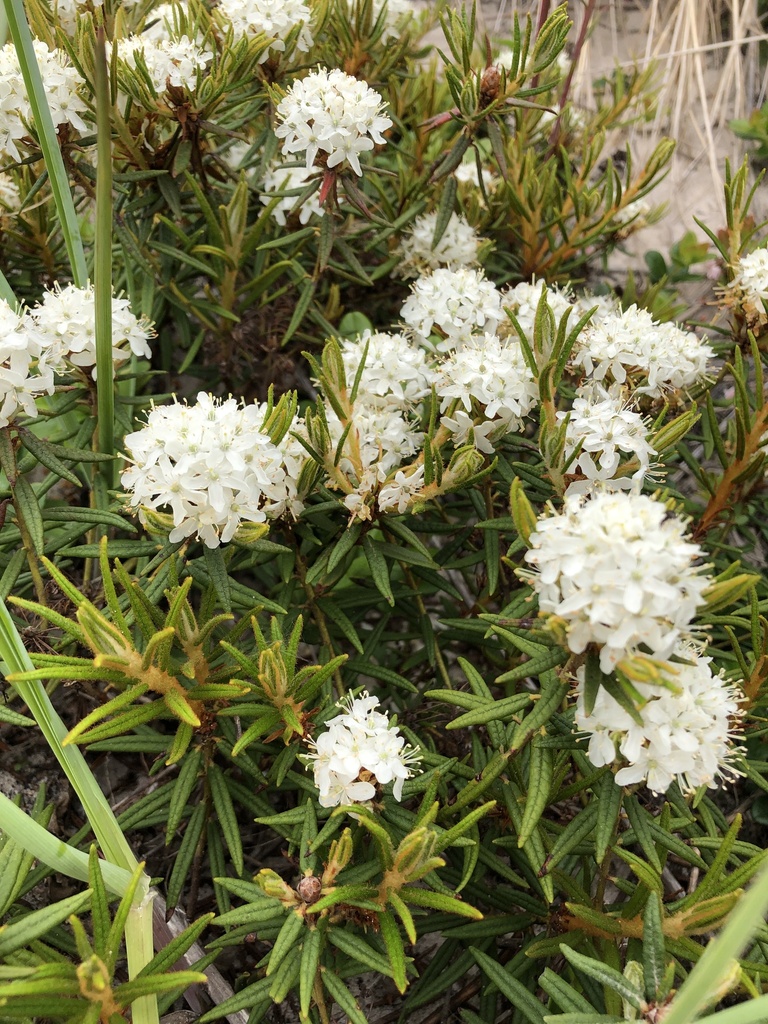
marsh Labrador tea
Rhododendron tomentosum
Rhododendron tomentosum (syn. Ledum palustre), commonly known as marsh Labrador tea, northern Labrador tea, marsh rosemary or wild rosemary, is a flowering plant in the subsection Ledum of the large genus Rhododendron in the family Ericaceae.
From the article Rhododendron tomentosum on Wikipedia (CC BY-SA), quoted section by section
Description
It is a low shrub growing to 50 cm (rarely up to 120 cm) tall with evergreen leaves 12–50 mm long and 2–12 mm broad. The flowers are small, with a five-lobed white corolla, and produced several together in a corymb 3–5 cm diameter. They emit strong smell to attract bees and other pollinating insects.
Range & habitat
It grows in northern latitudes in North America, Greenland, Canada, and Alaska, in Europe in the northern and central parts, and in Asia south to northern China, Korea and Japan. It grows in peaty soils, shrubby areas, moss and lichen tundra.
Wikipedia: “Distribution and habitat”
At the table
Marsh Labrador tea has traditionally been used as a gruit in brewing beer in the Middle Ages. Due to its strong fragrance, it has also formerly been used as a natural deterrent against clothes moths, also mosquitos and bugs in general, in Scandinavia and in Eastern Europe.
Wikipedia: “Other uses”
In medicine
Rhododendron tomentosum is used in herbalism to make an herbal tea called "Labrador tea". However, no material benefit has been documented in any properly controlled study.
Wikipedia: “Herbal medicine”
Where it lives
Recorded sightings
—
geo-referenced records in GBIF, from museums, herbaria and field observers.
Drag the globe to turn it. Dots are where records exist, not a range map; darker means more records.
In the stacks
Searching the stacks…
Every page naming Rhododendron tomentosum in the Biodiversity Heritage Library →
This page is assembled live from iNaturalist, GBIF, Wikipedia, the Source Library and the Internet Archive. It is not yet part of the hand-edited codex. iNaturalist taxon 516757.