- Plants
- ›Vascular Plants
- ›flowering plants
- ›monocots
- ›Agaves, Orchids, Irises, and Allies
- ›Aloe family
- ›Aloes and allies
- ›Bulbine
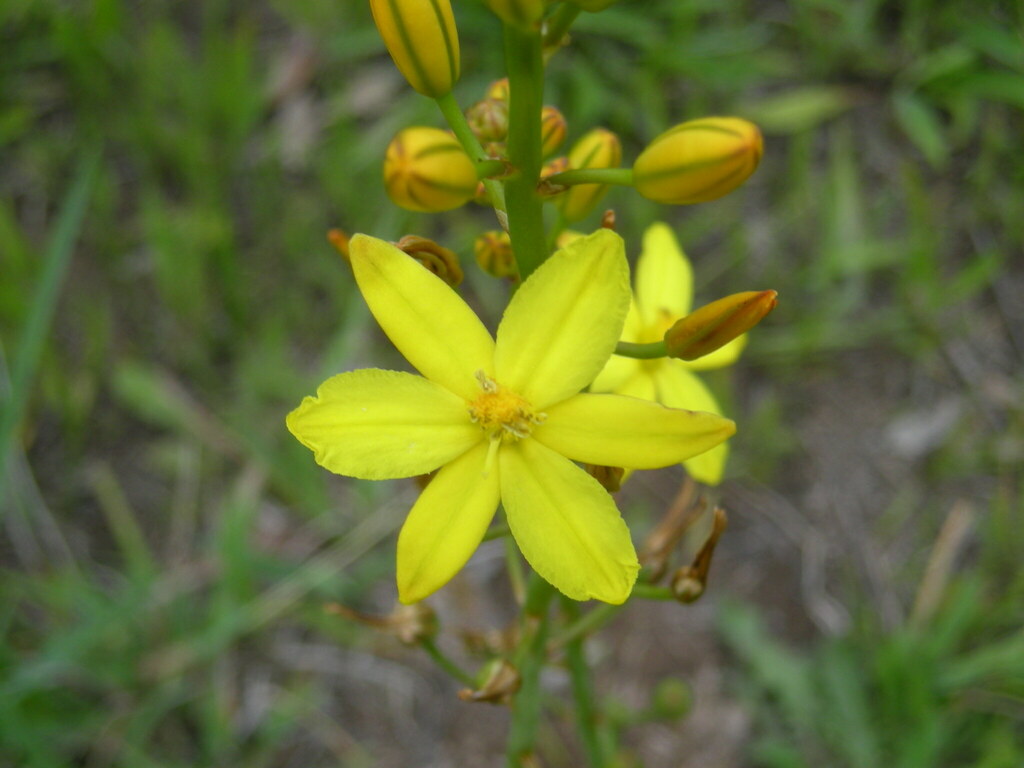
Bulbine Lily
Bulbine bulbosa
Bulbine bulbosa, commonly known as bulbine lily, native leek, golden lily, or native onion, is a species of flowering plant in the family Asphodelaceae and is endemic to Australia. It is a perennial herb with thick roots, channelled leaves, and yellow flowers with hairy stamen filaments.
From the article Bulbine bulbosa on Wikipedia (CC BY-SA), quoted section by section
Description
Bulbine bulbosa is a perennial herb that grows in tufts 27–75 cm (11–30 in) high with thick, fleshy roots and usually a bulb-like tuber. There are between three and seven leaves, channelled to more or less cylindrical, tapering and hollow, up to 30 cm (12 in) long and 1–5 mm (0.039–0.197 in) wide. The flowers are borne in racemes 4.5–26 cm (1.8–10.2 in) long with up to fifty fragrant flowers on one or two scapes 19–50 cm (7.5–19.7 in) long. Each flower is on a pedicel 5–30 mm (0.20–1.18 in) long with a bract 0.7–15 mm (0.028–0.591 in) long at the base. The six tepals are yellow, 9–22 mm (0.35–0.87 in) long and 1–3.5 mm (0.039–0.138 in) wide, and the stamens are 8–9 mm (0.31–0.35 in) long with golden-brown, club-shaped hairs on the filaments, and gold-coloured anthers. Flowering occurs from February to March and the fruit is a more or less spherical to oval capsule 3–6 mm (0.12–0.24 in) long.
Range & habitat
Bulbine bulbosa is found in all Australian states and the Australian Capital Territory, except for Western Australia and the Northern Territory. It grows in a wide range of habitats but usually in damp places in grassland, woodland and forest, sometimes at altitudes above 1,800 m (5,900 ft).
Wikipedia: “Distribution and habitat”
What it does
Experiments have shown that the ability of self-sown seeds of B. bulbosa to germinate between tufts of grasses of several species, depends on the species of grass and the gap width between the tufts. The experiments were performed to test the performance of the B. bulbosa in habitat reconstruction programs in south-eastern Australia.
Wikipedia: “Ecology”
At the table
The corms of mature plants are nutritious, containing calcium and iron, and were used as food by Aboriginal people, who called it parm, puewan, and pike. They regarded the corms as the sweetest-tasting of the lily and lily-like Australian plants.
Wikipedia: “Bush food”
Toxicity
The plant is said to cause scouring if eaten by sheep or cattle.
== References ==
How it is grown
The long-lasting stalks of fragrant, attractive yellow flowers and its moderate frost-hardiness have encouraged its use as a garden flower in suitable areas. Few garden varieties have been developed, however. The plant can be propagated from seeds or by division of the corm. Seeds are released from the ripened seed capsules and are best kept at least a month or two before use. They should be sown in the spring, and germination takes about 35 days. Watering and good drainage are essential. The species suppresses self-fertilization, so collecting seeds from garden-grown plants may result in low germination. Planting seeds from multiple sources may increase yield.
Wikipedia: “Use in horticulture”
Where it lives
Recorded sightings
—
geo-referenced records in GBIF, from museums, herbaria and field observers.
Drag the globe to turn it. Dots are where records exist, not a range map; darker means more records.
In the stacks
Searching the stacks…
Every page naming Bulbine bulbosa in the Biodiversity Heritage Library →
This page is assembled live from iNaturalist, GBIF, Wikipedia, the Source Library and the Internet Archive. It is not yet part of the hand-edited codex. iNaturalist taxon 516738.