- Plants
- ›Vascular Plants
- ›flowering plants
- ›monocots
- ›lilies, supplejacks, and allies
- ›lily family
- ›true lily subfamily
- ›bead lilies and cucumber roots
- ›Clintonia
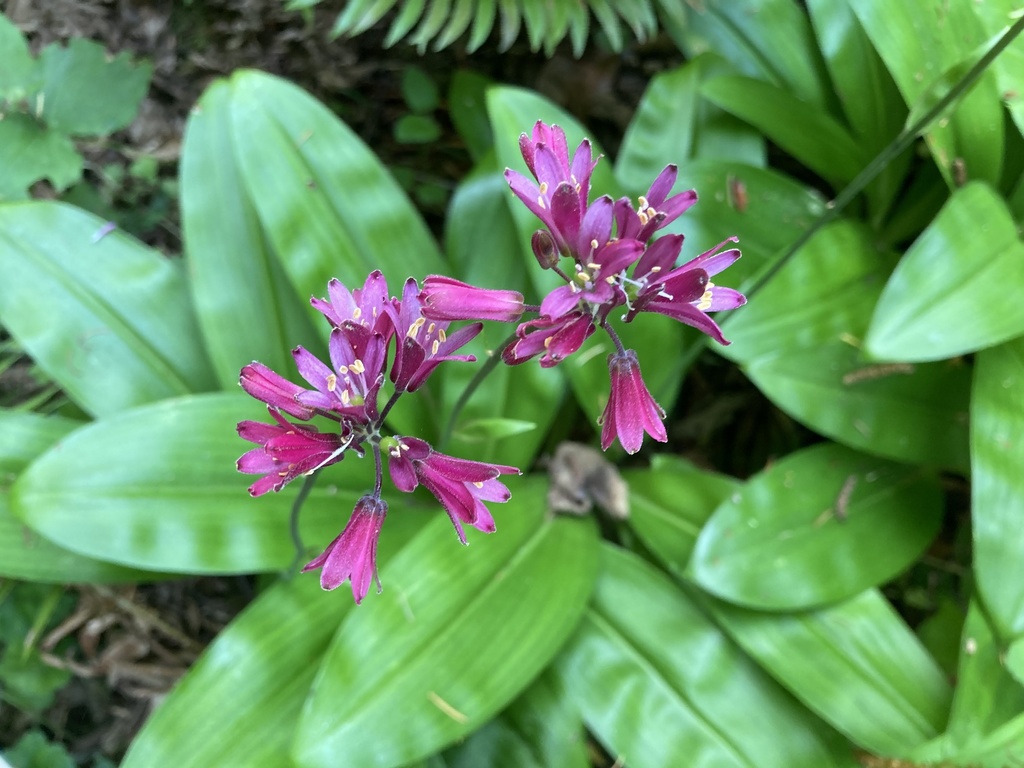
Andrews' Clintonia
Clintonia andrewsiana
Clintonia andrewsiana is a species of flowering plant in the lily family Liliaceae. The species was discovered by John Milton Bigelow in 1854 and described by John Torrey in 1856. The specific epithet andrewsiana honors Timothy Langdon Andrews (1819–1908), a "gentleman who assiduously examined the botany" of California during the mid-19th century. The species is commonly known as Andrews clintonia or red clintonia, where the latter refers to the color of the flowers. In California, it is also known as bluebead lily or western bluebead lily, not to be confused with C. borealis, which is likewise known as bluebead lily. The Pomo people of northern California consider the plant to be poisonous.
From the article Clintonia andrewsiana on Wikipedia (CC BY-SA), quoted section by section
Description
Clintonia andrewsiana is a perennial herbaceous plant that spreads by means of underground rhizomes. It is the largest plant species in the genus, standing 30 to 80 cm (12 to 31 in) tall. Around the base of the plant are 5 or 6 oval-shaped, dark green leaves, each 20 to 35 cm (8 to 14 in) long and 5 to 15 cm (2 to 6 in) wide. The tall, erect inflorescence consists of a terminal umbel with 10–20 flowers and up to three lateral umbels with 2–4 flowers each. Each flower has six pink to reddish-purple tepals 1 to 2 cm (0.4 to 0.8 in) long and six stamens about half as long as the tepals. The fruit is a blue or blue-black berry approximately 1 cm (0.4 in) in diameter.
Range & habitat
Clintonia andrewsiana is found along the West Coast of the United States, from Monterey County in central California north to Curry County in southwestern Oregon. It prefers the shady, moist areas of the coastal redwood forests. The range of C. andrewsiana overlaps with that of C. uniflora in Humboldt County and Del Norte County in northwestern California and Curry County in Oregon, but the two species are readily distinguished by their flowers. C. andrewsiana has multiple flowers arranged in one or more umbels while C. uniflora has a single flower with white tepals. The tepals of C. andrewsiana are a deep claret red.
Wikipedia: “Distribution and habitat”
Where it lives
Recorded sightings
—
geo-referenced records in GBIF, from museums, herbaria and field observers.
Drag the globe to turn it. Dots are where records exist, not a range map; darker means more records.
In the stacks
Searching the stacks…
Every page naming Clintonia andrewsiana in the Biodiversity Heritage Library →
This page is assembled live from iNaturalist, GBIF, Wikipedia, the Source Library and the Internet Archive. It is not yet part of the hand-edited codex. iNaturalist taxon 51647.