- Plants
- ›Vascular Plants
- ›flowering plants
- ›monocots
- ›Agaves, Orchids, Irises, and Allies
- ›amaryllis, onions, and allies
- ›amaryllis subfamily
- ›Galantheae
- ›Galanthus
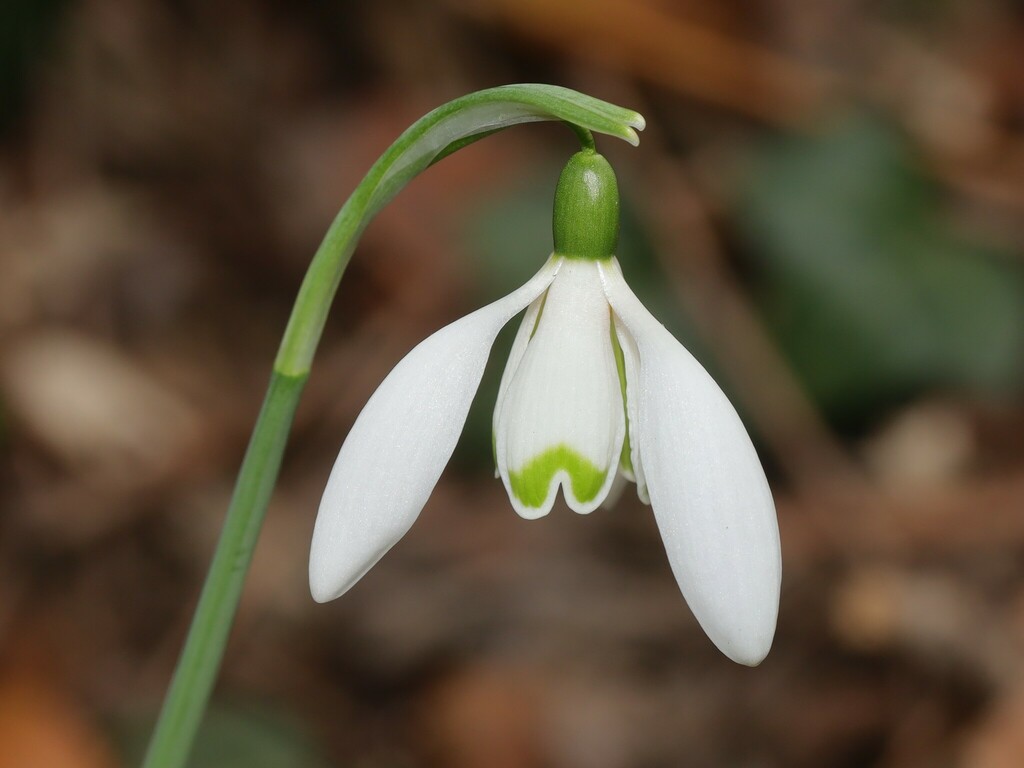
common snowdrop
Galanthus nivalis
Galanthus nivalis, the snowdrop or common snowdrop, is the best-known and most widespread of the 20 species in its genus, Galanthus. Snowdrops are among the first bulbs to bloom in spring and can form impressive carpets of white in areas where they are native or have been naturalised. They should not be confused with the snowflakes, in the genera Leucojum and Acis.
From the article Galanthus nivalis on Wikipedia (CC BY-SA), quoted section by section
Description
Galanthus nivalis grows to around 7–15 cm tall, flowering between January and April in the northern temperate zone (January–May in the wild). They are perennial, herbaceous plants which grow from bulbs. Each bulb generally produces two linear, or very narrowly lanceolate, greyish-green leaves and an erect, leafless scape (flowering stalk), which bears at the top a pair of bract-like spathe valves joined by a papery membrane. From between them emerges a solitary, pendulous, bell-shaped white flower, held on a slender pedicel. The flower consists of six tepals, also referred to as segments. The outer three are larger and more convex than the inner ones. The inner flower segments are usually marked on their outer surface with a green or greenish-yellow V- or U-shaped mark (sometimes described as "bridge-shaped") over the small sinus (notch) at the tip of each tepal. The inner surface has a faint green mark covering all or most of it. Occasionally plants are found with green markings on the outer surface of the outer tepals. The six long, pointed anthers open by pores or short slits. The ovary is three-celled, ripening into a three-celled capsule. Each whitish seed has a small, fleshy tail (the elaiosome) containing substances attractive to ants which distribute the seeds. The leaves die back a few weeks after the flowers have faded. G. …
Range & habitat
Galanthus nivalis is widely grown in gardens, particularly in northern Europe, and is widely naturalised in woodlands in the regions where it is grown. It is, however, native to a large area of Europe, from Spain in the west, eastwards to Ukraine. It is native to Albania, Armenia, Austria, Bosnia and Herzegovina, Bulgaria, Croatia, the Czech Republic, France, Georgia, Germany, Greece, Hungary, Italy, Poland, Macedonia, Moldova, Montenegro, Romania, Serbia, Slovakia, Slovenia, Spain, Switzerland, Turkey, and Ukraine. It is considered naturalised in Great Britain, Belgium, Netherlands, Norway, Sweden, Denmark and parts of North America (Newfoundland, New Brunswick, Ontario, Massachusetts, Alabama, Rhode Island, Connecticut, Delaware, Indiana, Washington state, New York state, Michigan, Utah, New Jersey, Ohio, Pennsylvania, Maryland, Virginia and North Carolina).
Although often thought of as a British native wild flower, or to have been brought to the British Isles by the Romans, it is now thought that it was probably introduced much later, perhaps around the early sixteenth century.
Wikipedia: “Distribution and habitat”
Where it lives
Recorded sightings
—
geo-referenced records in GBIF, from museums, herbaria and field observers.
Drag the globe to turn it. Dots are where records exist, not a range map; darker means more records.
In the old herbals & bestiaries

In the stacks
Searching the stacks…
Every page naming Galanthus nivalis in the Biodiversity Heritage Library →
This page is assembled live from iNaturalist, GBIF, Wikipedia, the Source Library and the Internet Archive. It is not yet part of the hand-edited codex. iNaturalist taxon 51606.