- Plants
- ›Vascular Plants
- ›flowering plants
- ›Dicots
- ›Soapberries, Cashews, Mahoganies, and Allies
- ›soapberry family
- ›Harpullia
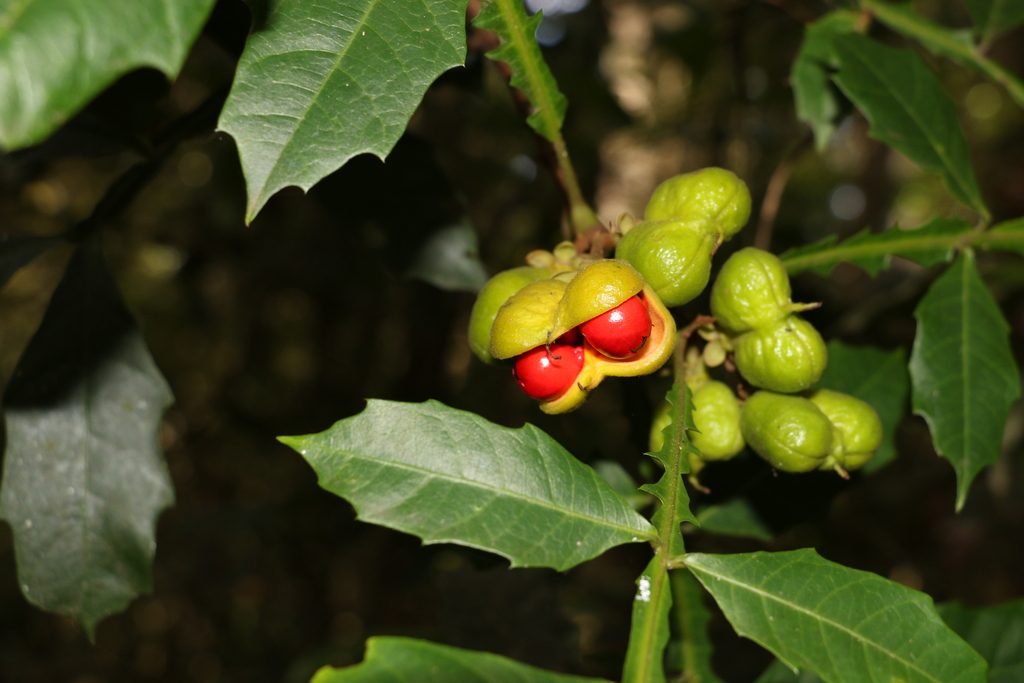
Harpullia alata
Harpullia alata, commonly known as winged tulip or wing-leaved tulip, is a species of flowering plant in the family Sapindaceae, and is endemic to eastern Australia. It is a tree with paripinnate leaves, the leaflets elliptic with teeth on the edges, white flowers and capsules containing a seed with a yellow to reddish aril.
From the article Harpullia alata on Wikipedia (CC BY-SA), quoted section by section
Description
Harpullia alata is a tree that typically grows to a height of up to 4 m (13 ft), its new growth covered with rusty hairs. Its leaves are paripinnate, 100–350 mm (3.9–13.8 in) long with 6 to 10 elliptic to lance shaped leaflets with the narrower end towards the base, mostly 50–150 mm (2.0–5.9 in) long and 20–50 mm (0.79–1.97 in) wide on a winged petiole 30–80 mm (1.2–3.1 in) long. The flowers are borne in racemes in leaf axils and are 50–140 mm (2.0–5.5 in) long. The sepals are 7 mm (0.28 in) long and covered with downy hairs, the petals are white and 12 mm (0.47 in) long, there are 8 stamens, and the ovary covered with soft hairs. The fruit is a sessile, broadly oval, yellowish capsule 18–24 mm (0.71–0.94 in) long containing two shiny chestnut brown seeds, nearly enclosed in a yellow to reddish aril. This is the only Australian Harpullia species that has dentate margins on the leaflets and wings on the leaf stem.
Range & habitat
Winged tulip grows in rainforest at high altitudes in gullies and steep slopes from the McPherson Ranges in southern Queensland where it is quite common, to the Clarence River in northern New South Wales.
Wikipedia: “Distribution and habitat”
Where it lives
Recorded sightings
—
geo-referenced records in GBIF, from museums, herbaria and field observers.
Drag the globe to turn it. Dots are where records exist, not a range map; darker means more records.
In the stacks
Searching the stacks…
Every page naming Harpullia alata in the Biodiversity Heritage Library →
This page is assembled live from iNaturalist, GBIF, Wikipedia, the Source Library and the Internet Archive. It is not yet part of the hand-edited codex. iNaturalist taxon 515135.