- Plants
- ›Vascular Plants
- ›flowering plants
- ›monocots
- ›lilies, supplejacks, and allies
- ›Herb-Paris, False Hellebores, Trilliums and allies
- ›Parideae
- ›Trillium
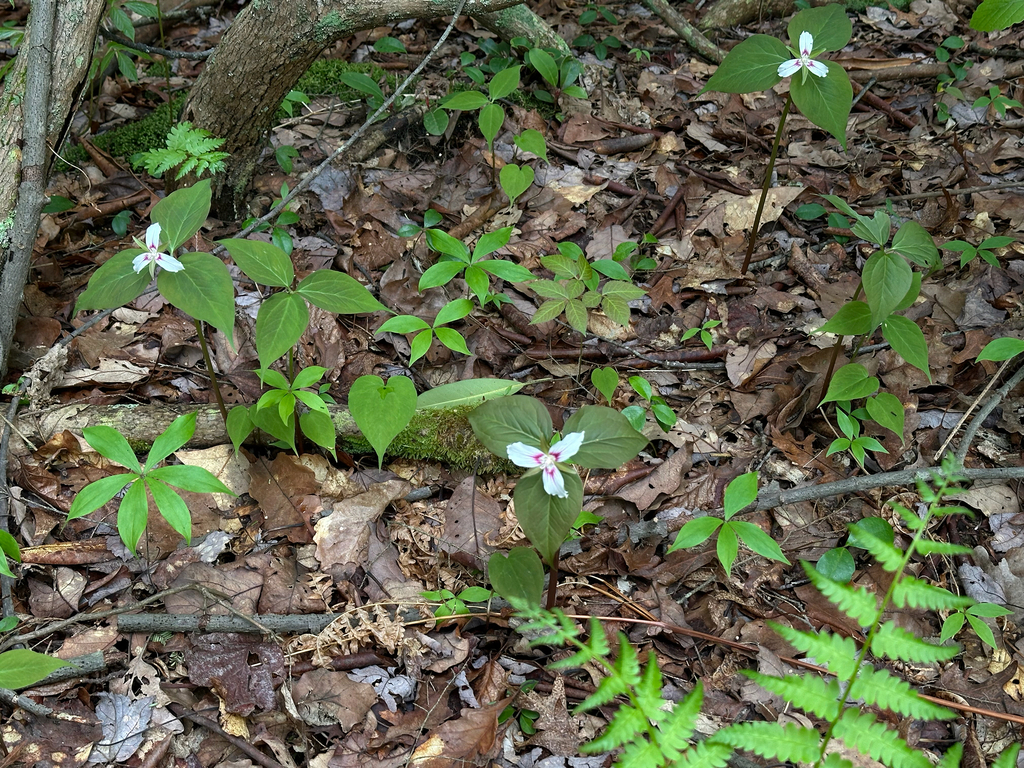
painted trillium
Trillium undulatum
Trillium undulatum, commonly called painted trillium, painted lady (not to be confused with the painted lady butterfly), or trille ondulé in French, is a species of flowering plant in the bunchflower family Melanthiaceae. It is also known as smiling wake robin or striped wake-robin. The specific epithet undulatum means "wavy", which refers to the wavy edges of the flower petals. The plant is found from Ontario in the north to northern Georgia in the south and from Michigan in the west to Nova Scotia in the east.
From the article Trillium undulatum on Wikipedia (CC BY-SA), quoted section by section
Description
Trillium undulatum is a perennial herbaceous plant that spreads by means of an underground rhizome. It has three large leaf-like bracts arranged in a whorl about a scape (stem) that rises directly from the rhizome. The bracts (leaves) are ovate, each with a definite petiole (leaf stalk). Flowering occurs from late April to the end of June. The single, terminal flower is pedicellate (on a stalk) with three sepals and three petals. The white petals have wavy edges with a red to reddish purple splotch at the base of each petal. The white ovary usually has a pink tip with no sharp edges. If the flower is successfully pollinated, a single fruit develops. Initially the fruit is green, ripening to a bright red by mid to late summer. The fruit is a berry-like capsule, 1 to 2 cm (0.5 to 1 in) long, with no ridges. No other North American Trillium species has a fruit of this size, color, and shape. Trillium undulatum is one of a dozen pedicellate-flowered Trillium species known to occur throughout its range, yet it is one of the easiest trilliums to identify. First check the leaves, each of which has a distinct petiole at least 4 mm (0.2 in) in length. Other Trillium species occasionally have leaves with petioles, so check the pedicel (flower stalk) to confirm. The pedicel of Trillium undulatum is short and erect. …
Range & habitat
The range of Trillium undulatum extends from Ontario in the north to northern Georgia in the south and from Michigan in the west to Nova Scotia in the east. The species is known to occur in the following provinces and states:
Canada: New Brunswick, Nova Scotia, Ontario, Prince Edward Island, Quebec United States: Connecticut, Georgia, Kentucky, Maine, Maryland, Massachusetts, Michigan, New Hampshire, New Jersey, New York, North Carolina, Ohio, Pennsylvania, Rhode Island, South Carolina, Tennessee, Vermont, Virginia, West Virginia T. undulatum demands strongly acidic, humus-rich soils and tends to be found in the shade of acid-loving trees such as eastern white pine, red maple, red spruce and balsam fir. Although the soils that support it have low base saturation, this species was found to have relatively high levels of calcium, magnesium, and especially potassium in its foliage. As of October 2019, Trillium undulatum is globally secure. It is vulnerable (or worse) in at least seven U.S. states. In particular, it is endangered in both Ohio and Michigan.
Wikipedia: “Distribution”
Where it lives
Recorded sightings
—
geo-referenced records in GBIF, from museums, herbaria and field observers.
Drag the globe to turn it. Dots are where records exist, not a range map; darker means more records.
In the stacks
Searching the stacks…
Every page naming Trillium undulatum in the Biodiversity Heritage Library →
This page is assembled live from iNaturalist, GBIF, Wikipedia, the Source Library and the Internet Archive. It is not yet part of the hand-edited codex. iNaturalist taxon 51435.