- Plants
- ›Vascular Plants
- ›flowering plants
- ›monocots
- ›Agaves, Orchids, Irises, and Allies
- ›Orchids
- ›Orchidoid Orchids
- ›Orchideae
- ›Orchidinae
- ›Galearis
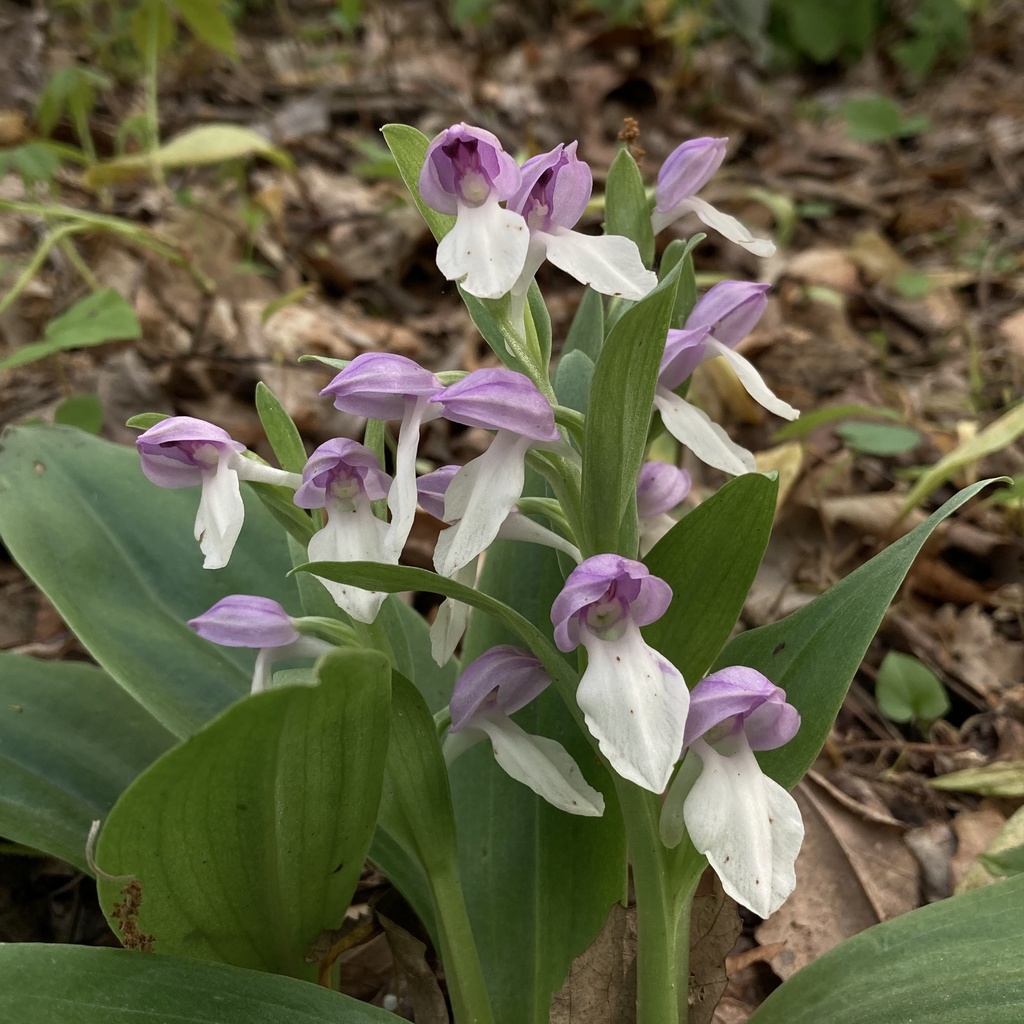
showy orchis
Galearis spectabilis
Galearis spectabilis, commonly known as showy orchis or showy orchid, is an orchid species of the genus Galearis. It is native to eastern Canada (Quebec, Ontario and New Brunswick) and much of the eastern half of the United States. In the United States they are found from eastern Oklahoma north to eastern South Dakota in the west and from Atlanta, Georgia and North Alabama north up into Maine to the east.
From the article Galearis spectabilis on Wikipedia (CC BY-SA), quoted section by section
Description
Galearis spectabilis can be found in mesic deciduous woodlands in the eastern United States. G. spectabilis produces one or two oval, fleshy basal leaves from a rhizome, which persist throughout summer. Flower stalks arise on 10–15-centimeter (3.9–5.9 in) stems with three to twelve flowers blooming in April to May. The flowers are hooded and the namesake of the plant due to the showy, typically bicolored lavender and white flowers. The lavender hood is formed from three fused sepals. Two petals are tucked inside the hood and the labellum (third petal) is longer and white. There are two color variants: G. spectabilis f. gordinierii has an all-white flower, while G. spectabilis f. willeyi has an entirely pink flower.
What it does
Galearis spectabilis can be found in mesic deciduous woodlands in the eastern United States, they begin growth in spring, producing one or two oval, fleshy basal leaves from a rhizome, which persist throughout summer. Pollination of the flower is conducted by long-tongued Bombus, as well as other bees, butterflies, and moths. Besides its alluring colors, G. spectabilis flowers also provide pollinators a nectar reward which collects at the base of the spur. G. spectabilis is typically found on hillsides which may be rocky, damp and near seeps growing under a canopy of deciduous trees in half to deep shade. Plants have also been reported to be found thriving living just about a floodplain, again under a deciduous canopy. Plants are rarely seen in full sun. Plants are slow-growing and form clumps over time via crown offshoots from the rhizome.
Wikipedia: “Ecology”
Where it lives
Recorded sightings
—
geo-referenced records in GBIF, from museums, herbaria and field observers.
Drag the globe to turn it. Dots are where records exist, not a range map; darker means more records.
In the stacks
Searching the stacks…
Every page naming Galearis spectabilis in the Biodiversity Heritage Library →
This page is assembled live from iNaturalist, GBIF, Wikipedia, the Source Library and the Internet Archive. It is not yet part of the hand-edited codex. iNaturalist taxon 51432.