- Plants
- ›Vascular Plants
- ›flowering plants
- ›Dicots
- ›Buttercups, Poppies, and Allies
- ›buttercup family
- ›Columbines and Meadow-Rues
- ›Aquilegia
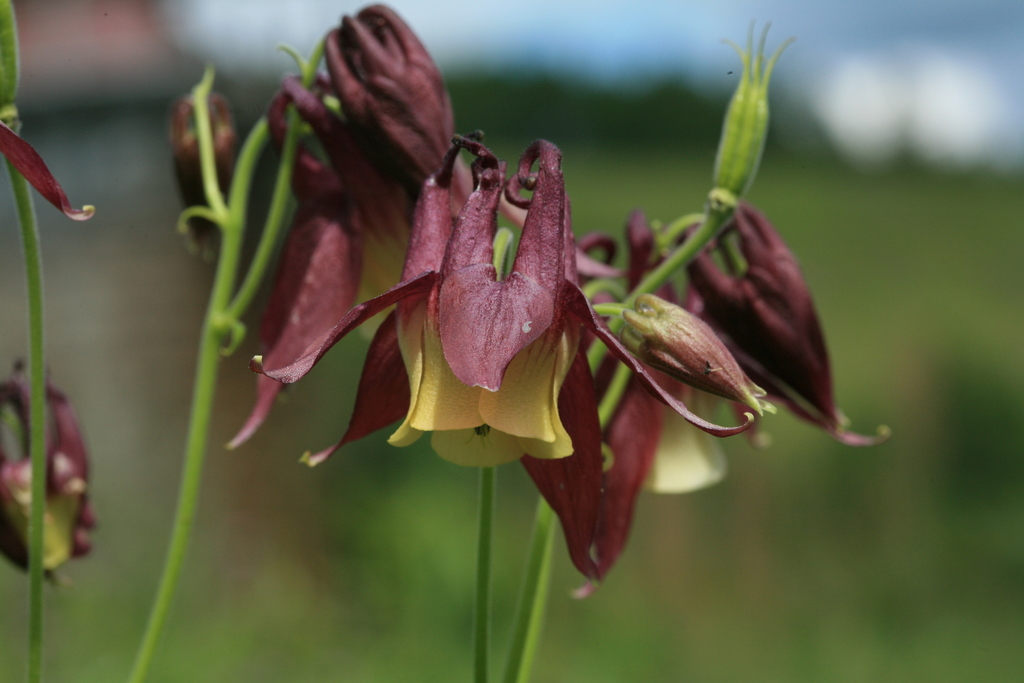
Oriental columbine
Aquilegia oxysepala
Aquilegia oxysepala is a perennial flowering plant species in the genus Aquilegia (columbine) in the family Ranunculaceae. It is native to East Asia, with a range extending from southeastern Siberia to Japan. It produces purple and yellow flowers that bloom for three weeks in May. The plant has been used in traditional Chinese medicine for thousands of years, while modern scientific research has determined that its extract has limited antioxidant qualities.
From the article Aquilegia oxysepala on Wikipedia (CC BY-SA), quoted section by section
Description
Aquilegia oxysepala is a species of herbaceous, perennial flowering plant in the family Ranunculaceae (buttercups). A. oxysepala plants flower in May with blooms that last three weeks. Columbines possess flowers that generally have five sepals and five petals. Each petal of Aquilegia typically comprises a broad portion protruding forward, known as a blade, and an elongated structure protruding backwards, known as a nectar spur. The spurs contain the nectar of the flower. On A. oxysepala plants, the purple sepals each possess an ovate-lanceolate shape which comes to an acute tip. The sepals range between 20 mm (0.79 in) and 30 mm (1.2 in) in length. Each petal's blade is pale yellow to yellowish white, measuring 10 mm (0.39 in) to 13 mm (0.51 in) long. The nectar spurs are purple and strongly hooked, reaching approximately 20 mm (0.79 in) long. The morphology of A. oxysepala is substantially similar to that of A. vulgaris. The purple and yellow coloration and acute terminuses of the sepals and staminodes on A. oxysepala are diagnostic in differentiating it from A. vulgaris. The seeds are approximately 2 mm (0.079 in) long with shiny black surfaces. Aquilegia species generally demonstrate a significant degree of interfertility, permitting hybridization. However, research had determined that A. oxysepala and the fellow Asian columbine A. …
Range & habitat
Aquilegia oxysepala is native to East Asia, with a range extending from southeastern Siberia to Japan. The species prefers temperate biomes. It is found on the edges of forests and on grassy slopes at elevations between 400 m (1,300 ft) and 2,700 m (8,900 ft) above sea level.
Wikipedia: “Distribution”
At the table
In China, A. oxysepala has been used as a dietary supplement and medicine for thousands of years. There, A. oxysepala has been used to treat diseases in women such as irregular menstruation and intermenstrual bleeding. While the antioxidant properties of its extract are known, with its medicinal use possibly attributable to the extract's good scavenging of superoxide anion radicals, it is inferior to the common dietary supplement ascorbic acid. Research has also determined A. oxysepala possesses antibacterial qualities.
Wikipedia: “Uses”
How it is grown
The American botanist Philip A. Munz reported in 1946 that A. oxysepala was broadly available in cultivation. He recorded that garden specimens of A. oxysepala were sometimes labelled as other species, while Aquilegia buergeriana was sometimes erroneously labelled A. oxysepala var. yabeana.
== References ==
Wikipedia: “Cultivation”
Where it lives
Recorded sightings
—
geo-referenced records in GBIF, from museums, herbaria and field observers.
Drag the globe to turn it. Dots are where records exist, not a range map; darker means more records.
In the stacks
Searching the stacks…
Every page naming Aquilegia oxysepala in the Biodiversity Heritage Library →
This page is assembled live from iNaturalist, GBIF, Wikipedia, the Source Library and the Internet Archive. It is not yet part of the hand-edited codex. iNaturalist taxon 509385.