- Plants
- ›Vascular Plants
- ›flowering plants
- ›monocots
- ›Agaves, Orchids, Irises, and Allies
- ›agave and allies
- ›Hyacinth subfamily
- ›poison squill tribe
- ›Drimia
- ›Thuranthos
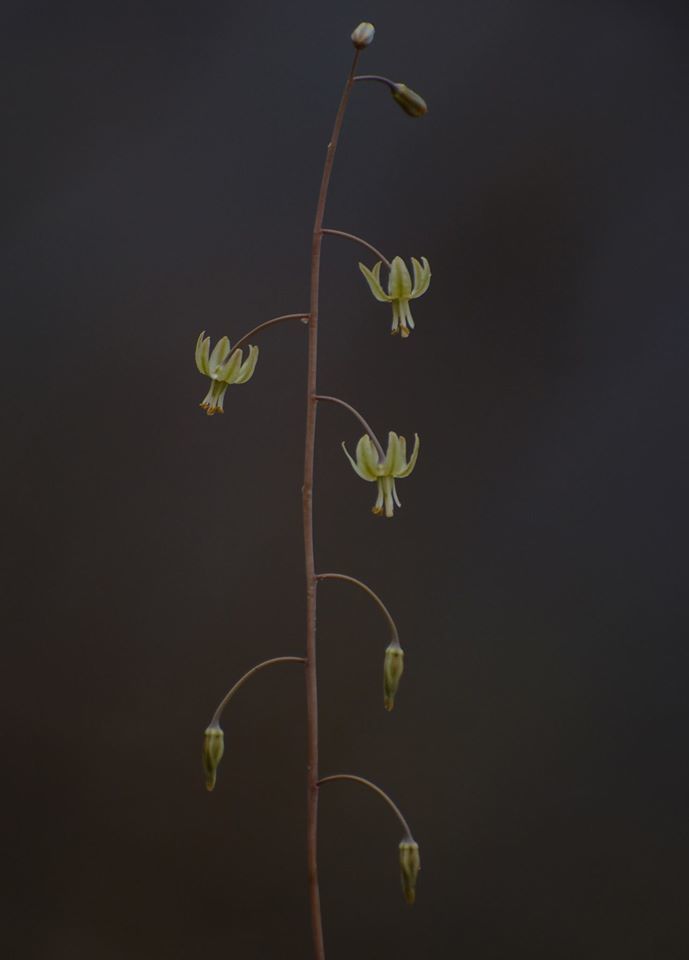
Secret Night Squill
Drimia indica
Drimia indica is a species of flowering plant in the family Asparagaceae. It is a bulbous geophyte native to the Indian subcontinent and Indochina.
From the article Drimia indica on Wikipedia (CC BY-SA), quoted section by section
Description
Drimia indica is a perennial herbaceous flowering plant which grows from bulbs. It has long leaves, typically 15–30 cm long by 1–2.5 cm wide, but sometimes considerably longer. The flowers, which appear in spring before the leaves, are borne in racemes on a leafless stem (scape) up to 60 cm long. The flowers are widely spaced on the raceme, which is 15–31 cm long, and are carried on stalks (pedicels) 2.5–4 cm long. Individual flowers are bell-shaped. The six pale brown tepals have white margins. The 6–7 cm long stamens have yellow anthers and filaments which are flattened at the base. Between six and nine seeds are produced in a capsule which is 1.5–1.8 cm long. Individual seeds are black and shaped like flattened ellipsoids.
Range & habitat
D. indica ranges through the Indian subcontinent, from Pakistan and the Himalayas to Sri Lanka, and eastwards to Myanmar, Thailand, and Vietnam. Populations in southern and southeastern Africa are now considered a separate species, Drimia zambesiaca.
Wikipedia: “Distribution”
At the table
D. indica is used as a substitute for the "true squill", Drimia maritima, in traditional medicine.
Wikipedia: “Uses”
Where it lives
Recorded sightings
—
geo-referenced records in GBIF, from museums, herbaria and field observers.
Drag the globe to turn it. Dots are where records exist, not a range map; darker means more records.
In the stacks
Searching the stacks…
Every page naming Drimia indica in the Biodiversity Heritage Library →
This page is assembled live from iNaturalist, GBIF, Wikipedia, the Source Library and the Internet Archive. It is not yet part of the hand-edited codex. iNaturalist taxon 507277.