- Plants
- ›Vascular Plants
- ›flowering plants
- ›monocots
- ›Agaves, Orchids, Irises, and Allies
- ›Orchids
- ›Lower Epidendroid Orchids
- ›Neottieae
- ›Limodorinae
- ›Epipactis
- ›Epipactis
- ›Epipactis
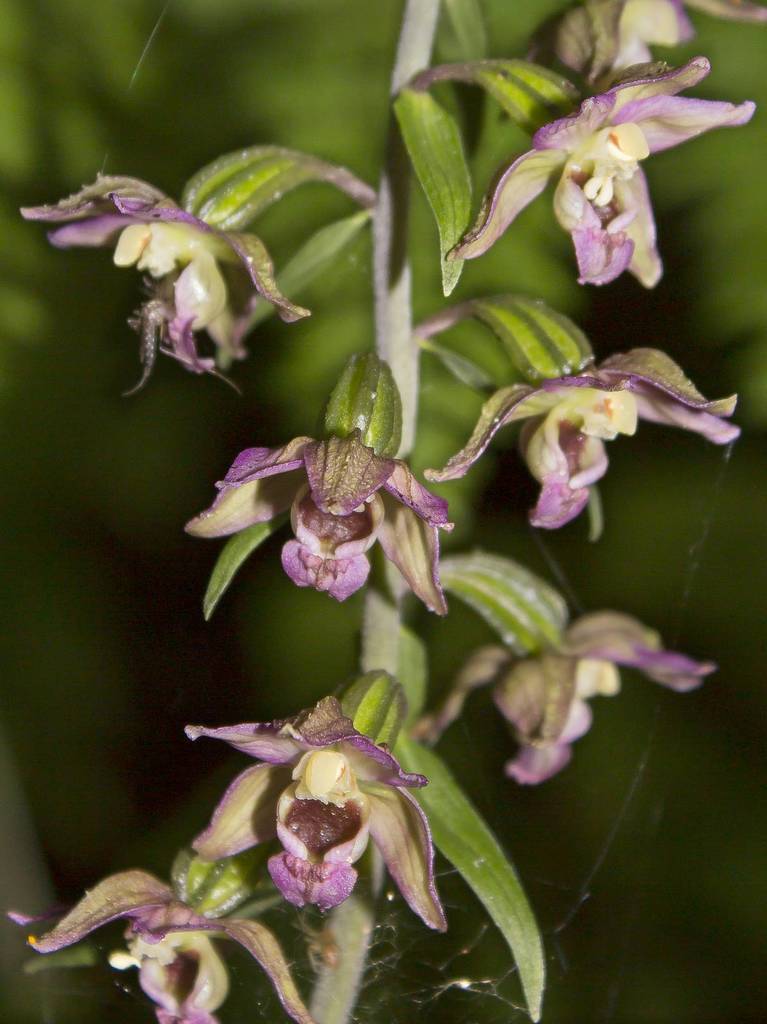
Broad-leaved helleborine
Epipactis helleborine
Epipactis helleborine, the broad-leaved helleborine, is a terrestrial species of orchid with a broad distribution. Its nodding flowers vary from greenish pink to purple. It prefers shaded woodland environments.
From the article Epipactis helleborine on Wikipedia (CC BY-SA), quoted section by section
Description
Epipactis helleborine can grow to a maximum height of 1 m (3 ft 3 in) or more under good conditions, and has broad dull green leaves which are strongly ribbed and flat. The flowers are arranged in long drooping racemes with dull green sepals and shorter upper petals. The lower labellum is pale red and is much shorter than the upper petals. Achlorophyllous, white Epipactis helleborine plants have been found. Achlorophyllous forms tend to be shorter, as small as 17 cm. Flowering occurs June–September.
Range & habitat
This species is widespread across much of Europe and Asia, from Portugal to China, as well as northern Africa. In the United Kingdom, the species is widespread and common in England and Wales, but is absent from most of Scotland scattered across Ireland. In North America, it is an introduced species and widely naturalized mostly in the Northeastern United States, eastern Canada and the Great Lakes Region, but also in scattered locations in other parts of the continent. In the US it is sometimes referred to as the "weed orchid" or "weedy orchid" and continues to spread throughout the country to new areas including Michigan, Wisconsin, and the San Francisco Bay Area.
Wikipedia: “Distribution”
What it does
This species of orchid is pollinated by several species of Hymenoptera, particularly the common wasp, but also other species in the genera Vespula and Dolichovespula. Flowers release a sweet nectar to attract the wasps, which has an intoxicating effect on them. Eight populations of Epipactis helleborine in central Europe (Lower Silesia, Poland) had their nectar studied and they were found to contain naturally occurring oxycodone (as well as another narcotic-like opioid) in minute amounts. Epipactis helleborine requires a mycorrhizal symbiosis to germinate successfully and remains partially dependent upon the fungus when plants mature, however it is not particularly selective among fungal species. Fungi associated with the live roots include Tuber, Helotiales, Peziza, Leptodontidium, Hydnotrya and Wilcoxina. It has been suggested that the presence of this orchid species in a woodland is an indicator that edible truffles can be found there, but this is not always the case.
Wikipedia: “Ecology”
Where it lives
Recorded sightings
—
geo-referenced records in GBIF, from museums, herbaria and field observers.
Drag the globe to turn it. Dots are where records exist, not a range map; darker means more records.
In the stacks
Searching the stacks…
Every page naming Epipactis helleborine in the Biodiversity Heritage Library →
This page is assembled live from iNaturalist, GBIF, Wikipedia, the Source Library and the Internet Archive. It is not yet part of the hand-edited codex. iNaturalist taxon 50717.