- Plants
- ›Vascular Plants
- ›flowering plants
- ›Dicots
- ›pinks, cactuses, and allies
- ›four o'clock family
- ›Mirabilis
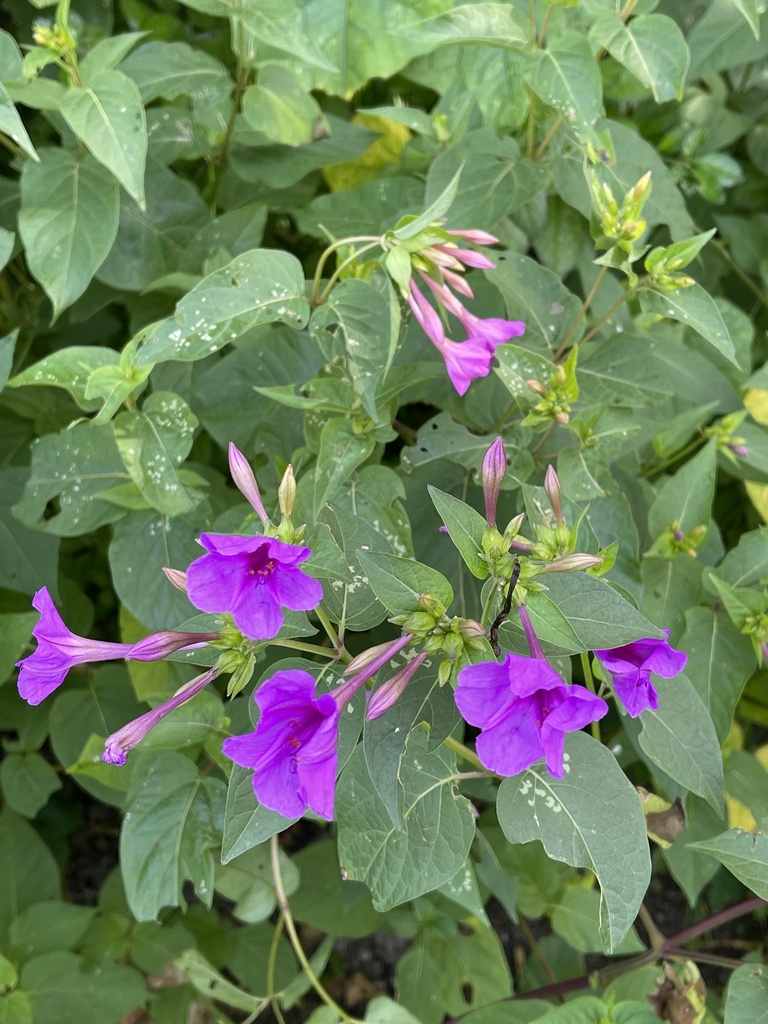
marvel of Peru
Mirabilis jalapa
Mirabilis jalapa, the marvel of Peru or four o'clock flower, is the most commonly grown ornamental species of Mirabilis plant, and is available in a range of colors. Mirabilis in Latin means wonderful and Jalapa (or Xalapa) is the state capital of Veracruz in Mexico. Mirabilis jalapa is believed to have been cultivated by the Aztecs for medicinal and ornamental purposes.
The flowers usually open from late afternoon or at dusk (namely between 4 and 8 o'clock), giving rise to one of its common names. The flowers then produce a strong, sweet fragrance throughout the night, then close in the morning. New flowers open the following day. It arrived in Europe in 1525. Today, it is common in many tropical regions and is also valued in Europe as an ornamental plant, although not necessarily hardy. It is the children's state flower of Connecticut under the name of Michaela Petit's Four O'Clocks.
From the article Mirabilis jalapa on Wikipedia (CC BY-SA), quoted section by section
Description
It is a perennial, herbaceous, bushy plant that reaches stature heights of mostly 1 meter, rarely up to 2 meters, in height. It may also be grown as an annual, especially in the temperate zone. The single-seeded fruits are spherical, wrinkled and black upon maturity, having started out greenish-yellow. The stems are thick, full, quadrangular with many ramifications and rooting at the nodes. The posture is often prostrate. A curious aspect of M. jalapa is that flowers with different colors grow simultaneously on the same plant. Additionally, an individual flower can be splashed with different colors. Flower patterns are referred to as sectors (whole sections of flower), flakes (stripes of varying length), and spots. A single flower can be plain yellow, red, magenta, pink, or white, or have a combination of sectors, flakes, and spots. Furthermore, different combinations of flowers and patterns can occur on different flowers of the same plant. Usually, the flowers are yellow, pink and white, but a different combination of flowers growing on the same single four o’clock plant can be found. Another interesting point is a color-changing phenomenon. For example, in the yellow variety, as the plant matures, it can display flowers that gradually change to a dark pink colour. Similarly, white flowers can change to light violet. …
Range & habitat
Mirabilis jalapa is native to the dry tropical regions of North, Central and South America: Mexico, Guatemala, Chile and Peru. This plant has been introduced for ornamental purposes and has become naturalized throughout tropical, subtropical and temperate regions of the world. It is currently present in many countries in Asia, Africa, United States, Middle East and Europe. In Réunion, Mirabilis jalapa was initially an ornamental species; however it became naturalized on the west coast, between 400 and 700 m altitude, and on the south coast between 0 and 700 m. It occurs in a ruderal debris area, and is relatively common in weedy sugarcane fields on the west and south coasts. Its high seed production and rapid growth allow it to cover up to 30% to 50% in cane plots. In cooler subtropical and temperate regions, it will die back with the first frosts or as the weather starts to cool down (especially after it fully matures and finished self-seeding), regrowing in the following spring from the tuberous roots.
Wikipedia: “Distribution and habitat”
At the table
The flowers are used in food colouring. The leaves may be eaten cooked as well, but only as an emergency food. An edible crimson dye is obtained from the flowers to color cakes and jellies. In herbal medicine, parts of the plant may be used as a diuretic, purgative, and for vulnerary (wound healing) purposes. The root is believed to be an aphrodisiac as well as having diuretic and purgative properties. It is also used in the treatment of dropsy. The leaves are used to reduce inflammation. A decoction of them (by mashing and boiling) is used to treat abscesses. Leaf juice may be used to treat wounds. The bulbous roots of the flower have a laxative effect. Powdered, the seed of some varieties is used as a cosmetic and a dye. The seeds are considered poisonous. The plant has a potential for the bioremediation of soils polluted with moderate concentrations of heavy metals such as cadmium. In Brazil, the Kayapo sniff the powder of dried flowers to cure headaches and use the root decoction to wash wounds and treat skin conditions such as leprosy. In Peru, juice extracted from flowers is used for herpes lesions and earache. The juice extracted from the root is also used to treat earache, as well as diarrhea, dysentery, syphilis and liver infections. …
Wikipedia: “Uses”
How it is grown
The plant does best in full sun. Often in the sun the leaves wither, then return vigorously in the evening, when temperatures start to fall and the sun sets. It cannot stand the cold as the aerial part, with the first frosts, deteriorates and can die, but the underground part that can return to vegetate in spring remains vital. The plant will self-seed, often spreading rapidly if left unchecked in a garden. Some gardeners recommend that the seeds should be soaked before planting, but this is not totally necessary. In North America, the plant perennializes in warm, coastal environments, particularly in USDA zones 7–10. The plant is easy to grow, as long as it is sunny or partially shaded. Under these conditions, it grows very quickly. It grows preferably in light soil, rich in humus and well draining, it is neutral side acidity (pH). Pot cultivation is always possible with a mixture of 80% soil and 20% garden soil and a very deep container with the tubers being put at a depth of 10 cm. It is usually sown from mid-February to May. The seeds germinate rapidly at a temperature of 18 °C.
Wikipedia: “Cultivation”
In human culture
The name of Mirabilis jalapa given by Carl Von Linné in 1753 is formed from the scientific Latin Mirabilis meaning "admirable" by allusion to the remarkable colors of its flowers and the specific name jalapa that would refer to its origin in the Jalapa in Guatemala. But the epithet of jalapa could also refer to the city of Xalapa (Jalapa) in Mexico from which came a former purgative drug, named jalap, taken from the tubers of the tuberous jalap. Xalapa also gives its name to the Jalapeño pepper.
Linnaeus refers to all species of Jalapa described by Joseph Pitton de Tournefort who in 1694 wrote: "The Jalap, or Belle de Nuit is a kind of plant whose flower is a funnel-shaped flared pipe with a crenellated pavilion ... Father Plumier assured me that the Jalap, which is brought to us with the root of America, was a true species of Belle de nuit. We have also received the seed, which has produced in the Jardin Royal de Paris a plant quite like the common Belle de nuit; but this seed is more wrinkled, and the leaves of the plant are less smooth."
Wikipedia: “Etymology”
Where it lives
Recorded sightings
—
geo-referenced records in GBIF, from museums, herbaria and field observers.
Drag the globe to turn it. Dots are where records exist, not a range map; darker means more records.
In the old herbals & bestiaries

History of Rare Plants
Carolus Clusius · 1601 · p.466

History of Rare Plants
Carolus Clusius · 1601 · p.465

History of Rare Plants of Pannonia
Carolus Clusius · 1576 · p.465

History of Rare Plants Observed in Pannonia
Carolus Clusius · 1583 · p.405

Rariorum Plantarum Historia (with Fungorum Historia)
Carolus Clusius · 1601 · p.472

The Flowering Garden: Autumn
Crispijn van de Passe · 1616 · p.42

Hortus Eystettensis
Basilius Besler · 1640 · p.357

Hortus Eystettensis
Basilius Besler · 1640 · p.356

Thesaurus of Medical Things of New Spain, or History of Mexican Plants, Animals, and Minerals
Francisco Hernández; Nardo Antonio Recchi (ed.) · 1651 · p.307
In the stacks
Searching the stacks…
Every page naming Mirabilis jalapa in the Biodiversity Heritage Library →
This page is assembled live from iNaturalist, GBIF, Wikipedia, the Source Library and the Internet Archive. It is not yet part of the hand-edited codex. iNaturalist taxon 50616.