- Plants
- ›Vascular Plants
- ›flowering plants
- ›Dicots
- ›Mints, Plantains, Olives, and Allies
- ›Verbena Family
- ›Lantaneae
- ›Lantana
- ›Lantana
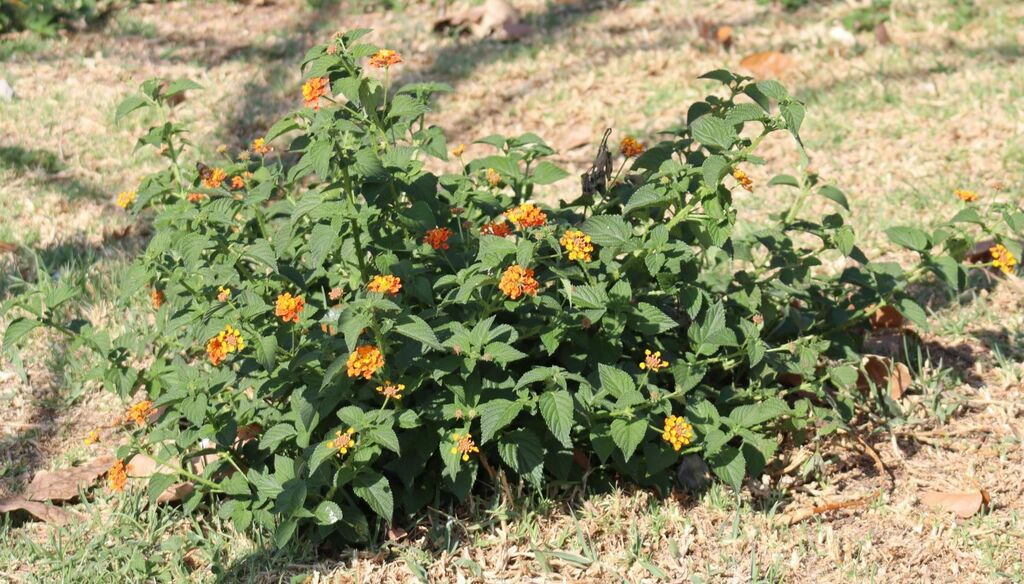
common lantana
Lantana camara
Lantana camara (common lantana) is a species of flowering plant in the verbena family (Verbenaceae), native to the tropics of the Americas. It is a very adaptable species, which can inhabit a wide variety of ecosystems; once it has been introduced into a habitat it spreads rapidly; between 45ºN and 45ºS and less than 1,400 metres (4,600 feet) in altitude.
It has spread from its native range to around 50 countries, where it has become an invasive species. It first spread out of the Americas when it was brought to Europe by Dutch explorers and cultivated widely, soon spreading further into Asia and Oceania where it has established itself as a notorious weed, and in Goa Former Estado da Índia Portuguesa it was introduced by the Portuguese.
From the article Lantana camara on Wikipedia (CC BY-SA), quoted section by section
Description
Lantana camara is a perennial, erect sprawling or scandent, shrub which typically grows to around 2 metres (6+1⁄2 feet) tall and form dense thickets in a variety of environments. Under the right conditions, it can scramble up into trees and can grow to 6 m (20 ft) tall. The leaves are broadly ovate, opposite, and simple and have a strong odour when crushed. L. camara has small tubular-shaped flowers, which each have four petals and are arranged in clusters in terminal areas stems. Flowers come in many different colours, including red, yellow, white, pink and orange, which differ depending on location in inflorescences, age, and maturity. The flower has a tutti frutti smell with a peppery undertone. After pollination occurs, the colour of the flowers changes (typically from yellow to orangish, pinkish, or reddish); this is believed to be a signal to pollinators that the pre-change colour contains a reward as well as being sexually viable, thus increasing pollination efficiency. …
Range & habitat
The native range of Lantana camara is Central and South America; however, it has become naturalised in around 60 tropical and sub-tropical countries worldwide. It is found frequently in east and southern Africa, where it occurs at altitudes below 2,000 m (6,600 ft), and often invades previously disturbed areas such as logged forests and areas cleared for agriculture. L. camara has also spread across the areas of Africa, Southern Europe, such as Spain and Portugal, and also the Middle East, India, tropical Asia, Australia, New Zealand, and the US, as well as many Atlantic, Pacific and Indian Ocean islands. It has become a significant weed in Sri Lanka after escaping from the Royal Botanical Gardens in 1926. Lantanas were brought to Australia as an ornamental garden plant in 1841, which spread and escaped domestic cultivation and became established in the wild within 20 years. They were brought to India by the British around 200 years ago, which then spread and became invasive there as well. A national-level monitoring in 2023 found that L. camara has invaded around 50% of the natural areas in India. It was introduced into the Philippines from Hawaii as part of an exchange program between the United States and the Philippines; however, it managed to escape and has become naturalized in the islands. …
Wikipedia: “Distribution and habitat”
At the table
Lantana camara stalks have been used in the construction of furniture, such as chairs and tables.
Ornamental. Lantana camara has been grown specifically for use as an ornamental plant since Dutch explorers first brought it to Europe from the New World. Its ability to last for a relatively long time without water, and the fact that it does not have many pests or diseases which affect it, have contributed to it becoming a common ornamental plant. L. camara also attracts butterflies and birds and is frequently used in butterfly gardens. As an ornamental, L. camara is often cultivated indoors, or in a conservatory, in cool climates, but can also thrive in a garden with sufficient shelter.
As a host plant. Many butterfly species feed on the nectar of L. camara. Papilio homerus, the largest butterfly in the western hemisphere, is known to feed on the nectar of the flowers as an opportunistic flower feeder. A jumping spider, Evarcha culicivora, has an association with L. camara. They consume the nectar for food and preferentially use these plants as a location for courtship.
Wikipedia: “Uses”
Toxicity
Lantana camara is known to be toxic to livestock, such as cattle, sheep, horses, dogs and goats. The active substances causing toxicity in grazing animals are pentacyclic triterpenoids called lantadenes, which result in liver disease and photosensitivity. L. camara also excretes allelopathic chemicals, which reduce the growth of surrounding plants by inhibiting germination and root elongation. The toxicity of L. camara to humans is undetermined, although studies indicate that ingesting berries can be toxic to humans. Ingestion of the flowers, fruits, and leaves may cause vomiting, diarrhea, difficulty breathing, and liver failure in people, while the leaves may cause contact dermatitis. A field guide by the US Department of the Army says that eating the plant can even be fatal. Contrarily, a 2010 study of poisoning cases in California reported that eating unripe or ripe berries did not have significant toxic effects in children under age 16.
In human culture
The name Lantana derives from the Latin name of the wayfaring tree Viburnum lantana, the flowers of which closely resemble Lantana. Camara is derived from an indigenous Brazilian name for this and several other plants.
Wikipedia: “Etymology”
Where it lives
Recorded sightings
—
geo-referenced records in GBIF, from museums, herbaria and field observers.
Drag the globe to turn it. Dots are where records exist, not a range map; darker means more records.
In the old herbals & bestiaries

In the stacks
Searching the stacks…
Every page naming Lantana camara in the Biodiversity Heritage Library →
This page is assembled live from iNaturalist, GBIF, Wikipedia, the Source Library and the Internet Archive. It is not yet part of the hand-edited codex. iNaturalist taxon 50333.