- Plants
- ›Vascular Plants
- ›flowering plants
- ›Dicots
- ›Mallows, Rock Roses, and Allies
- ›Mallow and Hibiscus Family
- ›Malvoideae
- ›Malveae
- ›Sphaeralcea
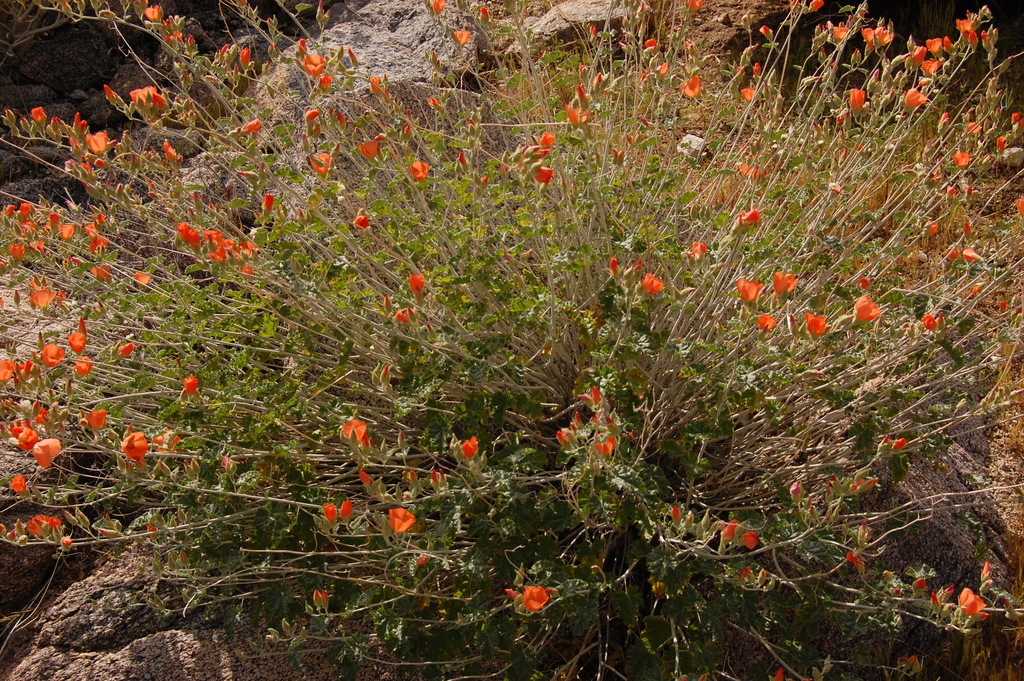
apricot globemallow
Sphaeralcea ambigua
Sphaeralcea ambigua is a species of flowering plant commonly known as desert globemallow or apricot mallow, for its predominantly orange blooms. It has fuzzy, grey-green leaves. It is a member of the genus Sphaeralcea in the mallow family (Malvaceae).
It is a perennial shrub native to the Southwestern United States and northwest Mexico. S. ambigua is a prevalent species in desert habitat and helps provide food and habitat for other species
From the article Sphaeralcea ambigua on Wikipedia (CC BY-SA), quoted section by section
Description
Sphaeralcea ambigua grows to 3 ft (0.91 m) in height and spreads to 2–3 ft (0.61–0.91 m) in width. The leaves (see image) are fuzzy with white hairs on both sides, lobed, palmately veined, and on long stems, the number of which increases with age. The fruit is a brown capsule containing numerous seeds, first quite spherical as implied by the genus name, later flattening to a disk. The flowers are bowl-shaped, five-petaled, apricot to orange in color (although morphs may be white or light pink), and blooming in the spring. S. ambigua is also a larval host to several species of butterflies, such as the common checkered skipper, northern white skipper, painted lady, small checkered skipper, and West Coast lady.
Varieties. S. ambigua A. Gray has eight or nine named varieties:
S. a. var. ambigua S. a. var. aculeata Jeps. (synonym for S. a. var. ambigua) S. a. var. rosacea (Munz & I.M. Johnst.) Kearney S. a. var. rugosa (Kearney) Kearney
Range & habitat
Desert globemallow is native to parts of California, Nevada, Utah, Arizona, and New Mexico in the United States and Sonora and Baja California in northwest Mexico. It grows well in alkaline soils, both sandy and clay, usually in the company of creosote bush scrub and desert chaparral habitats, at 150–2,500 m (490–8,200 ft) in elevation. It is found in the Mojave, Great Basin, and Sonoran desert ecoregions.
Wikipedia: “Native habitat”
What it does
Numerous bee pollinators visit this flower. The solitary ground-dwelling bee Diadasia ochracea is a specialist pollinator of this mallow.
Wikipedia: “Pollinators”
How it is grown
S. ambigua is cultivated as an ornamental plant by specialty plant nurseries for use in desert and drought-tolerant gardens, and a native plant its desert region's natural landscaping and habitat restoration projects. It requires full sun and can do well with natural rainfall, although supplemental watering increases flowering. Sandy, desert soil with good drainage is preferred, but it is tolerant of some clay. It is winter hardy in USDA Zones 6–10, withstanding temperatures as low as -10°F. General maintenance is low. Plants may be periodically cut back to maintain a vegetative look. Propagation is easy by seed, but tricky by vegetative cuttings.
Wikipedia: “Cultivation”
Where it lives
Recorded sightings
—
geo-referenced records in GBIF, from museums, herbaria and field observers.
Drag the globe to turn it. Dots are where records exist, not a range map; darker means more records.
In the stacks
Searching the stacks…
Every page naming Sphaeralcea ambigua in the Biodiversity Heritage Library →
This page is assembled live from iNaturalist, GBIF, Wikipedia, the Source Library and the Internet Archive. It is not yet part of the hand-edited codex. iNaturalist taxon 50153.