- Plants
- ›Vascular Plants
- ›flowering plants
- ›Dicots
- ›Heathers, Balsams, Primroses, and Allies
- ›camellia family
- ›Camellia
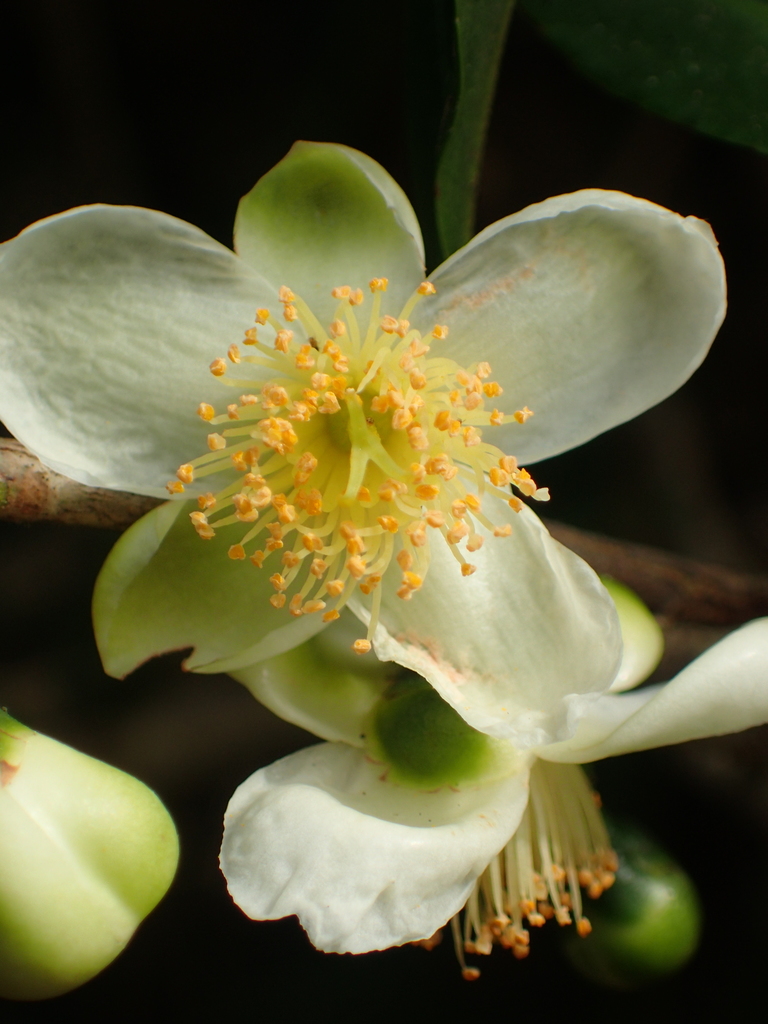
Camellia formosensis
Camellia sinensis, commonly known as tea plant, tea shrub, and tea tree, is a species of evergreen shrub in the flowering plant family Theaceae. The leaves harvested from C. sinesis are brewed into tea.
Originally native to the highlands of the Hengduan–Purvanchal region between southwestern China, northern Myanmar and northeastern India, the leaves, buds and stems of C. sinensis are harvested by humans to produce tea, leading to its artificial introduction and cultivation as valuable cash crops in many other parts of the world, with China, India and Kenya being the three largest tea-producing countries.
From the article Camellia sinensis on Wikipedia (CC BY-SA), quoted section by section
Description
Camellia sinensis is a woody shrub or tree that is typically 1 to 5 m (3.3 to 16.4 ft) tall, but can be as tall as 20 m (66 ft). It is usually trimmed to a height of about 1 m (3.3 ft) with a flat top when in commercial tea plantations. The bark on trunks is smooth and gray with a yellow or brown tone. Young branches are yellow with a gray cast to them while new twigs are red-purple with white hairs. In older trees the trunk reaches as much as 40 cm in diameter. In seedlings the taproot is dominant, but in mature plants the distribution of roots depends upon individual plant characteristics and growing conditions. In areas with shallow soils or high water tables tea bushes will have a shallow, fibrous root system while in areas with deep soils root have been found at depths of 5.5 m. Tea bushes reach peak productivity at ages of 30 to 50 years, but can remain productive for over a century.
The leaves are an attractive green and tend to be smaller on cultivated plants than wild ones, ranging in size from 4 to 22 cm (1.5 to 8.5 in) and a width of 2 to 7.7 cm (0.8 to 3.0 in). Their shape is elliptic, oblong-elliptic, or oblong, and they have a leathery texture. The upper surface is shining dark green and hairless while the underside is pale green and can be hairless or pubescent, covered in plant hairs. …
Range & habitat
The origins of tea plants are obscured by their long history of cultivation. The natural range is unknown, though it is reasonably certain that the species comes from East Asia with the exact location being debated by experts. The borderlands theory suggests the species originated in the borderlands of far eastern India, north Myanmar, and southwestern China. Alternatively, other experts point to an origin to the northeast in Yunnan province within China. In the Plants of the World Online database many more places are listed as part of the native range including not only southcentral and southwest China, Assam and the eastern Himalayas in India, and Myanmar, but also Laos, Thailand, and Vietnam.
Wikipedia: “Range and habitat”
How it is grown
Camellia sinensis is mainly cultivated in tropical and subtropical climates, in areas with at least 127 cm (50 in) of rainfall a year. Tea plants prefer a rich and moist growing location in full to part sun, and can be grown in hardiness zones 7–9. However, the species is commercially cultivated from the equator to as far north as Scotland, with the northernmost tea plantation at 59°N latitude on Shapinsay in the Orkney Islands. Many high quality teas are grown at high elevations, up to 2,200 m (7,200 ft), as the plants grow more slowly and acquire more flavour. Tea plants will grow into a tree if left undisturbed, but cultivated plants are pruned to waist height for ease of plucking. Two principal varieties are used, the small-leaved Chinese variety plant (C. s. var. sinensis) and the large-leaved Assamese plant (C. s. var. assamica), used mainly for black tea. Tea trees can remain productive for many years.
Chinese teas. The Chinese plant is a small-leafed bush with multiple stems that reaches a height of some 3 m (9.8 ft). It is native to southeast China. The first tea plant variety to be discovered, recorded, and used to produce tea dates back 3,000 years ago; it yields some of the most popular teas. C. s. var. waldenae was considered a different species, C. waldenae by SY Hu, but it was later identified as a variety of C. sinensis. …
Wikipedia: “Cultivation”
Where it lives
Recorded sightings
—
geo-referenced records in GBIF, from museums, herbaria and field observers.
Drag the globe to turn it. Dots are where records exist, not a range map; darker means more records.
In the stacks
Searching the stacks…
Every page naming Camellia formosensis in the Biodiversity Heritage Library →
This page is assembled live from iNaturalist, GBIF, Wikipedia, the Source Library and the Internet Archive. It is not yet part of the hand-edited codex. iNaturalist taxon 500216.