- Plants
- ›Vascular Plants
- ›flowering plants
- ›Dicots
- ›pinks, cactuses, and allies
- ›Old World pitcher plants
- ›Nepenthes
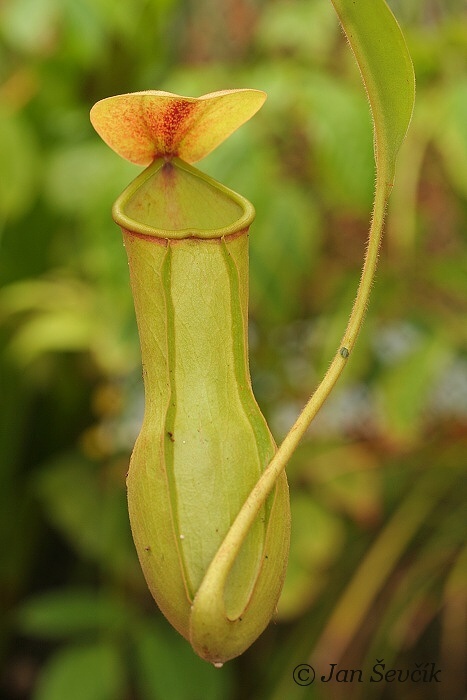
Indian pitcher plant
Nepenthes khasiana
Nepenthes khasiana (/nɪˈpɛnθiːz ˌxæsiˈɑːnə/; after the Khasi Hills, to which it is largely endemic) is an endangered tropical pitcher plant of the genus Nepenthes. It is the only Nepenthes species native to India. It is thought to attract prey by means of blue fluorescence.
From the article Nepenthes khasiana on Wikipedia (CC BY-SA), quoted section by section
Range & habitat
The species has a very localised distribution and is rare in the wild. But with new advancement in agro-technology and tissue culture, it is now being cultivated in campus of Nagaland University, Nagaland. These Pitcher Plants which are endemic to Meghalaya can be seen widely as decorative plants outside many houses of Nagaland.
Isolated populations are known to occur in the Jarain area of the Jaintia Hills, the Baghmara area of the Garo Hills, adjacent to the Khasi Hills region of Meghalaya, in the Upper Kharthong area, of Dima Hasao district Assam and in some parts of Nagaland.Nevertheless, N. khasiana exhibits considerable genetic diversity. The Khasi people call the plant tiew-rakot, which means demon-flower or devouring-plant. The Jaintias call it kset phare, which is roughly translated as lidded fly net. The Garo call the plant memang-koksi, which literally means the basket of the devil and the Biate tribe of Assam call the plant Jug-Par which means Jug-flower or Loisul Kola which literally means Pitcher-plant.
Wikipedia: “Distribution”
In human culture
The specific epithet khasiana is spelled khasyana in some older texts. This spelling actually predates that under which the species was formally published in Joseph Dalton Hooker's 1873 monograph, "Nepenthaceae", as it appeared in an article by Maxwell T. Masters in the April 20, 1872 issue of The Gardeners' Chronicle and Agricultural Gazette (this article was itself based on the manuscript of Hooker's monograph). In the horticultural trade of the late 19th century, N. khasiana was often confused with N. distillatoria of Sri Lanka.
Wikipedia: “Etymology”
Where it lives
Recorded sightings
—
geo-referenced records in GBIF, from museums, herbaria and field observers.
Drag the globe to turn it. Dots are where records exist, not a range map; darker means more records.
In the stacks
Searching the stacks…
Every page naming Nepenthes khasiana in the Biodiversity Heritage Library →
This page is assembled live from iNaturalist, GBIF, Wikipedia, the Source Library and the Internet Archive. It is not yet part of the hand-edited codex. iNaturalist taxon 498922.