- Plants
- ›Vascular Plants
- ›flowering plants
- ›Dicots
- ›beeches, oaks, walnuts, and allies
- ›birch family
- ›Betula
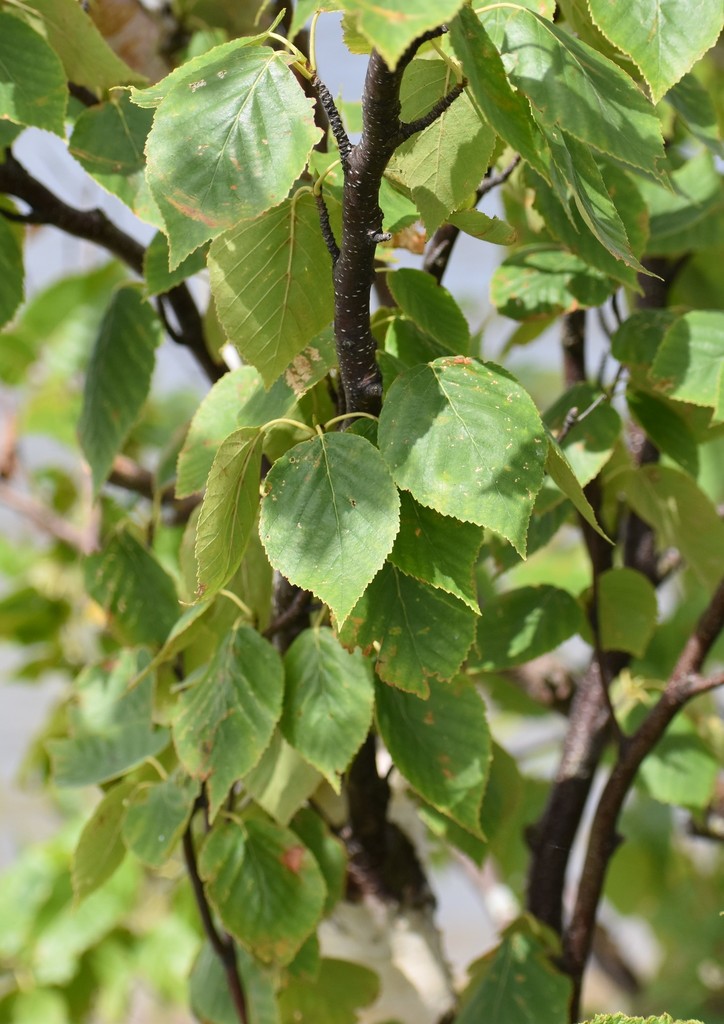
paper birch
Betula papyrifera
Betula papyrifera (paper birch, also known as (American) white birch and canoe birch) is a short-lived species of birch native to northern North America. Paper birch is named after the tree's thin white bark, which often peels in paper-like layers from the trunk. Paper birch is often one of the first species to colonize a burned area within the northern latitudes, and is an important species for moose browsing. Primary commercial uses for paper birch wood are as boltwood and sawlogs, while secondary products include firewood and pulpwood. It is the provincial tree of Saskatchewan and the state tree of New Hampshire.
From the article Betula papyrifera on Wikipedia (CC BY-SA), quoted section by section
Description
Betula papyrifera is a medium-sized deciduous tree typically reaching 20 metres (66 feet) tall, and exceptionally to 40 m (130 ft) with a trunk up to 75 centimetres (30 inches) in diameter. Within forests, it often grows with a single trunk but when grown as a landscape tree it may develop multiple trunks or branch close to the ground. Paper birch is a typically short-lived species. It handles heat and humidity poorly and may live only 30 years in zones six and up, while trees in colder-climate regions can grow for more than 100 years. B. papyrifera will grow in many soil types, from steep rocky outcrops to flat muskegs of the boreal forest. Best growth occurs in deeper, well drained to dry soils, depending on the location.
In older trees, the bark is white, commonly brightly so, flaking in fine horizontal strips to reveal a pinkish or salmon-colored inner bark. It often has small black marks and scars. In individuals younger than five years, the bark appears a brown red color with white lenticels, making the tree much harder to distinguish from other birches. The bark is highly weather-resistant. It has a high oil content and this gives it its waterproof and weather-resistant characteristics. …
Range & habitat
Betula papyrifera is mostly confined to Canada and the far northern United States. It is found in interior (var. humilus) and south-central (var. kenaica) Alaska and in all provinces and territories of Canada, except Nunavut, as well as the far northern continental United States. Isolated patches are found as far south as the Hudson Valley of New York and Pennsylvania, northern Connecticut, and Washington. High elevation stands are also in mountains to North Carolina, New Mexico, and Colorado. The most southerly stand in the Western United States is located in Long Canyon in the City of Boulder Open Space and Mountain Parks. This is an isolated Pleistocene relict that most likely reflects the southern reach of boreal vegetation into the area during the last Ice Age.
Wikipedia: “Distribution”
What it does
In Alaska, paper birch often naturally grows in pure stands by itself or with black or white spruce. In the eastern and central regions of its range, it is often associated with red spruce and balsam fir. It may also be associated with big-toothed aspen, yellow birch, Betula populifolia, and maples. Shrubs often associated with paper birch in the eastern part of its range include beaked hazel (Corylus cornuta), common bearberry (Arctostaphylos uva-ursi), dwarf bush-honeysuckle (Diervilla lonicera), wintergreen (Gaultheria procumbens), wild sarsaparilla (Aralia nudicaulis), blueberries (Vaccinium spp.), raspberries and blackberries (Rubus spp.), elderberry (Sambucus spp.), and hobblebush (Viburnum alnifolium).
Successional relationships. Betula papyrifera is a pioneer species, meaning it is often one of the first trees to grow in an area after other trees are removed by some sort of disturbance. Typical disturbances colonized by paper birch are wildfire, avalanche, or windthrow areas where the wind has blown down all trees. When it grows in these pioneer, or early successional, woodlands, it often forms stands of trees where it is the only species. Paper birch is considered well adapted to fires because it recovers quickly by means of reseeding the area or regrowth from the burned tree. …
Wikipedia: “Ecology”
At the table
Betula papyrifera has a moderately heavy white wood. It makes excellent high-yielding firewood if seasoned properly. The dried wood has a density of 37.4 lb/cu ft (0.599 g/cm3) and an energy density 20,300,000 BTU/cord (5,900,000 kJ/m3). Although paper birch does not have a very high overall economic value, it is used in furniture, flooring, popsicle sticks, pulpwood (for paper), plywood, and oriented strand board. The wood can also be made into spears, bows, arrows, snowshoes, sleds, and other items. When used as pulp for paper, the stems and other nontrunk wood are lower in quantity and quality of fibers, and consequently the fibers have less mechanical strength; nonetheless, this wood is still suitable for use in paper. The sap is boiled down to produce birch syrup. The raw sap contains 0.9% carbohydrates (glucose, fructose, sucrose) as compared to 2 percent to 3 percent within sugar maple sap. The sap flows later in the season than maples. Currently, only a few small-scale operations in Alaska and Yukon produce birch syrup from this species.
Bark. Its bark is an excellent fire starter; it ignites at high temperatures even when wet. The bark has an energy density of 5,740 cal/g (24,000 J/g) and 3,209 cal/cm3 (220,000 J/cu in), the highest per unit weight of 24 species tested. Birch bark is used in a number of crafts by various Native American tribes (e.g. Ojibwe). …
Wikipedia: “Uses”
Where it lives
Recorded sightings
—
geo-referenced records in GBIF, from museums, herbaria and field observers.
Drag the globe to turn it. Dots are where records exist, not a range map; darker means more records.
In the stacks
Searching the stacks…
Every page naming Betula papyrifera in the Biodiversity Heritage Library →
This page is assembled live from iNaturalist, GBIF, Wikipedia, the Source Library and the Internet Archive. It is not yet part of the hand-edited codex. iNaturalist taxon 49883.