- Animals
- ›Molluscs
- ›Bivalves
- ›Autobranchia
- ›Heteroconchia
- ›Euheterodonta
- ›Imparidentia
- ›True Cockles, Tellins, and Allies
- ›Tellins, Sunset Clams, and Allies
- ›Short Razor Clams
- ›Solecurtus
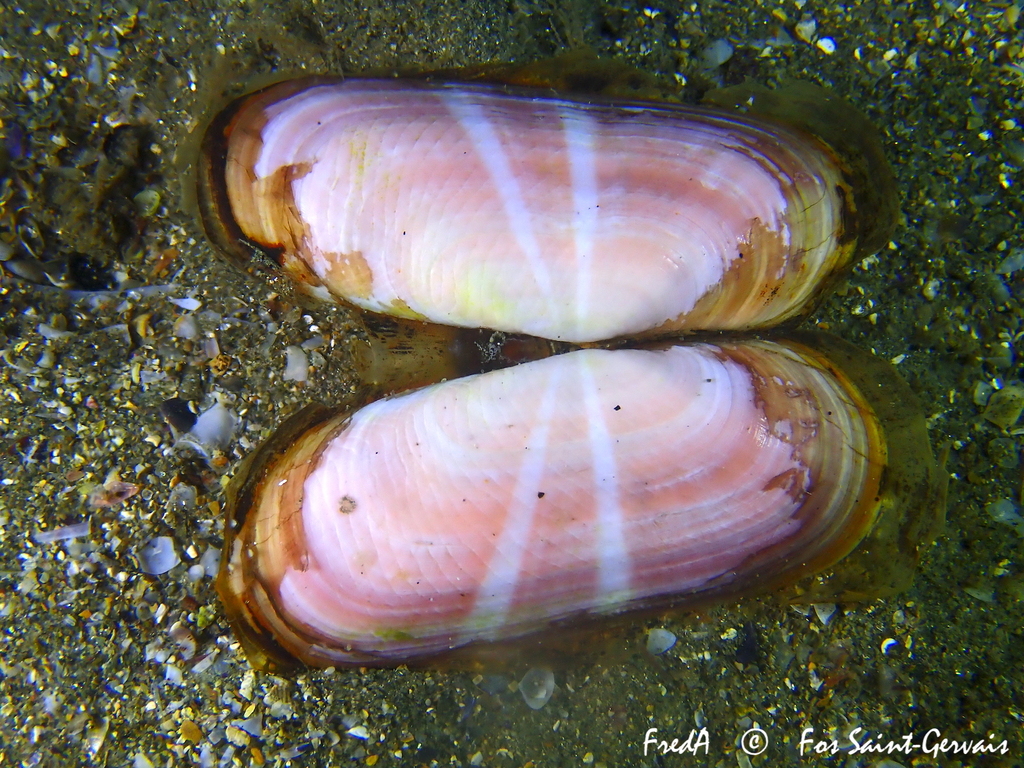
rosy razor clam
Solecurtus strigilatus
Solecurtus strigilatus, also known as the rosy razor clam, is a species of saltwater clam, a marine bivalve mollusc in the family Solecurtidae. This mollusc is a suspension feeder and can burrow with great rapidity to escape predators. It is an unusual bivalve in that its shell valves are too small to contain all the soft tissue, and the animal is unable to retreat into its shell.
From the article Solecurtus strigilatus on Wikipedia (CC BY-SA), quoted section by section
Description
The valves of the rosy razor clam are relatively small, thin and finely sculptured. At the anterior end of the animal there is a strong, protruding foot. At the posterior end, is the large mantle sac containing the gills; when relaxed, it protrudes and is twice the length of the valves, but it can be contracted back between the valves. Posterior to this are the two robust, contractile siphons. The maximum length of the shell is 8 cm (3 in).
Range & habitat
The rosy razor clam occurs in the Mediterranean Sea and the adjoining part of the Atlantic Ocean. It is present from the lower shore down to the shallow sublittoral zone.
Wikipedia: “Distribution”
What it does
The species lives immersed in soft sediment, usually medium-grade sand. The burrow is J-shaped and has a mucus lining. The clam has two siphons which it can extend to the surface in order to feed, but when not feeding it burrows further into the sediment, often living 50 cm (20 in) under the sand surface. Many clams are detritivores, consuming decomposing organic matter they find in their environment, but this clam is a filter feeder, drawing water in through one siphon, removing the edible particles and exhaling the water through the other siphon. It can dig through the sand with great rapidity, and any attempt by humans to dig it out results in it descending diagonally, even deeper into the sediment. In an apparent attempt to distract predators, the tips of the two siphons can be shed, and these pulsate as they drift in the water column. The ends of the siphons can be regenerated. …
Wikipedia: “Behaviour and ecology”
Where it lives
Recorded sightings
—
geo-referenced records in GBIF, from museums, herbaria and field observers.
Drag the globe to turn it. Dots are where records exist, not a range map; darker means more records.
In the stacks
Searching the stacks…
Every page naming Solecurtus strigilatus in the Biodiversity Heritage Library →
This page is assembled live from iNaturalist, GBIF, Wikipedia, the Source Library and the Internet Archive. It is not yet part of the hand-edited codex. iNaturalist taxon 498442.