- Plants
- ›Vascular Plants
- ›flowering plants
- ›Dicots
- ›Gentians, Dogbanes, Madders, and Allies
- ›Dogbane Family
- ›milkweeds
- ›Asclepiadeae
- ›Tylophorinae
- ›Vincetoxicum
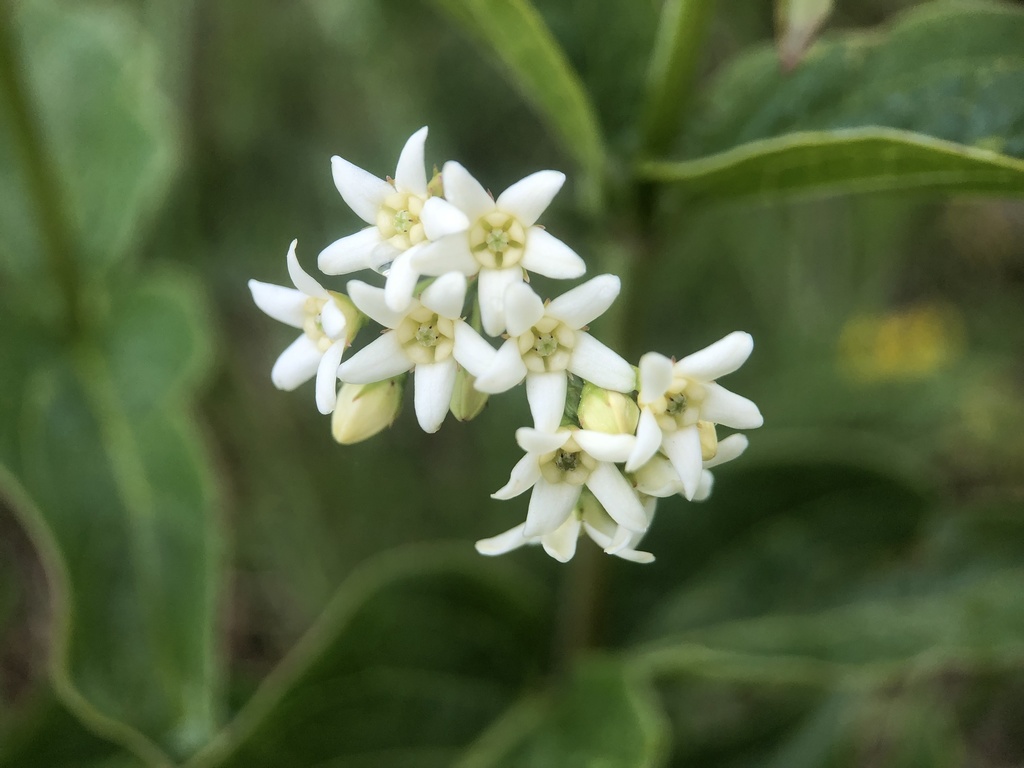
Swallow-wort
Vincetoxicum hirundinaria
Vincetoxicum hirundinaria, commonly named white swallow-wort, is a long-lived herbaceous perennial of the genus Vincetoxicum in the family Apocynaceae.
From the article Vincetoxicum hirundinaria on Wikipedia (CC BY-SA), quoted section by section
Description
Vincetoxicum hirundinaria can reach a height of 30–70 centimetres (12–28 in). Stem is erect, stout and glabrous. Flowers in whorls form a raceme. They have a diamenter of about 1 centimetre (0.39 in). Corolla has five white petals. Calyx is composed by five fused, sharp-pointed sepals. Leaves are opposite, ovate to lanceolate and short-stalked. Fruits reach a length of about 5 cm and contain many seeds showing a tuft of white hairs. Flowering time lasts from June to the end of July.
Range & habitat
This species is native to cliffs and slopes, especially in calcareous soils, of continental Eurasia (including some Baltic islands). There are introduced populations in North America (Ontario, Michigan, and New York). It is not present in Great Britain and Ireland.
Wikipedia: “Distribution and habitat”
In human culture
The generic name Vincetoxicum, in Latin meaning ‘conqueror of poison’, derives from the traditional use of this plant as an antidote to poisons. The Latin species name hirundinaria (from hirundo, meaning swallow) and the common name white swallow-wort refer to its seedpods, that are reminiscent of a swallow's wing, or tail.
Wikipedia: “Etymology”
Where it lives
Recorded sightings
—
geo-referenced records in GBIF, from museums, herbaria and field observers.
Drag the globe to turn it. Dots are where records exist, not a range map; darker means more records.
In the old herbals & bestiaries

Living Images of Plants
Otto Brunfels · 1532 · p.379

Notable Commentaries on the History of Plants
Leonhart Fuchs · 1542 · p.163

Notable Commentaries on the History of Plants
Leonhart Fuchs · 1549 · p.161

On the Names of Plants
Hieronymus Bock (Tragus) · 1552 · p.252

The Dutch Herbarium or Herbal
Petrus Nylandt · 1670 · p.217

Herbarium Portatile, Oder Behendes Kräuter- und Gewächs-Buch: Darinn nicht allein 1363. so wol Einheimische als Außländndische Kräuter mit Lateinisch und Deutscher Benennung abgebildet, sondern auch die meisten, so in der Medicin gebräuchlich, kürtzlich erkläret werden
Panckow, Thomas · 1656 · p.290
In the stacks
Searching the stacks…
Every page naming Vincetoxicum hirundinaria in the Biodiversity Heritage Library →
This page is assembled live from iNaturalist, GBIF, Wikipedia, the Source Library and the Internet Archive. It is not yet part of the hand-edited codex. iNaturalist taxon 498350.