- Plants
- ›Vascular Plants
- ›flowering plants
- ›monocots
- ›grasses, sedges, cattails, and allies
- ›grasses
- ›Pooideae
- ›needlegrasses and allies
- ›Stipa
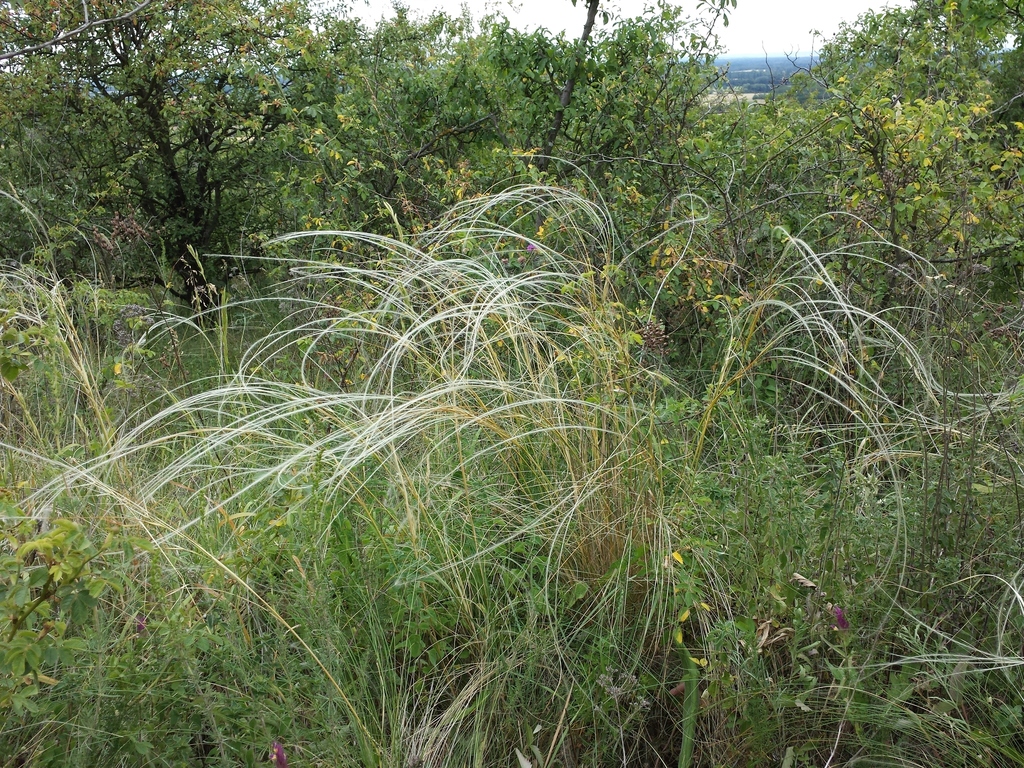
Horsetail Feather Grass
Stipa tirsa
Stipa tirsa is a species of perennial grass native to Europe and temperate Asia. Culms are 40–100 cm long; leaf blades are filiform, involute, and 1–2 mm wide.
From the article Stipa tirsa on Wikipedia (CC BY-SA), quoted section by section
Description
S. tirsa is a perennial, tuft-forming grass with culms 40–100 cm tall. Leaf-sheaths are glabrous, ligules short (0.2–0.5 mm), and blades filiform, involute, 1–2 mm wide, puberulous and hairy beneath, with attenuate tips. The inflorescence is a contracted, linear panicle subtended at the base by a leaf. Spikelets are solitary, pedicelled, and 50–65 mm long, each with a single fertile floret and disarticulating at maturity. Glumes are lance-shaped (lanceolate), pointed (acuminate), membranous, and longer than the florets (50–65 mm). The fertile lemma is elliptic, 18–20 mm long, pubescent in lines, convolute around the inner bract (palea), and terminates in a single awn. The awn is bent twice (bigeniculate), 350–500 mm long, with a twisted column and feathery (plumose) limb. The inner bract equals the lemma in length, 2-veined. Flowers have three small scales (lodicules), three smooth-tipped anthers, and two stigmas; the ovary is glabrous. The fruit is a grain (caryopsis) with adherent outer layer (pericarp) and a linear narrow scar (hilum).
Range & habitat
According to Plants of the World Online, Stipa tirsa is native to parts of Europe and Asia, occurring from the Iberian Peninsula eastwards to Siberia.
Wikipedia: “Distribution and habitat”
Where it lives
Recorded sightings
—
geo-referenced records in GBIF, from museums, herbaria and field observers.
Drag the globe to turn it. Dots are where records exist, not a range map; darker means more records.
In the stacks
Searching the stacks…
Every page naming Stipa tirsa in the Biodiversity Heritage Library →
This page is assembled live from iNaturalist, GBIF, Wikipedia, the Source Library and the Internet Archive. It is not yet part of the hand-edited codex. iNaturalist taxon 497925.