- Plants
- ›Vascular Plants
- ›flowering plants
- ›Dicots
- ›proteas, lotuses, planes, and allies
- ›plane family
- ›Platanus
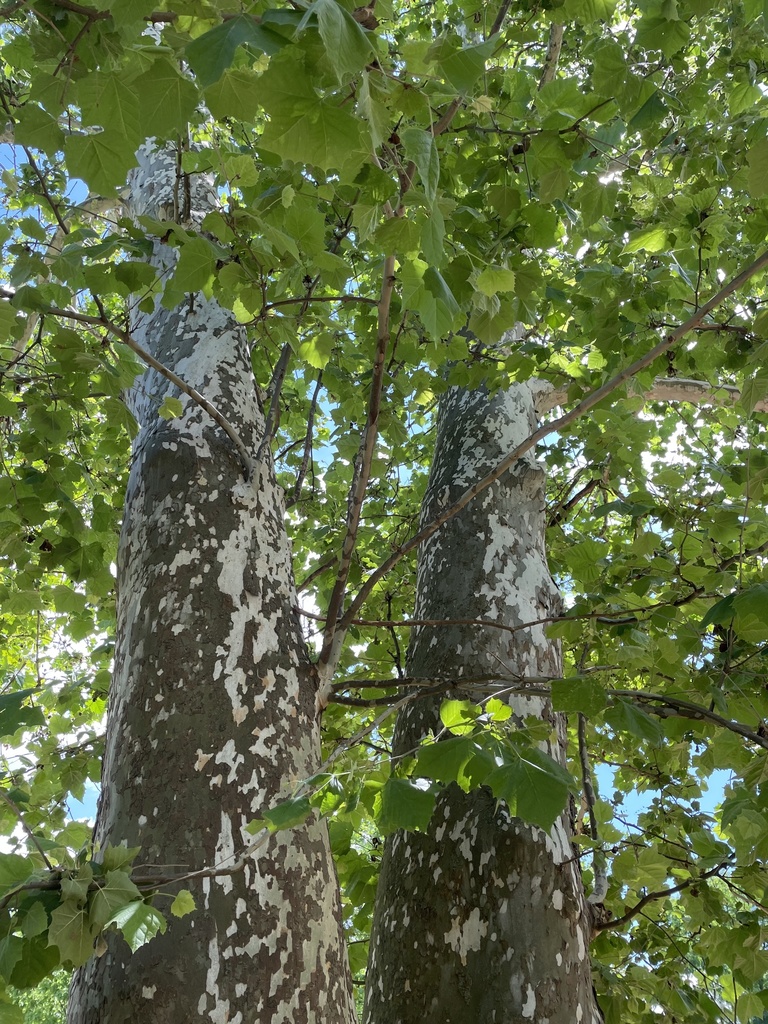
American sycamore
Platanus occidentalis
Platanus occidentalis, also known as American sycamore or American planetree, is a species of Platanus native to the eastern and central United States, the mountains of northeastern Mexico, extreme southern Ontario, and extreme southern Quebec. It is usually called sycamore in North America, a name which can refer to other types of trees in other parts of the world; in the United Kingdom, for example, the name sycamore typically refers to Acer pseudoplatanus. The American sycamore is a long-lived species, typically surviving at least 200 years and likely as long as 500–600 years. It is capable of becoming a massive tree, with a wide girth and heights reaching up to 24 m (80 ft) or more.
The species epithet occidentalis is Latin for "western", referring to the Western Hemisphere, because at the time when it was named by Carl Linnaeus, the only other species in the genus was P. orientalis ("eastern"), native to the Eastern Hemisphere. Confusingly, in the United States, this species was first known in the Eastern United States, thus it is sometimes called eastern sycamore, to distinguish it from Platanus racemosa, which was discovered later in the Western United States and called western sycamore.
From the article Platanus occidentalis on Wikipedia (CC BY-SA), quoted section by section
Description
Platanus occidentalis can often be easily distinguished from other trees by its mottled bark that flakes off in large, irregular masses, leaving the surface mottled and gray, greenish-white, and brown. The bark of all trees has to yield to a growing trunk by stretching, splitting, or infilling, but sycamore bark is more rigid and less elastic than the bark of other trees, so to accommodate the growth of the wood underneath, the tree sheds it in large, brittle pieces. A sycamore can grow to massive proportions, typically reaching up to 30 to 40 m (98 to 131 ft) high and 1.5 to 2 m (4.9 to 6.6 ft) in diameter when grown in deep soils. The largest of the species have been measured to 53 m (174 ft), and nearly 4 m (13 ft) in diameter. Larger specimens were recorded in historical times. In 1744, a Shenandoah Valley settler named Joseph Hampton and two sons lived for most of the year in a hollow sycamore in what is now Clarke County, Virginia. In 1770, at Point Pleasant, Virginia (now in West Virginia), near the junction of the Kanawha and Ohio Rivers, George Washington recorded in his journal a sycamore measuring 13.67 m (44 ft 10 in) in circumference at 91 cm (3 ft) from the ground. The sycamore tree is often divided near the ground into several secondary trunks, very free from branches. Spreading limbs at the top make an irregular, open head. Roots are fibrous. …
Range & habitat
In its native range, it is often found in riparian and wetland areas. The range extends from Iowa to Ontario and New Hampshire in the north, Nebraska in the west, and south to Texas and Florida. It is apparently extirpated from Maine. It can be found in southeastern Minnesota. Closely related species (see Platanus) occur in Mexico and the southwestern states of the United States. It is sometimes grown for timber and has become naturalized in some areas outside its native range. It can be found growing successfully in Bismarck, North Dakota, and it is sold as far south as Okeechobee. The American sycamore is also well adapted to life in Argentina and Australia and is quite widespread across the Australian continent, especially in the cooler southern states such as Victoria and New South Wales.
Wikipedia: “Distribution”
What it does
American sycamore is found most commonly in bottomland or floodplain areas, thriving in the wet environments provided by rivers, streams, or abundant groundwater, though it will die after being flooded for more than two weeks at a time. It is a fast-growing, early-mid successional hardwood tree species. Its life cycle follows the pattern of a "weedy" species: it grows mature enough to reproduce rather young and produces large numbers of wind-distributed seeds. The dominance of sycamore in a forest depends on the conditions where it grows; it is often a pioneer species, but in the wet sites that are most ideal for it, it persists as a subclimax to climax species, partly because of its fast growth and very long lifespan. As one of the largest trees in the wet bottomland habitats where it dominates, it is a key component of the structure of those habitats. The heartwood of a sycamore tree decays quickly, producing large hollow cavities in the center of the trees which are used by many animals as nesting sites. The largest hollow trees can be big enough for black bear dens, but average trees create homes for bats and cavity-nesting birds like wood ducks, barred owls, screech owls, chimney swift, and great-crested flycatcher.
As host plant. …
Wikipedia: “Ecology”
At the table
The American sycamore is able to endure a big-city environment and was formerly extensively planted as a shade tree, but due to the defacing effects of anthracnose, it has been largely usurped in this function by the resistant London plane. Its wood has been used extensively for butcher's blocks. It has been used for boxes and crates; although coarse-grained and difficult to work, it has also been used to make furniture, siding, and musical instruments. Investigations have been made into its use as a biomass crop.
Use by Native Americans. The tree bark has traditionally been used by Native Americans to make little dishes for gathering whortleberries.
Wikipedia: “Uses”
In human culture
The terms under which the New York Stock Exchange was formed are called the "Buttonwood Agreement", because it was signed under a buttonwood (sycamore) tree at 68 Wall Street, New York City in 1792. The sycamore made up a large part of the forests of Greenland and Arctic America during the Cretaceous and Tertiary periods. It once grew abundantly in central Europe, from which it has now disappeared. It was brought to Europe early in the 17th century.
Wikipedia: “History”
Where it lives
Recorded sightings
—
geo-referenced records in GBIF, from museums, herbaria and field observers.
Drag the globe to turn it. Dots are where records exist, not a range map; darker means more records.
In the stacks
Searching the stacks…
Every page naming Platanus occidentalis in the Biodiversity Heritage Library →
This page is assembled live from iNaturalist, GBIF, Wikipedia, the Source Library and the Internet Archive. It is not yet part of the hand-edited codex. iNaturalist taxon 49662.