- Plants
- ›Vascular Plants
- ›flowering plants
- ›Dicots
- ›Heathers, Balsams, Primroses, and Allies
- ›heath family
- ›monotropes
- ›Monotropa
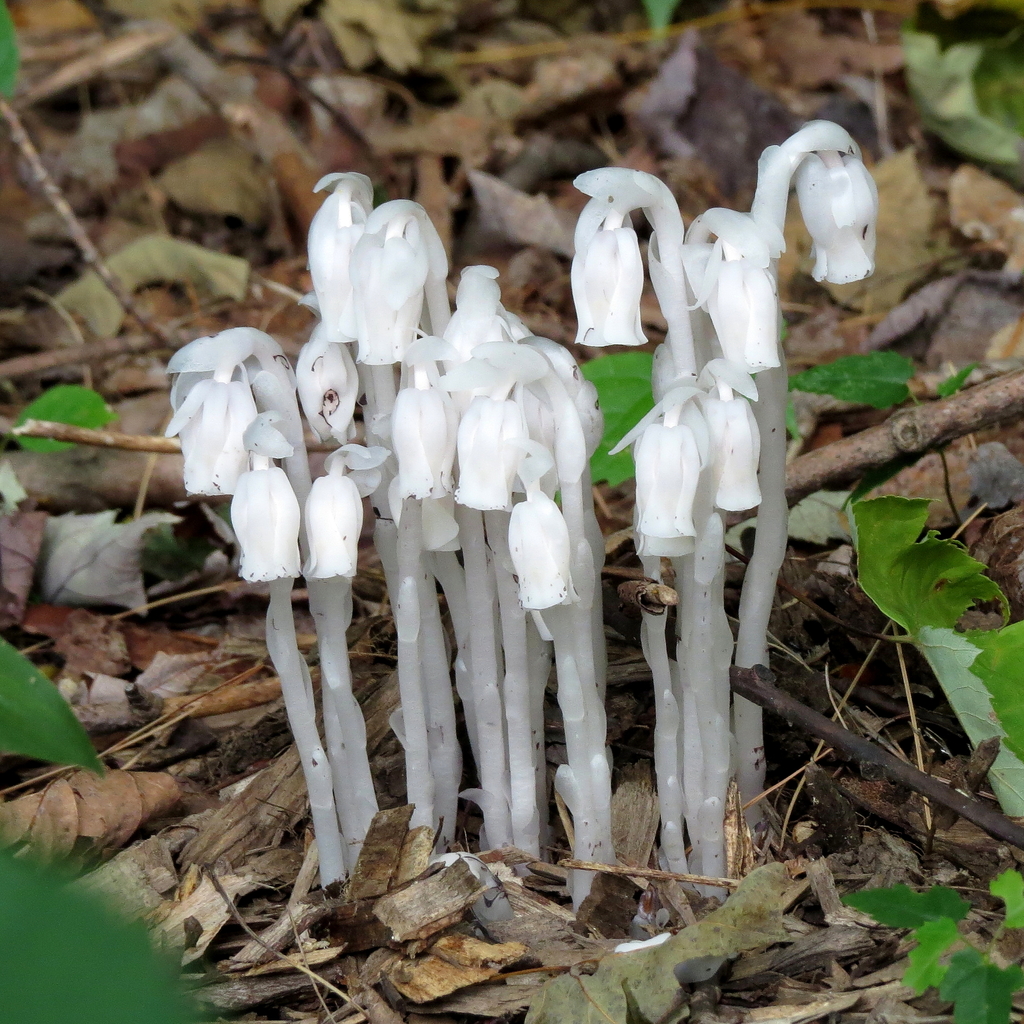
Ghost Pipe
Monotropa uniflora
Monotropa uniflora, also known as the American Indian ghost pipe plant (shortened to ghost plant, ghost pipe, American Indian pipe, or Indian pipe), is a herbaceous, parasitic, non-photosynthesizing, perennial flowering plant native to North America, Latin America, and East Asia but with large gaps between areas. The plant is waxy white, but some specimens have been described as having black flecks or pale pink coloration. Rare variants may have a deep red color. The name "Monotropa" is Greek for "one turn" and "uniflora" is Latin for "one flowered" as there is one sharply curved stem for each single flower. M. uniflora is commonly found growing in clumps of two or more, with its fungal source nearby.
From the article Monotropa uniflora on Wikipedia (CC BY-SA), quoted section by section
Description
The stems reach heights of 5–30 centimetres (2–12 in), sheathed with highly reduced leaves 5–10 millimetres (3⁄16–3⁄8 in) long, best identified as scales or bracts. These structures are small, thin, and translucent; they do not have petioles but instead extend in a sheath-like manner out of the stem. As its scientific name suggests, and unlike the closely related Monotropa hypopitys (but like Monotropastrum humile), the stems bear a single flower 10–20 mm (3⁄8–13⁄16 in) long, with 3–8 translucent petals, 10–12 stamens and a single pistil. It flowers from early summer to early autumn, often a few days after rainfall. The fruit, an oval capsule-like structure, enlarges and becomes upright when the seeds mature. After maturity the stem and capsule appear desiccated, and dark brown or black with a brittle texture. The seeds of M. uniflora are small, ranging between 0.6–0.8 mm (3⁄128–1⁄32 in) in length. Once the plant has been pollinated, the seeds are pushed through the petals in a tiny slit and dispersed via wind methods. Unlike most plants, it is white and does not contain chlorophyll. Instead of generating food using the energy from sunlight, it is parasitic, and more specifically a mycoheterotroph. Its hosts are in the Russulaceae family. Most fungi are mycorrhizal, meaning that they grow symbiotically in association with tree roots. …
What it does
The flowers of M. uniflora are visited by various bee and fly species, most commonly bumblebees. Bumblebees are an important pollen dispersal agent for the plant, crawling into the flower for pollen. Like most mycoheterotrophic plants, M. uniflora associates with a small range of fungal hosts, all of them members of Russulaceae. It is often associated with beech trees.
Wikipedia: “Ecology”
At the table
In addition to various reported traditional medicine uses, the plant has been used as an analgesic and anxiolytic in herbal medicine since the late 19th century. This may be due to the plant containing salicylic acid and grayanotoxins. Walter H. Prest described the plant as having an asparagus-like flavor once cooked.
Cultural references. M. uniflora has been featured in several pieces from renowned American poet Emily Dickinson. The Cherokee of North America feature the "pipe plant" in some of their creation stories. The legend states that the plant was named "Indian pipe" due to a group of chiefs quarreling without resolution, while passing a pipe around during the dispute; the Great Spirit then turned the chiefs into the plant, as they should have smoked the sacred pipe after making peace with each other. The plant is said to grow wherever friends have quarreled. The Nlaka'pamux use the presence of plentiful, blooming M. uniflora as a temporal indicator that Tricholoma mushrooms are abundant.
Wikipedia: “Uses”
Where it lives
Recorded sightings
—
geo-referenced records in GBIF, from museums, herbaria and field observers.
Drag the globe to turn it. Dots are where records exist, not a range map; darker means more records.
In the stacks
Searching the stacks…
Every page naming Monotropa uniflora in the Biodiversity Heritage Library →
This page is assembled live from iNaturalist, GBIF, Wikipedia, the Source Library and the Internet Archive. It is not yet part of the hand-edited codex. iNaturalist taxon 49477.