- Plants
- ›Vascular Plants
- ›flowering plants
- ›monocots
- ›lilies, supplejacks, and allies
- ›Herb-Paris, False Hellebores, Trilliums and allies
- ›Parideae
- ›Trillium
- ›Callipetalon
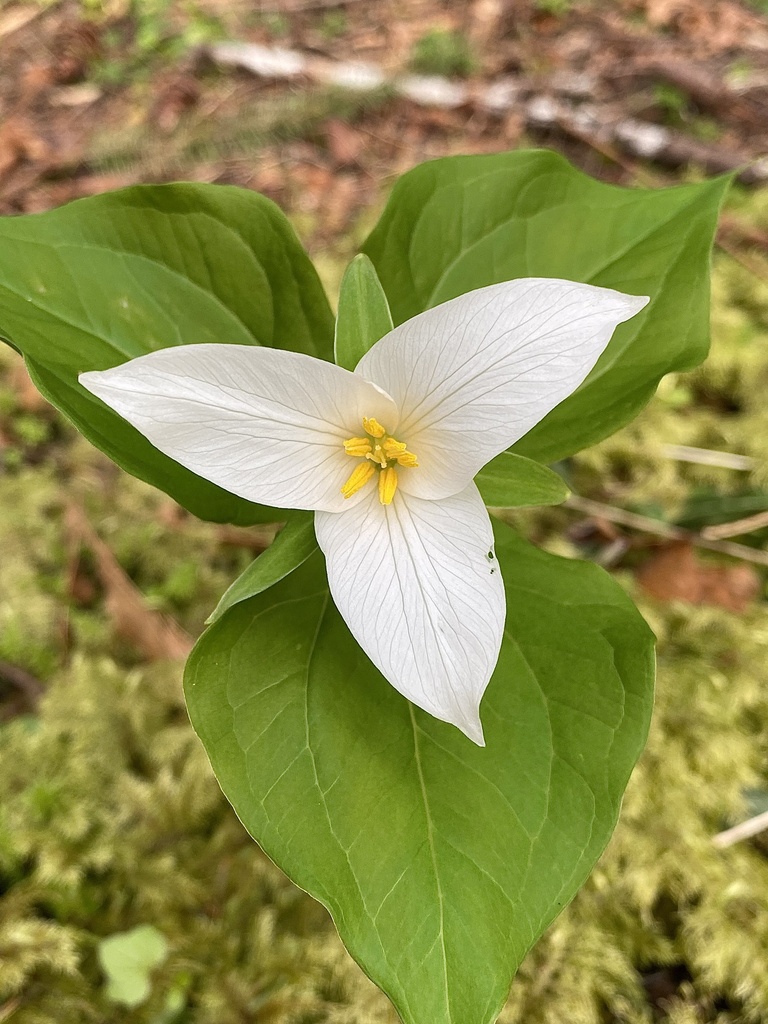
Pacific trillium
Trillium ovatum
Trillium ovatum, the Pacific trillium, western trillium, western wakerobin, or western white trillium, is a member of the Trilliaceae family, or sometimes included within the Liliaceae or Melanthiaceae. It occurs in parts of the western United States and western Canada, usually in rich forest. In the northern part of its range, which includes southern British Columbia, extreme southwestern Alberta, Washington, Oregon and east to Montana, Wyoming and northern Colorado, it often grows under Douglas-fir. Other trees...
From the article Trillium ovatum on Wikipedia (CC BY-SA), quoted section by section
Description
The most widespread of the western North American trilliums, Trillium ovatum varies greatly within its range. Despite this, T. ovatum closely resembles the eastern T. grandiflorum. Apart from geographic location, the two species are not easily distinguished. Trillium ovatum is a perennial herbaceous plant that spreads by means of underground rhizomes. At maturity, each plant has one or two flowering scapes, each 20 to 50 cm (8 to 19.5 in) in length. The specific epithet ovatum means "egg-shaped", which refers to the petals, not the leaves. The latter are generally ovate-rhombic, 7 to 12 cm (3 to 5 in) long by 5 to 20 cm (2 to 8 in) wide. The flower sits on a pedicel 2 to 6 cm (1 to 2.5 in) in length. The sepals are 15 to 50 mm (0.59 to 1.97 in) long and 6 to 20 mm (0.24 to 0.79 in) wide, while the petals are 15 to 70 mm (0.59 to 2.76 in) long and 10 to 40 mm (0.39 to 1.57 in) wide. Typically the flower opens white and becomes pink with age, but in the Smith River Canyon area of northern California and southern Oregon, the petals become almost barn-red.
Range & habitat
Trillium ovatum sensu lato is the most widespread and abundant trillium in western North America. It ranges from Monterey County in central California northward throughout the California Coast Ranges to Vancouver Island and southwestern British Columbia. It also occurs in the Rocky Mountains from southeastern British Columbia and the tip of southwestern Alberta, southward through Idaho, eastern Washington and northeastern Oregon, and southeastward through western Montana. There is a small, isolated population in northern Colorado and southern Wyoming. It is often found growing in coniferous and mixed coniferous-deciduous forests, in and around alder thickets and shrubs. Along the California coast, it is commonly found under coast redwood and mixed evergreen forest. At Lolo Pass, Montana, it grows under spruce and Douglas fir in ravines along mountain streams. It does not grow in the dry chaparral inland from the redwood and Douglas fir forests of California and Oregon, nor on ridges where the trees are sparse. Trillium ovatum var. oettingeri is endemic to a relatively small region in northwestern California. It occurs primarily in the Salmon Mountains, a subrange of the Klamath Mountains, in southwestern Siskiyou County, northern Trinity County, and northeastern Humboldt County. …
Wikipedia: “Distribution and habitat”
What it does
Flowers bloom late February in the southern part of its range, and in March or April elsewhere. Citizen science observations of flowering plants of this species peak during the first week of April. For comparison, when Trillium grandiflorum is fully open in eastern North America, T. ovatum is already fading in western North America. Apparently T. ovatum lacks sufficient winter hardiness to flourish east of the continental divide. The life-cycle stages of T. ovatum include a cotyledon stage, a one-leaf vegetative stage, a three-leaf vegetative (juvenile) stage, a three-leaf reproductive (flowering) stage, and a three-leaf nonflowering regressive stage. An example of the latter involves a transition from the three-leaf flowering stage to a three-leaf nonflowering regressive stage. Approximately one of every four reproductive plants regresses to a nonflowering state in any given year. Under the right conditions, individuals may undergo extended dormancy, that is, they may cease above-ground growth for one or more years. In western Montana, dormancy was observed in all adult stage classes, with most plants returning to above ground status in a year or two, although some plants exhibited dormancy for 3–5 years.
Wikipedia: “Ecology”
At the table
Trillium ovatum is occasionally cultivated outside its native range as far north as Sitka, Alaska. As a cultivated plant, it usually does not perform well since it lacks the winter hardiness of other garden plants.
Wikipedia: “Uses”
Where it lives
Recorded sightings
—
geo-referenced records in GBIF, from museums, herbaria and field observers.
Drag the globe to turn it. Dots are where records exist, not a range map; darker means more records.
In the stacks
Searching the stacks…
Every page naming Trillium ovatum in the Biodiversity Heritage Library →
This page is assembled live from iNaturalist, GBIF, Wikipedia, the Source Library and the Internet Archive. It is not yet part of the hand-edited codex. iNaturalist taxon 49463.