- Plants
- ›Vascular Plants
- ›flowering plants
- ›Dicots
- ›Mints, Plantains, Olives, and Allies
- ›broomrape family
- ›Pedicularideae
- ›Castilleja
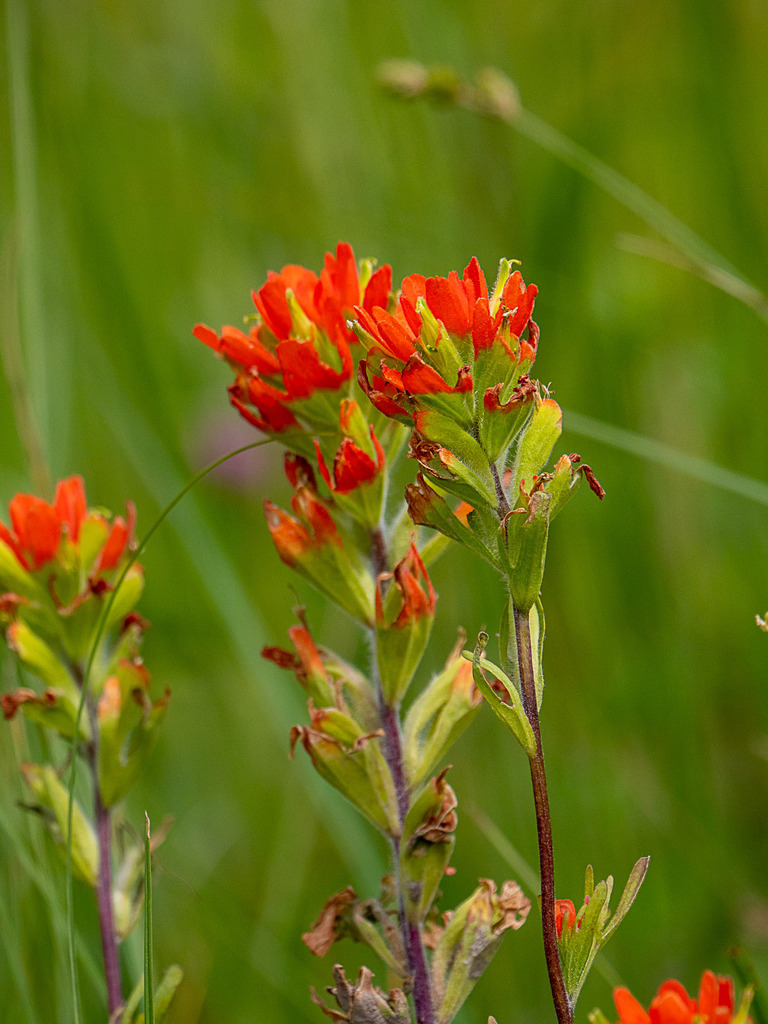
Painted-cup paintbrush
Castilleja coccinea
Castilleja coccinea, commonly known as scarlet paintbrush or scarlet painted-cup, is a biennial flowering plant in the Orobanchaceae (broomrape) family. It is usually found in prairies, rocky glades, moist and open woodlands, thickets, and along streams in central and eastern North America.
From the article Castilleja coccinea on Wikipedia (CC BY-SA), quoted section by section
Description
It is an upright, hairy, 1-to-7-decimeter (3.9 to 27.6 in) tall hemiparasitic plant. In its first year, the plant appears as a basal rosette, and in the second year the stem, usually unbranched, rises from the rosette. The basal leaves are oblong and mostly entire, and usually die before the flowers appear. The alternate stem leaves are deeply and irregularly lobed and measure up to 8 cm (3 in) long. The common names for this plant reflect the showy red bracts, inside of which is the actual greenish-yellow corolla ("flower"). Castilleja coccinea can be distinguished from other Castilleja of the southeastern US because it has a 2-to-3.5-millimeter (0.08 to 0.14 in) long, thin yellowish or orangish lip on the corolla, the inflorescence bracts are deeply lobed, and the basal rosettes of leaves are usually well-developed.
Range & habitat
C. coccinea is native throughout the central and eastern United States, from Oklahoma to the west, Florida to the south, Maine to the east, and the Canadian border to the north. It is listed as endangered in New York, Connecticut, and Maryland, It is critically imperiled in New Jersey, West Virginia, Kentucky, Georgia, Alabama, and Mississippi, presumed extirpated in Maine and new Hampshire, and possibly extirpated in Louisiana, Massachusetts, and Rhode Island. It is native in Canada in Saskatchewan, Manitoba, and Ontario, although it is critically imperiled in Saskatchewan. It is found in prairies, rocky glades, moist and open woodlands, thickets, and along streams.
Wikipedia: “Distribution and habitat”
What it does
C. coccinea have color polymorphism, which means that they can be yellow or scarlet in color, and this depends on the availability of pollinators such as bees. When pollinators are present, the scarlet C. coccinea tend to have a higher reproductive output, as they have higher seed and fruit set. On the other hand, the yellow C. coccinea would have a higher reproductive output when pollinators are scarce. Though it can survive on its own, studies indicate a forty-fold growth increase when its roots parasitize those of another plant for nutrients. It is primarily pollinated by ruby-throated hummingbirds who can transfer the pollen long distances between typically small and scattered populations of this plant.
Wikipedia: “Ecology”
In human culture
The genus name Castilleja is from the 18th-century Spanish botanist, Domingo Castillejo. The specific epithet coccinea is Latin for 'red'. It is similarly known by the common name scarlet paintbrush or scarlet Indian paintbrush, however other species such as Castilleja miniata are also known as this. (See: scarlet paintbrush for additional species) Like Castilleja miniata, it is occasionally known as red paintbrush. It is also simply called painted-cup. Regional names for the species include bloody warrior and bloody noses in Minnesota, election posies and wickackee in Massachusetts, fire pink and prairie-fire in Wisconsin, and nosebleed in Connecticut. It is also called wickaawee and wickawee, which is speculated to derive from an Algonquian word.
Wikipedia: “Etymology”
Where it lives
Recorded sightings
—
geo-referenced records in GBIF, from museums, herbaria and field observers.
Drag the globe to turn it. Dots are where records exist, not a range map; darker means more records.
In the stacks
Searching the stacks…
Every page naming Castilleja coccinea in the Biodiversity Heritage Library →
This page is assembled live from iNaturalist, GBIF, Wikipedia, the Source Library and the Internet Archive. It is not yet part of the hand-edited codex. iNaturalist taxon 49342.