- Plants
- ›Vascular Plants
- ›flowering plants
- ›Dicots
- ›Heathers, Balsams, Primroses, and Allies
- ›ocotillo family
- ›Fouquieria
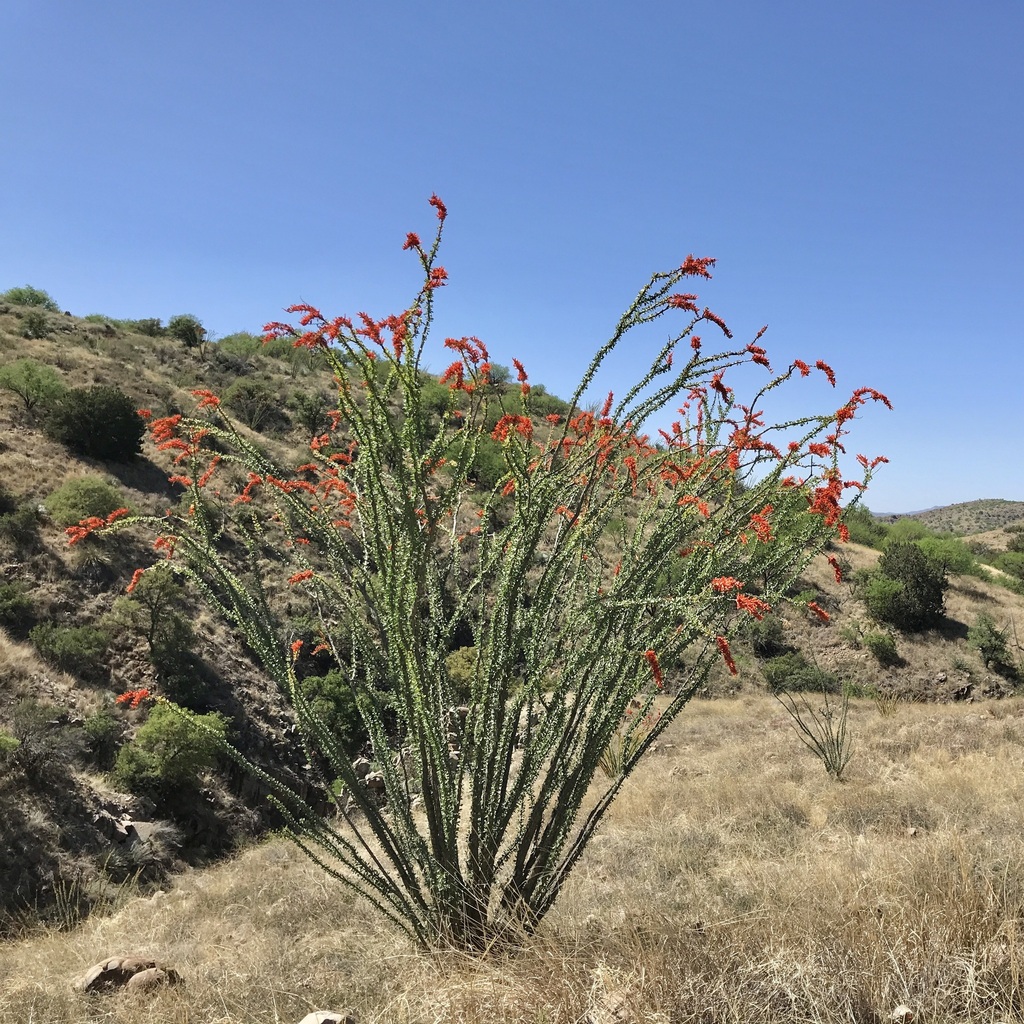
ocotillo
Fouquieria splendens
Fouquieria splendens, commonly known as ocotillo, is a plant indigenous to the Mojave, Sonoran, Chihuahuan and Colorado deserts in the Southwestern United States (southern California, southern Nevada, Arizona, New Mexico, Texas), and northern Mexico (as far south as Hidalgo and Guerrero).
Ocotillos look desiccated on the outside, but they are semi-succulent; it is more closely related to the tea plant and blueberries than to cactuses. It regenerates leaves after rainfall. They can be planted as garden ornamentals.
From the article Fouquieria splendens on Wikipedia (CC BY-SA), quoted section by section
At the table
Individual ocotillo stems are sometimes used as poles as a fencing material in their native region, and often take root to form a living fence. Due to their light weight and interesting pattern, ocotillo branches have been used for canes or walking sticks. Fresh flowers are sometimes used in salads and have a tangy flavor. Flowers are collected, dried, and used for tisanes. According to Medicinal Plants of the Desert and Canyon West (a book published in 1989 by Museum of New Mexico Press), a fresh bark tincture can be made by chopping or snipping freshly removed bark into 1/2-inch pieces. It is said to be useful for those symptoms that arise due to fluid congestion and to be absorbed from the intestines into the mesenteric lymph system by way of the lacteals of the small intestinal lining. This is believed to stimulate better visceral lymph drainage into the thoracic duct and improve dietary fat absorption into the lymph system. Bathing in water that contains crushed flowers or roots has been used to relieve fatigue. Native Americans place the flowers and roots of ocotillo over fresh wounds to slow bleeding. Ocotillo is also used to alleviate coughing, achy limbs, varicose veins, urinary tract infections, cervical varicosities, and benign prostate growths.
Wikipedia: “Uses”
How it is grown
Ocotillo can be planted year-round with care. Ideal plants have been grown in pots from stem cuttings and from seed. Transplanting large bare-root plants has marginal success. They should be planted to the original growing depth and, as with cacti, in their original directional orientation: the original south side of the plant, which has become more heat- and sunlight-resistant, should again face the brighter, hotter southern direction. If their direction is not marked, success is again limited.
Wikipedia: “Cultivation”
Where it lives
Recorded sightings
—
geo-referenced records in GBIF, from museums, herbaria and field observers.
Drag the globe to turn it. Dots are where records exist, not a range map; darker means more records.
In the stacks
Searching the stacks…
Every page naming Fouquieria splendens in the Biodiversity Heritage Library →
This page is assembled live from iNaturalist, GBIF, Wikipedia, the Source Library and the Internet Archive. It is not yet part of the hand-edited codex. iNaturalist taxon 49325.