- Plants
- ›Vascular Plants
- ›flowering plants
- ›Dicots
- ›carrots, ivies, and allies
- ›carrot family
- ›Saniculoideae
- ›Saniculeae
- ›Eryngium
- ›Eryngium
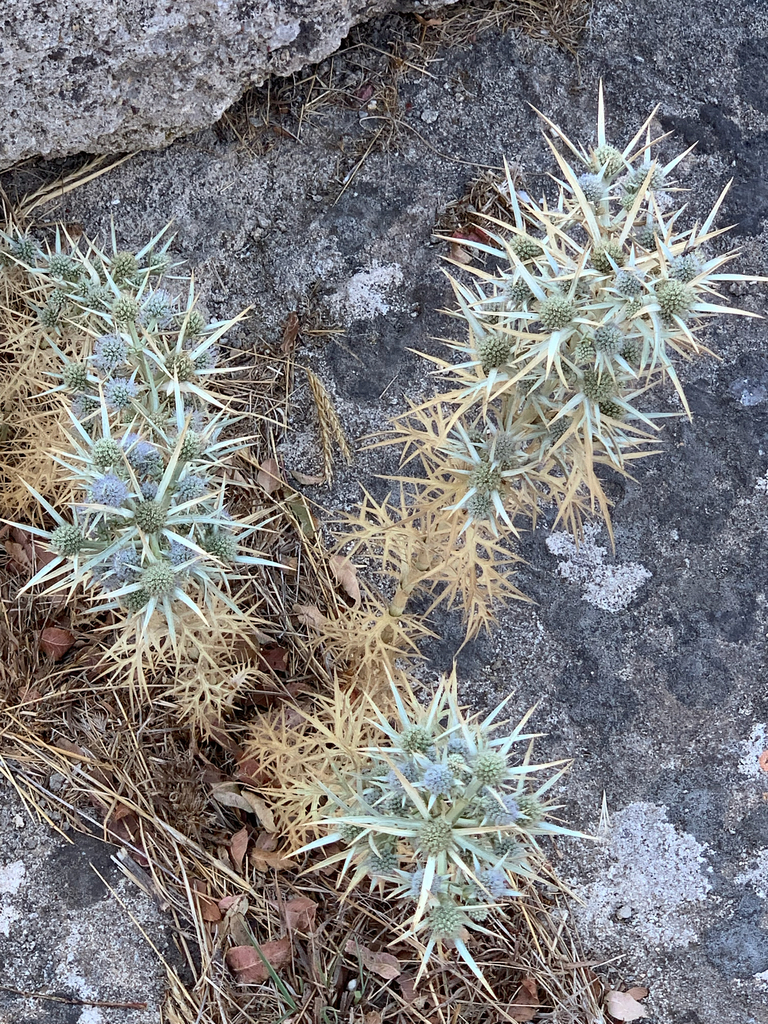
Ball Eryngo
Eryngium glomeratum
Eryngium glomeratum, the clustered eryngo or ball eryngo , in Turkish top boğadikeni , is a species of flowering plant in the family Apiaceae, native from Greece through to Saudi Arabia, and Tunisia .
From the article Eryngium glomeratum on Wikipedia (CC BY-SA), quoted section by section
Description
An Eryngo with numerous narrow tallish stems (to 60(100) cm) with many finely divided leaves, and a dense cylindrical presentation of flowerheads, the whole plant maturing greyish-green. Each flowerhead is surrounded by 5–6 slender spine-leaves, usually long, and within a head each small flower is attended by a small simple spine. It naturally grows in rocky places. It is allied to Eryngium amethystinum (Europe) and Eryngium desertorum (Syria). Due to the fine leaves, it might also be confused vegetatively with Eryngium kotschyi (Turkey) or the rare Eryngium babadaghense (SW Turkey).
Wikipedia: “Description and habitat”
Range & habitat
Eryngium glomeratum is native to Cyprus, East Aegean Island, Greece, Iraq, Crete, Lebanon-Syria, Palestine, Saudi Arabia, Sinai, Tunisia, and Turkey. In Turkey, it is found in the south and west coastal regions.
== References ==
Wikipedia: “Distribution”
Where it lives
Recorded sightings
—
geo-referenced records in GBIF, from museums, herbaria and field observers.
Drag the globe to turn it. Dots are where records exist, not a range map; darker means more records.
In the stacks
Searching the stacks…
Every page naming Eryngium glomeratum in the Biodiversity Heritage Library →
This page is assembled live from iNaturalist, GBIF, Wikipedia, the Source Library and the Internet Archive. It is not yet part of the hand-edited codex. iNaturalist taxon 492846.