- Plants
- ›Vascular Plants
- ›flowering plants
- ›Dicots
- ›beeches, oaks, walnuts, and allies
- ›beech family
- ›Castanea
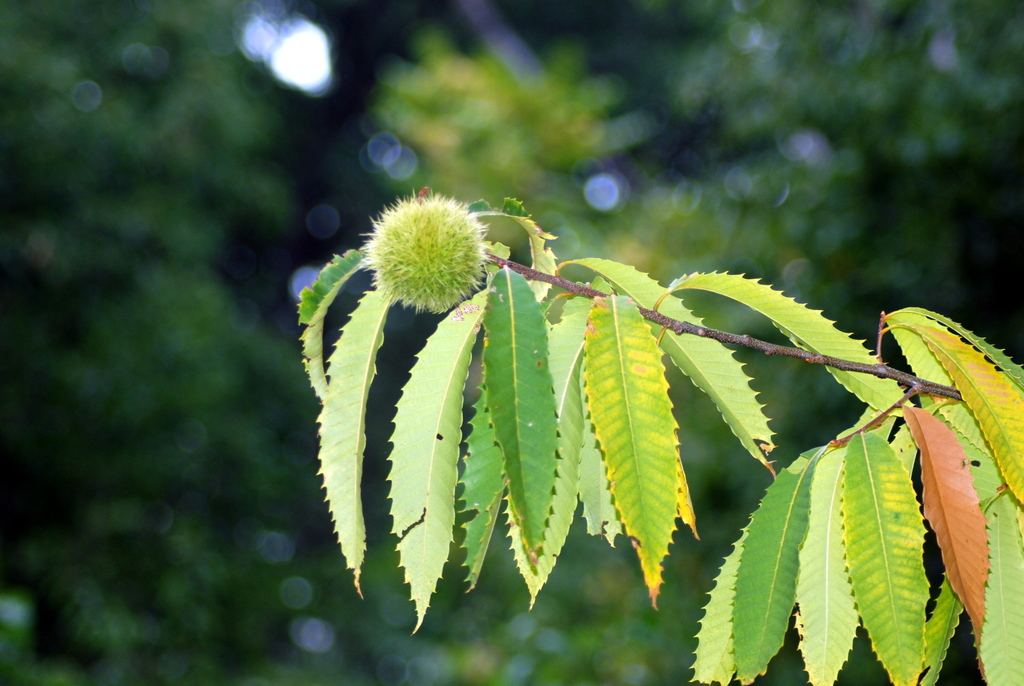
American chestnut
Castanea dentata
The American chestnut (Castanea dentata) is a large, fast-growing deciduous tree of the beech family native to eastern North America. As is true of all species in the genus Castanea, the American chestnut produces burred fruit with edible nuts. The American chestnut was once common in the Appalachian Mountain range and was a dominant species in the oak-chestnut forest region of its central and southern range.
During the early to mid-20th century, American chestnut trees were devastated by chestnut blight, a fungal disease that came from Japanese chestnut trees that were introduced into North America from Japan. It is estimated that the blight killed between three and four billion American chestnut trees in the first half of the 20th century, beginning in 1904. Four mature American chestnuts exist within its former range, although many stumps and root systems continue to send up saplings. Most of these saplings get infected by chestnut blight, which girdles and kills them before they attain maturity. There are hundreds of large (2 to 5 ft (0.6 to 1.5 m) in diameter) American chestnuts outside its historical range, some in areas where less virulent strains of the pathogen are more common, such as the 600 to 800 large trees in Northern Michigan. The species is listed as endangered in Canada under the Species at Risk Act. American chestnuts are also susceptible to ink disease, particularly in the southern part of its native range; this likely contributed to the devastation of the species.
From the article American chestnut on Wikipedia (CC BY-SA), quoted section by section
Description
Castanea dentata is a large, rapidly-growing, deciduous hardwood eudicot tree. A singular specimen manifest in Maine has attained a height of 115 feet (35 m). Pre-blight sources give a maximum height of 100 feet (30 m) and a maximum diameter of 13 feet (4.0 m). Post-blight sources erroneously report a greater maximum size of the species compared with pre-blight, likely the result of nostalgia, interpretations of pre-blight measurements of circumference as being measurements of diameter, and the misapprehension that pre-blight observations of maximum size represented observations of average size. It is considerably larger than the closely related Allegheny chinquapin (Castanea pumila). There are several other chestnut species, such as the European sweet chestnut (C. sativa), Chinese chestnut (C. mollissima), and Japanese chestnut (C. crenata). Castanea dentata can be distinguished by a few morphological traits, such as petiole length, nut size and number of nuts per burr, leaf shape, and leaf size, with leaves being 14–20 cm (5.5–8 in) long and 7–10 cm (3–4 in) broad—slightly shorter and broader than the sweet chestnut. It has larger and more widely spaced saw-teeth on the edges of its leaves, as indicated by the scientific name dentata, Latin for "toothed". The European sweet chestnut was introduced in the United States by Thomas Jefferson in 1773. …
What it does
Chestnuts are in the Fagaceae family along with beech and oak. Chestnuts are not closely related to the horse chestnut, which is in the family Sapindaceae. Phylogenetic analysis indicates a westward migration of extant Castanea species from Asia to Europe to North America, with the American chestnut more closely related to the Allegheny chinquapin (Castanea pumila v. pumila) than to European or Asian clades. The genomic range of chestnuts can be roughly divided into a clinal pattern of northeast, central, and southwest populations, with southwest populations showing greatest diversity, reflecting an evolutionary bottleneck likely caused by Quaternary glaciation. Two lineages of American chestnut have been identified, one a hybrid between the American chestnut and the Allegheny chinquapin from the southern Appalachians. The other lineage shows a gradual loss of genetic diversity along a northward vector, indicating possible expansion of range following the most recent glacial maximum during the Wisconsin glaciation. Ozark chinkapin (C. ozarkensis), which is typically considered either a distinct species or a subspecies of the Allegheny chinquapin (C. pumila subsp. ozarkensis), may be ancestral to both the American chestnut and the Allegheny chinquapin. A natural hybrid of C. dentata and C. …
Wikipedia: “Evolution and ecology”
At the table
The nuts were once an important economic resource in North America, being sold on the streets of towns and cities, as they sometimes still are during the Christmas season (usually said to be "roasting on an open fire" because their smell is readily identifiable many blocks away). Chestnuts are edible raw or roasted, though typically preferred roasted. One must peel the brown skin to access the yellowish-white edible portion. The nuts were commonly fed on by various types of wildlife and was also in such a high abundance that they were used to feed livestock by farmers, by allowing those livestock to roam freely into the forests that were predominantly filled with American chestnut trees. The tree was important to many Native American tribes in North America as it served as a food source, both for them and the wildlife they hunted, and also as a component in traditional medicine.
Wikipedia: “Food”
In human culture
In Washington Irving's 1819 short story, "The Legend of Sleepy Hollow," protagonist Ichabod Crane encounters the headless horseman along a road where "a group of oaks and chestnuts, matted thick with wild grape vines, threw a cavernous gloom over it." It was in this same grove, Irving reports, where the British spy, Major John André, was captured by Revolutionary forces. Nathaniel Hawthorne uses a chestnut "nutting" expedition as a narrative device in his collection of Greek myths, A Wonder-Book for Girls and Boys (1851). The protagonist, Cousin Eustace, describes the oaks that grow through the giant Atlas' toes as being "bigger than the great chestnut-tree which stands beyond Captain Smith's house." One of the young children, while listening to the tales, "had been sitting on a chestnut-burr, and was stuck as full as a pincushion of its prickles." The narrator encourages the children to gather more nuts: "Fill all your baskets ; and, at Christmas time, I will crack them for you, and tell you beautiful stories." One of the children comments that she would like the stories better "when there is nothing to do, than while there were nuts to be gathered, and beautiful weather to enjoy."
Wikipedia: “In popular culture”
Where it lives
Recorded sightings
—
geo-referenced records in GBIF, from museums, herbaria and field observers.
Drag the globe to turn it. Dots are where records exist, not a range map; darker means more records.
In the stacks
Searching the stacks…
Every page naming Castanea dentata in the Biodiversity Heritage Library →
This page is assembled live from iNaturalist, GBIF, Wikipedia, the Source Library and the Internet Archive. It is not yet part of the hand-edited codex. iNaturalist taxon 49186.