- Plants
- ›Vascular Plants
- ›flowering plants
- ›Dicots
- ›proteas, lotuses, planes, and allies
- ›Protea family
- ›Paired Proteas
- ›Embothrieae
- ›Hakeinae
- ›Grevillea
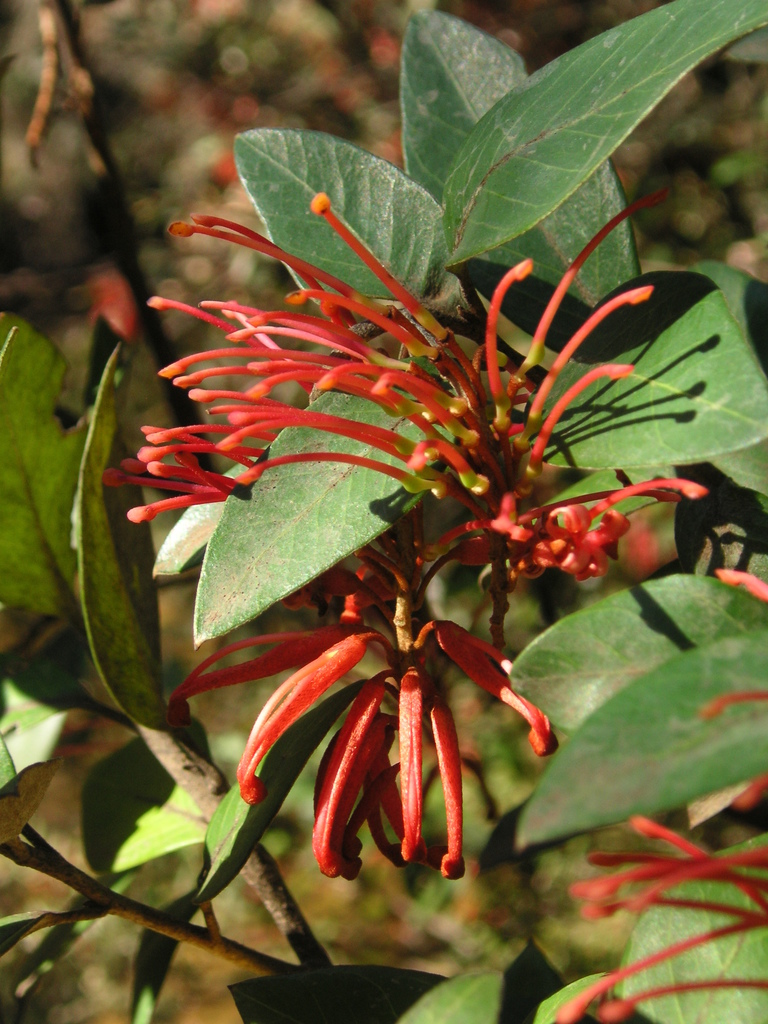
royal grevillea
Grevillea victoriae
Grevillea victoriae, also known as royal grevillea or mountain grevillea, is a species of flowering plant in the family Proteaceae and is endemic to mountainous regions of south-eastern continental Australia. It is an erect to spreading shrub with elliptic to lance-shaped leaves, and pendulous clusters of red to orange flowers.
From the article Grevillea victoriae on Wikipedia (CC BY-SA), quoted section by section
Description
Grevillea victoriae is an erect to spreading shrub that grows to a height of 0.2–4 m (7.9 in – 13 ft 1.5 in) and has more or less silky-hairy branchlets. Its leaves are elliptic or narrowly elliptic to lance-shaped, sometimes egg-shaped, 60–120 mm (2.4–4.7 in) long and 10–35 mm (0.39–1.38 in) wide. The upper surface of the leaves is more or less glabrous and the lower surface is densely silky- or woolly-hairy. The flowers are red to orange and arranged on the ends of the branches or in leaf axils in pendant, conical to loose, sometimes branched clusters on a rachis 20–90 mm (0.79–3.54 in) long, the pistil 17–26 mm (0.67–1.02 in) long. Flowering may occur in any month, but mainly from August to January in the absence of snow. The fruit is a glabrous follicle 17–20 mm (0.67–0.79 in) long.
Range & habitat
Grevillea victoriae occurs in rocky, mountainous areas of south-eastern Australia in forest, woodland and heath. Associated tree species include Eucalyptus pauciflora and Eucalyptus delegatensis. G. victoriae subsp. victoriae is found on some of Victoria's highest mountains including Mount Bogong, Mount Buffalo, Mount Buller, Mount Hotham, Mount Howitt, Mount St Bernard and Mount Torbreck. G. victoriae subsp. nivalis occurs in sub-alpine areas around Mount Kosciuszko and nearby ranges from Mount Gibbo and Mount Sassafras in the Victorian Alps northwards to Talbingo in New South Wales. In rare cases it may be seen above the treeline. G. victoriae subsp. brindabella occurs in the Brindabella Range on the border of New South Wales and the Australian Capital Territory.
Wikipedia: “Distribution and habitat”
What it does
Eastern spinebills and yellow-faced honeyeaters are known to feed on the nectar of Grevillea victoriae sensu lato. In Kosciuszko National Park, it has been noted that many bird species leave the area when Grevillea victoriae finishes flowering in January Taxa within the Grevillea victoriae complex are believed to be fire intolerant, regenerating from seed only.
Wikipedia: “Ecology”
How it is grown
Grevillea victoriae has a reputation for being hardy and reliable in cultivation, and has been successfully grown in all states of Australia, as well as New Zealand, the United States and Great Britain. Plants require a well-drained position with full-exposure to sun or partial shade and will benefit from pruning to maintain a more compact shape. Originating from mountainous regions, the species has a high tolerance to frost and snow. It is useful as a screening plant and to attract birds to the garden. In certain parts of North America, hummingbirds feed on the flowers of cultivated plants in the winter. Plants are easily propagated by seed or cuttings and have been successfully grafted on to Grevillea robusta rootstocks.
Cultivars. A number of hybrid cultivars involving Grevillea victoriae sensu lato have been developed including the following:
'Audrey' – G. juniperina x G. victoriae 'Bairnsdale' – selected seedling of G. 'Poorinda Constance' 'Canterbury Gold' – G. juniperina (prostrate yellow form) x G. victoriae var.leptoneura 'Glen Pearl' – G. victoriae x G. juniperina 'Lady O' – G. victoriae hybrid x G. rhyolitica 'Orange Box' – G. polychroma x G. juniperina subsp. juniperina 'Poorinda Constance' – New South Wales form of G. juniperina x red flower form of G. victoriae 'Poorinda Golden Lyre' – G. alpina x G. victoriae 'Poorinda Leane' – G. juniperina x G. …
Wikipedia: “Use in horticulture”
Where it lives
Recorded sightings
—
geo-referenced records in GBIF, from museums, herbaria and field observers.
Drag the globe to turn it. Dots are where records exist, not a range map; darker means more records.
In the stacks
Searching the stacks…
Every page naming Grevillea victoriae in the Biodiversity Heritage Library →
This page is assembled live from iNaturalist, GBIF, Wikipedia, the Source Library and the Internet Archive. It is not yet part of the hand-edited codex. iNaturalist taxon 491074.