- Plants
- ›Vascular Plants
- ›flowering plants
- ›Dicots
- ›beeches, oaks, walnuts, and allies
- ›beech family
- ›Quercus
- ›Quercus
- ›Virentes
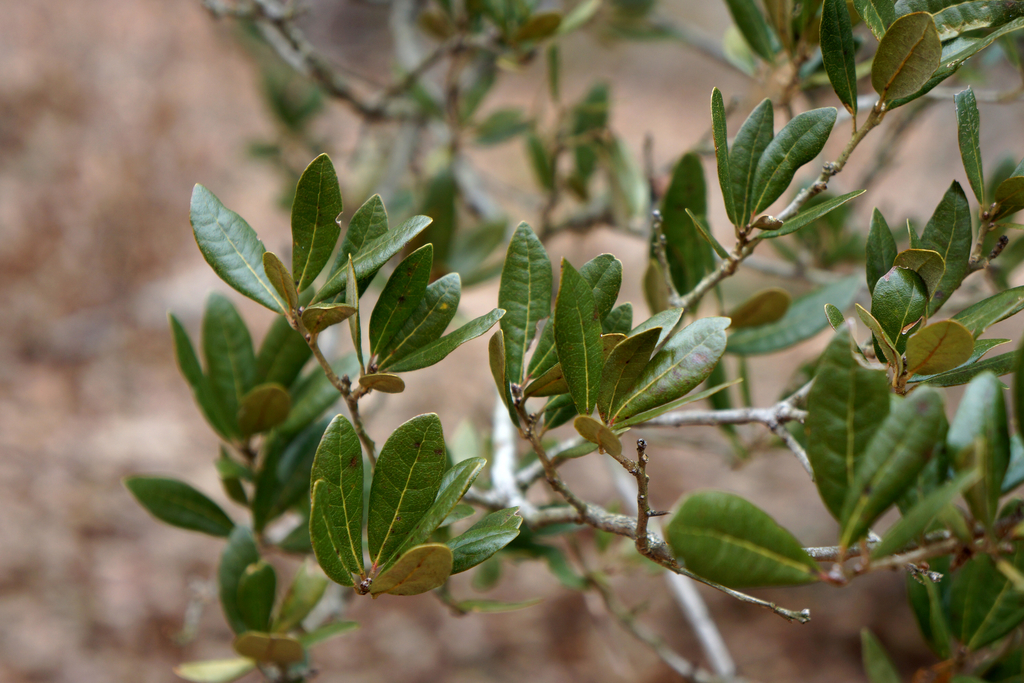
southern live oak
Quercus virginiana
Quercus virginiana, also known as the southern live oak, is an semi-evergreen oak tree native to the Southeastern United States Coastal Plain. Though many other species are loosely called live oak, the southern live oak is particularly iconic of the Old South. Many very large and old specimens of live oak can be found today in the Deep South region of the United States. Although it does not grow extremely high, it has a massive canopy: the greatest identified extant oak, in St. Tammany Parish, Louisiana, has only a 68 foot (20.7 m) tall trunk, but its arboreal cover spreads over a range of 139 feet (42.4 m).
From the article Quercus virginiana on Wikipedia (CC BY-SA), quoted section by section
Description
Although live oaks retain their leaves nearly year-round, they are not true evergreens. Live oaks drop their leaves immediately before new leaves emerge in the spring. Occasionally, senescing leaves may turn yellow or contain brown spots in the winter, leading to the mistaken belief that the tree has oak wilt, whose symptoms typically occur in the summer. A live oak's defoliation may occur sooner in marginal climates or in dry or cold winters. The bark is dark, thick, and furrowed longitudinally. The leaves are stiff and leathery, with the tops shiny dark green and the bottoms pale gray and very tightly tomentose, simple and typically flattish with bony-opaque margins, with a length of 2–15 centimetres (3⁄4–6 inches) and a width of 1–5 cm (3⁄8–2 in), borne alternately. The male flowers are green hanging catkins with lengths of 7.5–10 cm (3–4 in). The acorns are small, 1–2.5 cm (3⁄8–1 in), oblong in shape (ovoid or oblong-ellipsoid), shiny and tan-brown to nearly black, often black at the tips, and borne singly or in clusters.
Depending on the growing conditions, live oaks vary from a shrub-size to large and spreading tree-size: typical open-grown trees reach 20 m (66 ft) in height, with a limb spread of nearly 27 m (89 ft). Their lower limbs often sweep down towards the ground before curving up again. …
Range & habitat
Live oak can be found in the wild growing and reproducing on the lower coastal plain of the Gulf of Mexico and lower East Coast of the United States. Its native range begins in southeast Virginia, and then continues south in a narrow band through North Carolina along the coast to the interior South Carolina coast, where its range begins to expand farther inland. The range of live oak continues to expand inland as it moves south, growing across southern Georgia and covering all of Florida south to the northernmost Florida Keys. Live oak grows along the Florida panhandle to Mobile Bay, then westward across the southernmost two tiers of counties in Mississippi. Live oak grows across the southern third of Louisiana, except for some barrier islands and scattered parts of the most southern parishes. Live oak's range continues into Texas and narrows to hug the coast until just past Port Lavaca, Texas. There is a misconception that the southern live oak reaches its northwestern limit in the granite massifs and canyons in Southwestern Oklahoma. …
Wikipedia: “Distribution and habitat”
What it does
One source states that the southern live oak responds "with vigorous growth to plentiful moisture on well-drained soil." They tend to survive fire, because often a fire will not reach their crowns. Even if a tree is burned, its crowns and roots usually survive the fire and sprout vigorously. Furthermore, live oak forests discourage entry of fire from adjacent communities because they provide dense cover that discourages the growth of a flammable understory. They can withstand occasional floods and hurricanes, and are resistant to salt spray and moderate soil salinity. Although they grow best in well-drained sandy soils and loams, they will also grow in clay. The branches frequently support other plant species such as rounded clumps of ball moss (Tillandsia recurvata), thick drapings of Spanish moss (Tillandsia usneoides), resurrection fern (Pleopeltis polypodioides), and parasitic mistletoe.
Wikipedia: “Ecology”
At the table
Live oak wood is hard, heavy, and difficult to work with, but very strong. In the days of wooden ships, live oaks were the preferred source of the framework timbers of the ship, using the natural trunk and branch angles for their strength. The frame of USS Constitution was constructed from southern live oak wood harvested from St. Simons Island, Georgia, and the density of the wood grain allowed it to survive cannon fire, thus earning her the nickname "Old Ironsides". Even today, the U.S. Navy continues to own extensive live oak tracts. The primary uses for southern live oaks today are providing food and shelter for wildlife. Among the animals for which live oak acorns are an important food source are the bobwhite quail, the threatened Florida scrub jay, the wood duck, yellow-bellied sapsucker, wild turkey, black bear, various species of squirrel, and the white-tailed deer. The tree crown is very dense, making it valuable for shade, and the species provides nest sites for many mammal species. Native Americans extracted a cooking oil from the acorns, used all parts of live oak for medicinal purposes, leaves for making rugs, and bark for dyes. The roots of seedlings sometimes form starchy, edible tubers. …
Wikipedia: “Uses”
How it is grown
Southern live oak is cultivated in warmer climates as a specimen tree or for shade in the southern United States (zone 8 and south), Nuevo León and Tamaulipas states in Mexico, and in the warmer parts of the United States, Europe, and Australia. Cultivation is relatively simple, as southern live oak seedlings grow fast with ample soil moisture. Planting depth has little effect on the success of the tree. After a few years live oak needs only occasional supplemental water. Southern live oak is very long lived, and there are many specimens that are more than 400 years old in the deep southern United States. The southern live oak is reliably hardy to USDA Hardiness Zone 8a, which places its northern limit for long-term cultivation inland around Atlanta, Memphis, and Washington, D.C.
Wikipedia: “Cultivation”
In human culture
The tree is a powerful symbol of the southern United States, evoking steamy summers, with its expansive limbs wrapped in Spanish moss. Landscape designers in the region tend to plant it alongside roads and position it centrally in parks.
Wikipedia: “Cultural symbolism”
Where it lives
Recorded sightings
—
geo-referenced records in GBIF, from museums, herbaria and field observers.
Drag the globe to turn it. Dots are where records exist, not a range map; darker means more records.
In the stacks
Searching the stacks…
Every page naming Quercus virginiana in the Biodiversity Heritage Library →
This page is assembled live from iNaturalist, GBIF, Wikipedia, the Source Library and the Internet Archive. It is not yet part of the hand-edited codex. iNaturalist taxon 49013.