- Plants
- ›Vascular Plants
- ›flowering plants
- ›Dicots
- ›beeches, oaks, walnuts, and allies
- ›beech family
- ›Quercus
- ›Quercus
- ›Lobatae
- ›Coccineae
- ›Quercus shumardii
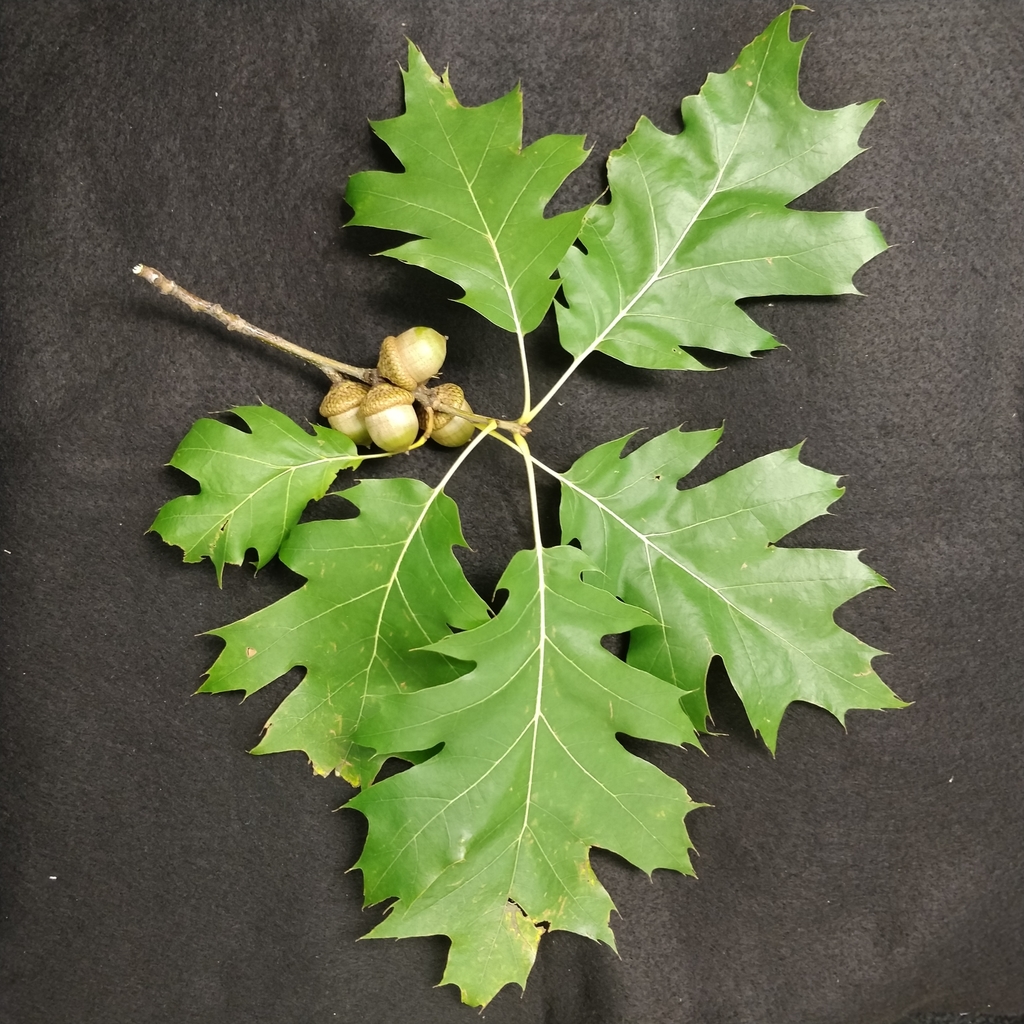
northern red oak
Quercus rubra
Quercus rubra, the northern red oak or common red oak, is an oak tree in the red oak group (Quercus section Lobatae). It is a native of North America, in the eastern and central United States and southeast and south-central Canada. It has been introduced to small areas in Western Europe, where it can frequently be seen cultivated in gardens and parks. It prefers good soil that is slightly acidic. Often simply called red oak, northern red oak is so named to distinguish it from southern red oak (Q. falcata), also known as the Spanish oak.
From the article Quercus rubra on Wikipedia (CC BY-SA), quoted section by section
Description
In many forests, Quercus rubra grows straight and tall, to 28 metres (92 feet), exceptionally to 43 m (141 ft) tall, with a trunk of up to 50–100 centimetres (20–39 inches) in diameter. Open-grown trees do not get as tall, but can develop a stouter trunk, up to 2 m (6+1⁄2 ft) in diameter. It has stout branches growing at right angles to the stem, forming a narrow round-topped head. Under optimal conditions and full sun, northern red oak is fast growing and a 10-year-old tree can be 5–6 m (16–20 ft) tall. Trees may live up to 400 years; a living example of 326 years was noted in 2001. Northern red oak is easy to recognize by its bark, which features ridges that appear to have shiny stripes down the center. A few other oaks have bark with this kind of appearance in the upper tree, but the northern red oak is the only tree with the striping all the way down the trunk. As with most other deciduous oaks, leafout takes place in spring when day length has reached 13 hours, tied entirely to the photoperiod regardless of air temperature. As a consequence (see below), in cooler regions, northern red oaks often lose their flowers to late spring frosts, resulting in no seed crop for the year. The catkins and leaves emerge at the same time. …
Range & habitat
The species grows from the north end of the Great Lakes, east to Nova Scotia, south as far as Georgia, Mississippi, Alabama, and Louisiana, and west to Oklahoma, Kansas, Nebraska, and Minnesota. It grows rapidly and is tolerant of many soils and varied situations, although it prefers the glacial drift and well-drained borders of streams. In the southeastern United States, it is frequently a part of the canopy in an oak-heath forest, but generally not as important as some other oaks. Northern red oak is the most common species of oak in the northeastern US after the closely related pin oak (Q. palustris). The red oak group as a whole are more abundant today than they were when European settlement of North America began as forest clearing and exploitation for lumber much reduced the population of the formerly dominant white oaks.
Wikipedia: “Distribution and habitat”
What it does
"Northern red oak (Quercus rubra L.) is monoecious, dichogamous, wind-pollinated, and self-incompatible". Pollination occurs in the first growing season, but fertilization and acorn maturation occur during the second growing season.
Wikipedia: “Reproduction”
At the table
The northern red oak is one of the most important oaks for timber production in North America. Quality red oak is of high value as lumber and veneer, while defective logs are used as firewood. Other related oaks are also cut and marketed as red oak, although their wood is not always of as high a quality. These include eastern black oak, scarlet oak, pin oak, Shumard oak, southern red oak and other species in the red oak group. Construction uses include flooring, veneer, interior trim, and furniture. It is also used for lumber, railroad ties, and fence posts. Red oak wood grain is so open that smoke can be blown through it from end-grain to end-grain on a flat-sawn board. For this reason, it is subject to moisture infiltration and is unsuitable for outdoor uses such as boatbuilding or exterior trim. The acorns can be collected in autumn, shelled, tied up in a cloth, and leached to remove bitterness. They can then be eaten whole or ground into meal.
Ornamental use. Quercus rubra is grown in parks and large gardens as a specimen tree. It is not planted as often as the closely related pin oak as it develops a taproot and quickly becomes difficult to transplant, however modern growing pots have made starting seedlings with taproots easier than in the past.
Wikipedia: “Cultivation and uses”
In human culture
It is the state tree of New Jersey and the provincial tree of Prince Edward Island.
Famous specimens. Ashford Oak – A very large Northern Red Oak in Ashford, Connecticut. The tree has suffered falling limbs because of its great age. However, this tree is still a sight to behold; the trunk is 8 m (26 ft) in circumference and the root-knees are also particularly impressive. The oak is located on Giant Oak Lane off U.S. Highway 44. There are several other large oaks in the area. Chase Creek Red Oak – This forest tree is located on a very rich steep slope in Anne Arundel County, Maryland. It is a high-stump coppice with three leads. It was the state champion oak in Maryland in 2002. The circumference at breast height is 6.7 m (22 ft 0 in), the height 41.5 m (136 ft 2 in) and the spread 29.9 m (98 ft 1 in) Shera-Blair Red Oak – This majestic red oak tree is located on Shelby Street in the South Frankfort neighborhood in Franklin County, Kentucky, and is the largest red oak tree in the oldest neighborhood in Frankfort, Kentucky. It is in the backyard of a house built in 1914 by architect Arthur Raymond Smith, who at one time worked for D.X. Murphy & Bros., famed architects that designed the twin spires at Churchill Downs. …
Wikipedia: “Culture”
Where it lives
Recorded sightings
—
geo-referenced records in GBIF, from museums, herbaria and field observers.
Drag the globe to turn it. Dots are where records exist, not a range map; darker means more records.
In the stacks
Searching the stacks…
Every page naming Quercus rubra in the Biodiversity Heritage Library →
This page is assembled live from iNaturalist, GBIF, Wikipedia, the Source Library and the Internet Archive. It is not yet part of the hand-edited codex. iNaturalist taxon 49005.