- Plants
- ›Vascular Plants
- ›flowering plants
- ›Dicots
- ›pinks, cactuses, and allies
- ›pink family
- ›Caryophylloideae
- ›Caryophylleae
- ›Dianthus
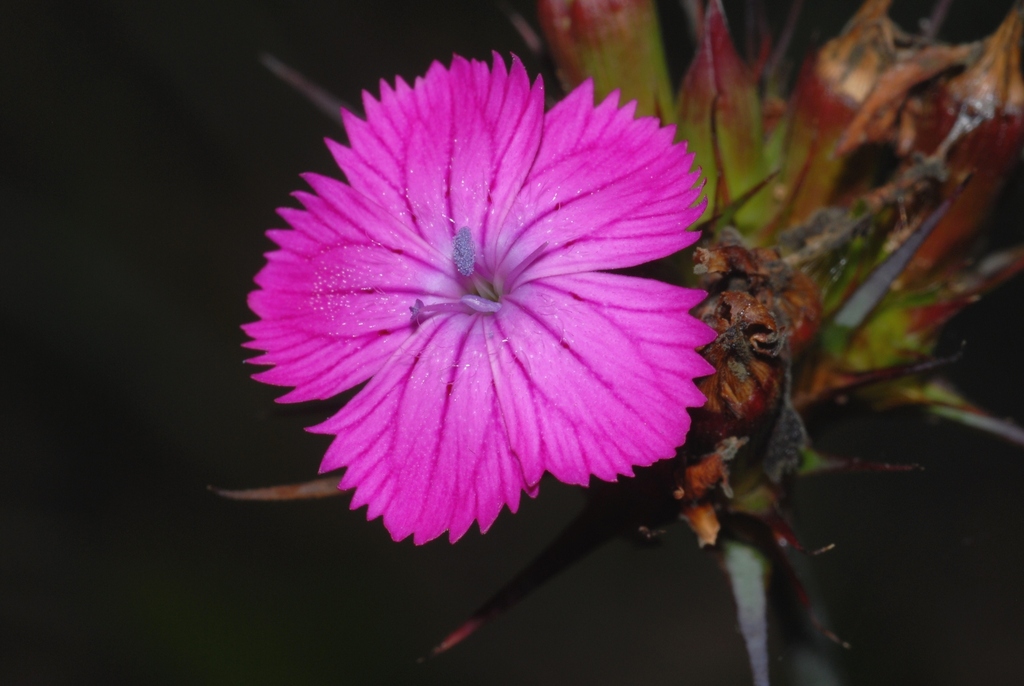
Balbis' Pink
Dianthus balbisii
Dianthus balbisii is a herbaceous perennial plant of the genus Dianthus belonging to the Caryophyllaceae family. The genus name Dianthus derives from the Greek words for divine ("dios") and flower ("anthos"), while the species name balbisii honors the Italian botanist Giovanni Battista Balbis (1765-1831).
From the article Dianthus balbisii on Wikipedia (CC BY-SA), quoted section by section
Description
Dianthus balbisii is a hemicryptophyte scapose plant reaching on average 20–50 centimetres (7.9–19.7 in) of height. The stem is erect and glabrous, the leaves are opposite, simple and linear. At the base of the cauline leaves a sheath embraces the stem. The epicalyx is formed by many leafy scales. The cylindrical tube of the calyx is green, deep purple-violet close to the 2 mm long teeth. The flowers are gathered into a dense cluster of 2–6 apical flowers in the axil of two bracts poorly differentiated from normal leaves. They have five pink-purplish petals, with frilled margins. The flowering period extends from June through September. The fruits are capsules with several seeds.
Range & habitat
This plant grows in dry meadows, woodlands and hillsides. It prefers bright and sunny areas, at an altitude of 0–1,400 metres (0–4,593 ft) above sea level.
Wikipedia: “Habitat”
Where it lives
Recorded sightings
—
geo-referenced records in GBIF, from museums, herbaria and field observers.
Drag the globe to turn it. Dots are where records exist, not a range map; darker means more records.
In the stacks
Searching the stacks…
Every page naming Dianthus balbisii in the Biodiversity Heritage Library →
This page is assembled live from iNaturalist, GBIF, Wikipedia, the Source Library and the Internet Archive. It is not yet part of the hand-edited codex. iNaturalist taxon 486111.