- Animals
- ›Molluscs
- ›Bivalves
- ›Autobranchia
- ›Heteroconchia
- ›Euheterodonta
- ›Imparidentia
- ›Venerids
- ›Veneroidea
- ›Venus Clams
- ›Venerinae
- ›Chamelea
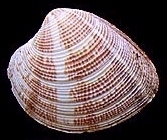
Striped Venus
Chamelea striatula
Chamelea striatula, the striped venus clam, is a marine bivalve mollusc of the family Veneridae which inhabits the northern shores of Europe.
From the article Chamelea striatula on Wikipedia (CC BY-SA), quoted section by section
Description
The valves of Chamelea striatula are robust and not very convex, with a beak which is prominently bent towards the shell's anterior and sits behind a clearly delimited lunula. The valves appear nearly triangular: The beak sits anterior to the center of the valve, and the dorsal margin behind it runs with a very slight curve all the way down to the lower margin of the shell, giving the posterior end a point. They commonly grow to about 3 cm in size. The ligament is inset, and both valves' hinges have three cardinal teeth but no lateral teeth. The pallial sinus is triangular and very small. The interior lower margin is finely crenelated and the outside of the shell is marked by many regular concentric ridges. Well preserved or live specimens typically have a pattern of darker rays or zigzags on a lighter background, and are cream coloured or brown with a lighter inside.
Range & habitat
The bivalve can be found from Norway to Morocco, and is known also from Madeira and the Canary Islands. Its range extends into the Mediterranean, where it coexists with the slightly larger common venus clam (Chamelea gallina). The two live sympatrically on the coast of Algarve, in the Gulf of Cádiz, the Strait of Gibraltar, and the Alboran Sea. Fossil valves are common in the North Sea, where they are likely not older than the Holocene or Pleistocene.
Wikipedia: “Distribution”
Where it lives
Recorded sightings
—
geo-referenced records in GBIF, from museums, herbaria and field observers.
Drag the globe to turn it. Dots are where records exist, not a range map; darker means more records.
In the stacks
Searching the stacks…
Every page naming Chamelea striatula in the Biodiversity Heritage Library →
This page is assembled live from iNaturalist, GBIF, Wikipedia, the Source Library and the Internet Archive. It is not yet part of the hand-edited codex. iNaturalist taxon 485806.