- Plants
- ›Vascular Plants
- ›flowering plants
- ›Dicots
- ›Soapberries, Cashews, Mahoganies, and Allies
- ›citrus family
- ›Zanthoxyloideae
- ›Zanthoxylum
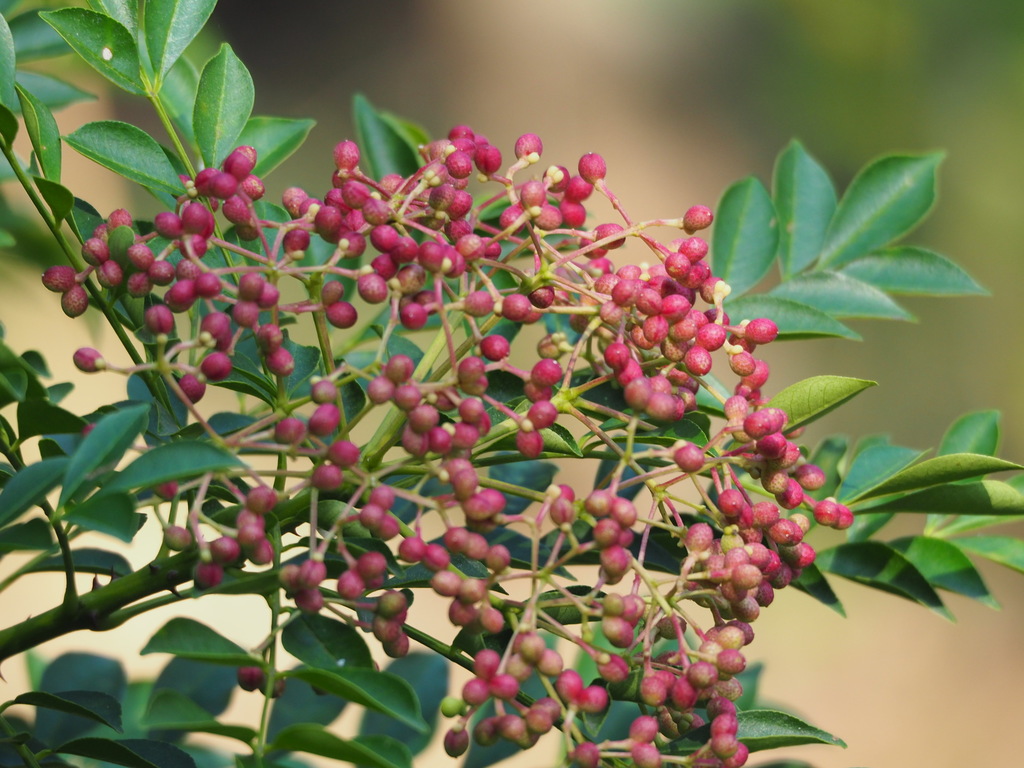
Chinese Wingleaf Prickly Ash
Zanthoxylum avicennae
Zanthoxylum avicennae is a woody plant in the family Rutaceae.
From the article Zanthoxylum avicennae on Wikipedia (CC BY-SA), quoted section by section
Description
Z. avicennae is a deciduous tree that reaches 15 meters (49 ft) high. The trunk has chicken-foot-like thorns, the thorn base is oblate and thickened, shaped like a bulge, and displays ring patterns. The leaflets of the seedlings are very small, but as many as 31, on the branches of young trees. The leaves are densely thorny, and each part is glabrous. The leaves have 11–21 leaflets that are usually opposite or occasionally irregularly opposite, obliquely ovoid, obliquely rectangular or sickle-shaped, and are sometimes obovate. Seedling leaflets are mostly broad-ovate, 2.5–7 cm (1.0–2.8 in) long, 1–3 cm (0.4–1.2 in) wide, short pointed or blunt at the top, asymmetrical on both sides. It has sparsely cracked teeth on the whole or above the middle. The oil spots on fresh leaves are visible, while some are not obvious on the ventral surface of the leaf shaft. The leaf edges are narrow and green, and often narrow wing-shaped. The inflorescence is terminal, with many flowers; the rachis and flowers are hard and sometimes purple-red. The male pedicel is 1–3 mm long. The sepals and petals are 5 mm. The sepals are broadly ovoid and green. The petals are yellow and white. The petals of the female flowers are slightly longer than those of the male flowers. …
Range & habitat
It is native to southern China's Fujian, Guangdong, Hainan, Guangxi, Macau, and Yunnan as well as Philippines, Northern Vietnam, and Taiwan. It is found in the area south of about 25° north latitude. It grows in low-altitude flat land, slope or valley and is more common in secondary forests.
Wikipedia: “Habitat”
In medicine
As a herbal medicine, it has the effects of expelling wind and dampness, promoting qi and resolving phlegm, and relieving pain. It can cure many types of pain and is also used as an ascaris repellent. The root water extract and alcohol extract have inhibitory effects on hemolytic streptococci and Staphylococcus aureus. The peel contains about 0.5% of essential oil; the leaf contains 0.3%. Main oils: terpinene, ylangene, α-pinene, etc. Root bark, stem bark and leaves contain alkaloids, including avicine, dihydroavicine, oxyavicine, nitidine, chelerythrine, magnoliflorine, δ-tembetarine, and candicine, as well as coumarins: avicennin, avicennol, diosmin and hesperidin. The leaves, root and fruit can be used for medicine. The taste is slightly bitter. It is slightly toxic. It can improve blood circulation and increase urination frequency.
== References ==
Wikipedia: “Traditional Chinese medicine”
Where it lives
Recorded sightings
—
geo-referenced records in GBIF, from museums, herbaria and field observers.
Drag the globe to turn it. Dots are where records exist, not a range map; darker means more records.
In the stacks
Searching the stacks…
Every page naming Zanthoxylum avicennae in the Biodiversity Heritage Library →
This page is assembled live from iNaturalist, GBIF, Wikipedia, the Source Library and the Internet Archive. It is not yet part of the hand-edited codex. iNaturalist taxon 484955.