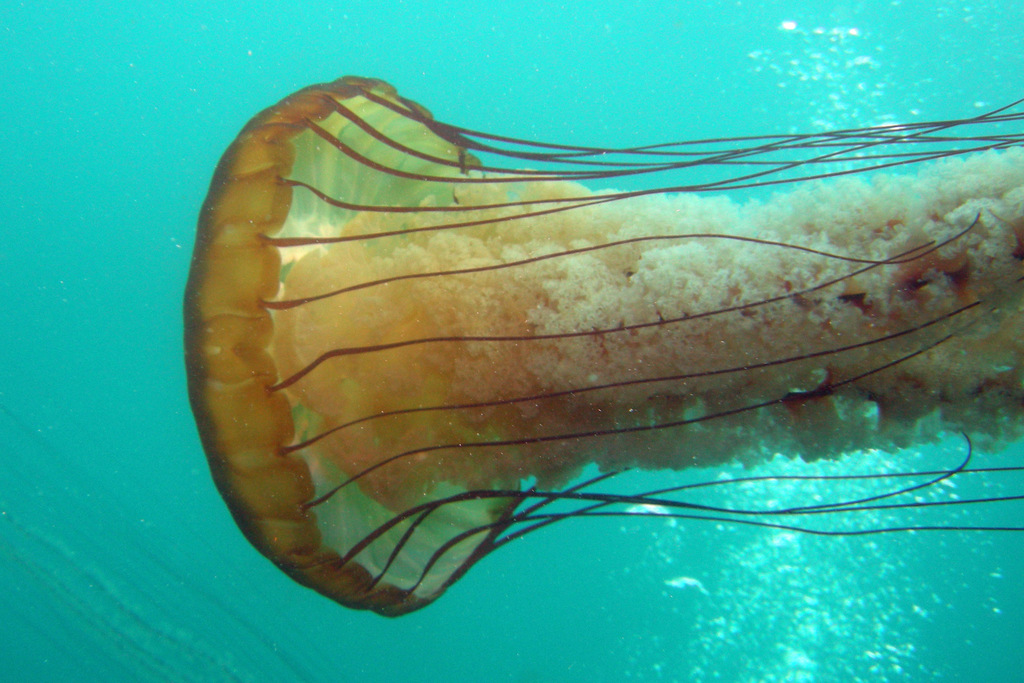
Pacific Sea Nettle
Chrysaora fuscescens
Chrysaora fuscescens, the Pacific sea nettle or West Coast sea nettle, is a widespread jellyfish that lives in the northeastern Pacific Ocean, in temperate to cooler waters off of British Columbia and the West Coast of the United States, ranging south to Mexico. The Pacific sea nettle earned its common name in-reference to its defensive, 'nettle'-like sting; much like the stinging nettle plant (Urtica dioica), the sea nettle's defensive sting is often irritating (possibly mildly painful) to humans, though rarely dangerous.
The Pacific sea nettle has a distinctive, golden-brown bell with a reddish tint. The bell can grow to be larger than one meter (3’) in diameter in the wild; however, most are less than 50 cm across. The long and spiraling, whitish oral arms (and 24 undulating, maroon tentacles) may trail behind the nettle as far as 15 feet (4.6 m).
From the article Chrysaora fuscescens on Wikipedia (CC BY-SA), quoted section by section
Range & habitat
Chrysaora fuscescens is commonly found along the coasts of southern British Columbia, Washington, Oregon and most of California to Baja California Sur, Mexico. Some sea nettles will range further north to the Gulf of Alaska, or west to Japan, and rarely into the Gulf of California. The populations reach their peak during the late summer. In recent years, C. fuscescens has become overly abundant off the coast of Oregon, which is thought to be an indicator of climate change. However, others suspect that the population is increasing because of human influences on coastal regions. Industrial runoff to the ocean, as well as agricultural waste and other forms of human pollution (such as fertilizer and chemical plants), add considerable amounts of nutrients to the water when dumped into the ocean. This then feeds microorganisms and helps to fuel algal blooms, which subsequently fuels the entire food chain and potentially provides the nettles with enough food to see a population increase.
Wikipedia: “Distribution and habitat”
What it does
In common with other cnidaria, Chrysaora fuscescens are carnivorous animals. They catch their prey via drift feeding by means of cnidocyst (or nematocyst) -laden tentacles that hang down in the water. The toxins in their nematocysts are effective against both their prey and humans, though it is typically nonlethal to the latter. Because C. fuscescens cannot chase after their prey, they must eat as they drift. By spreading out their tentacles like a large net, the sea nettle is able to catch food as it passes by. When prey come into contact with the tentacles, thousands of nematocysts discharge, launching barbed stingers that injects venom composed of various proteins, including proteases and pore forming toxins, which can disrupt cell membranes and tissues. The oral arms begin digestion as they transport the prey into the sea nettle's mouth. C. fuscescens feeds on a wide variety of zooplankton, crustaceans, salps, pelagic snails, as well as small fish, their eggs, and larvae, and other jellyfish. Copepods often dominate gut contents, prey selection analyses indicate a preference for slow moving or non-motile prey such as fish eggs, while more motile prey are selected against. Due to the growing population of C. fuscescens, they seem to be reducing fish populations and have become nuisances to the fishermen of Oregon by clogging up fishing nets. …
Wikipedia: “Feeding and predators”
Where it lives
Recorded sightings
—
geo-referenced records in GBIF, from museums, herbaria and field observers.
Drag the globe to turn it. Dots are where records exist, not a range map; darker means more records.
In the stacks
Searching the stacks…
Every page naming Chrysaora fuscescens in the Biodiversity Heritage Library →
This page is assembled live from iNaturalist, GBIF, Wikipedia, the Source Library and the Internet Archive. It is not yet part of the hand-edited codex. iNaturalist taxon 48479.