- Plants
- ›Vascular Plants
- ›flowering plants
- ›Dicots
- ›Heathers, Balsams, Primroses, and Allies
- ›heath family
- ›blueberries, cranberries, huckleberries, and allies
- ›Gaultherieae
- ›Gaultheria
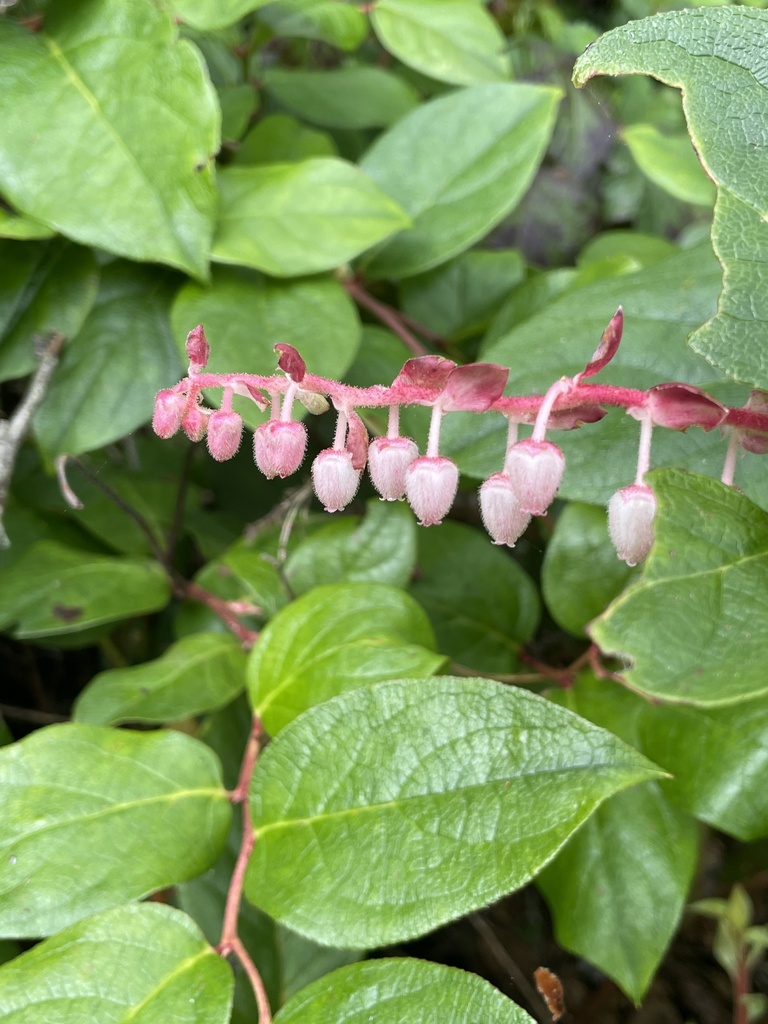
salal
Gaultheria shallon
Gaultheria shallon is a leathery-leaved shrub in the heather family (Ericaceae), native to western North America. In English, it is known as salal, shallon, or simply gaultheria in Britain.
From the article Gaultheria shallon on Wikipedia (CC BY-SA), quoted section by section
Description
Gaultheria shallon is 0.4 to 3.05 metres (1+1⁄2 to 10 feet) tall, sprawling to erect. It is loosely to densely branched and often forms dense, nearly impenetrable thickets. The twigs are reddish-brown, with shredding bark. Twigs can live up to 16 years or more, but bear leaves only the first few years. The leaves are alternate, evergreen, leathery, thick and egg shaped. They are shiny and dark green on the upper surface, and rough and lighter green on the lower. Each finely and sharply serrate leaf is 5 to 10 centimetres (2 to 4 inches) long. Each leaf generally lives for 2 to 4 years before it is replaced. The inflorescence of flowers consists of a bracteate raceme, one-sided, with 5–15 flowers at the ends of branches. Each flower is composed of a deeply five-parted, glandular-haired calyx and an urn-shaped pink to white, glandular to hairy, five-lobed petals (corolla), 7 to 10 millimetres (1⁄4 to 3⁄8 in) long. The fruit is reddish to blue, rough-surfaced, covered in tiny hairs, nearly spherical and 6 to 10 mm in diameter. The fruits are 'pseudoberries', or capsules made up of a fleshy outer calyx, and each fruit contains an average of 126 brown, reticulate seeds approximately 0.1 mm in length. These berries are also edible.
Range & habitat
Salal is found in Southeast Alaska, British Columbia, Washington and Oregon and along much of the California coast. It grows as far north as Baranof Island, Alaska. Western poison oak is a common associate in the California Coast Ranges.
In Europe. The species was introduced to Britain in 1828 by David Douglas, who intended the plant to be used as an ornamental. It is believed to have been planted as cover for pheasants on shooting estates.
Wikipedia: “Distribution”
What it does
Salal is adapted to a fire regime of infrequent fires, from intervals of 50 to 500+ years. Although aboveground portions of the plant may be consumed, rhizomes in the soil will survive and resprout after light to moderate fires. Severe fires on dry, shallow soil will penetrate into the roots and kill the plant.
Wikipedia: “Fire ecology”
At the table
The dark blue berries and young leaves are edible and efficient appetite suppressants, both with a unique flavor. The berries were a significant food resource for some Native American tribes, who ate them fresh and dried them into cakes. They were also used as a sweetener, and the Haida used them to thicken salmon eggs. The leaves of the plant were also sometimes used to flavor fish soup. More recently, the berries are used locally in jams, preserves, and pies. They are often combined with Oregon-grape because salal's mild sweetness partially masks the former's tartness. Salal is widely cultivated as an ornamental both within and outside of its native range, useful for ground cover and landscaping. In the Pacific Northwest, the harvesting of G. shallon is the heart of a large industry which supplies cut evergreens worldwide for use in floral arrangements. It is used in native plant gardens and sold as "Lemon Leaf".
Medicinal properties. The species has been used for its medicinal properties by local natives for generations, although its medicinal uses are not widely known. The leaves have an astringent effect, making it an effective anti-inflammatory and anti-cramping herb. …
Wikipedia: “Uses”
In human culture
Lewis and Clark reported the local Chinook Jargon name of the omnipresent evergreen shrub to be shallon, shelwel, or shellwell, but when Scottish naturalist David Douglas arrived at Fort George in April 1825 he noted that it was not called shallon but rather salal or sallal. The genus Gaultheria was named by Pehr Kalm for his guide in Canada, fellow botanist Jean François Gaultier. In the Squamish language, the fruits are called t’áḵa7 and the bush is called t’áḵa7áy̓. In the Saanich dialect, salal berries are called DAḴE In the Lushootseed language, the month of August is named pədt̕aqaʔ, literally 'time of the salal.'
Wikipedia: “Etymology”
Where it lives
Recorded sightings
—
geo-referenced records in GBIF, from museums, herbaria and field observers.
Drag the globe to turn it. Dots are where records exist, not a range map; darker means more records.
In the stacks
Searching the stacks…
Every page naming Gaultheria shallon in the Biodiversity Heritage Library →
This page is assembled live from iNaturalist, GBIF, Wikipedia, the Source Library and the Internet Archive. It is not yet part of the hand-edited codex. iNaturalist taxon 48441.