 NL·0518
Herbarium of the Nature Library
- Name
- Limulus polyphemus
- Family
- Limulidae
- Native to
- Atlantic coast of North America from Maine to the Gulf of Mexico and Yucatán; largest spawning in Delaware Bay
- Habitat
- Estuaries, Sandy beach, Continental shelf
Atlantic horseshoe crab
Limulus polyphemus
Also calledCangrejo herradura (Spanish) · Límulo (Spanish/Portuguese) · Měizhōu hòu 美洲鲎 (Chinese) · Limule (French)
Not a crab at all but a relative of spiders and scorpions, from a lineage whose body plan has changed little for over 400 million years. Its blue blood is used to test vaccines and medical equipment for bacterial contamination.
The Atlantic horseshoe crab, also known as the American horseshoe crab, is a species of horseshoe crab, a kind of marine and brackish chelicerate arthropod. It is found in the Gulf of Mexico and along the Atlantic coast of North America. The main area of annual migration is Delaware Bay along the South Jersey Delaware Bayshore. Wikipedia
What it can do
- iBlood cells (amoebocytes) clot instantly around bacterial endotoxins, the basis of the LAL test
- iiHas ten eyes, including large compound eyes that become a million times more sensitive to light at night
- iiiRights itself with its long tail (telson) when flipped over
- ivMass spawning on spring high tides gives migrating shorebirds such as red knots a key food source
In the field
Field marks
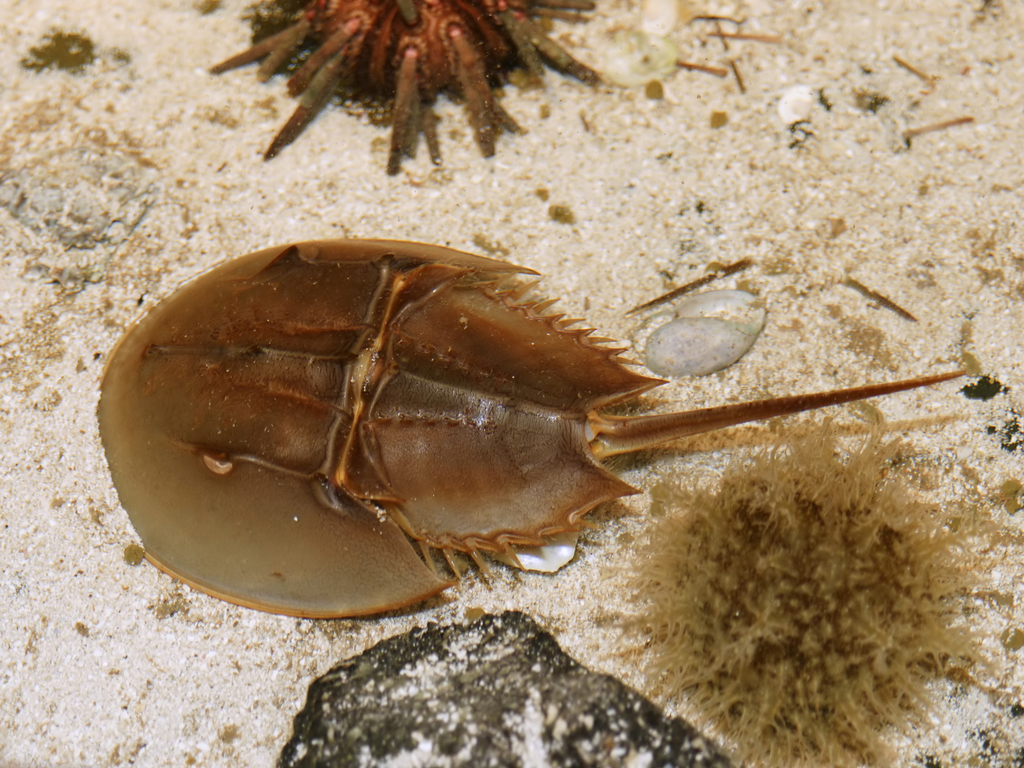
- aRounded, horseshoe-shaped shell
- bLong, spike-like tail (telson)
- cBrown-green colour
- dSpawns in crowds on beaches
- Where to see it
- Delaware Bay beaches, e.g. Reeds Beach (New Jersey) and Slaughter Beach (Delaware)
- When
- Spawning May–Jun, on high tides near new and full moons
Life & habits
- Diet
- Clams, worms, small crustaceans and other bottom invertebrates
- Habitat
- Shallow coastal waters and estuaries; spawns on sandy beaches
- Size
- Females up to ~60 cm long including tail; males smaller
- Lifespan
- 20+ years
On spring nights near new and full moons, females crawl ashore at high tide to lay thousands of eggs, with males clinging behind.
In the medicine cabinet
| Tradition | Use |
|---|---|
| Modern biomedicine | Limulus amebocyte lysate (LAL) from the blood detects bacterial endotoxins in vaccines, injectable drugs and implants |
Weight of evidence
Strong. An approved drug, or consistent results in well-run clinical trials.
Active compounds
Factor C, coagulogen, haemocyanin
Where it lives
Recorded sightings
—
geo-referenced records in GBIF, from museums, herbaria and field observers.
Native range
Atlantic coast of North America from Maine to the Gulf of Mexico and Yucatán; largest spawning in Delaware Bay
Drag the globe to turn it. Dots are where records exist, not a range map; darker means more records.
In the old herbals & bestiaries
Woodcuts and engravings matched from the Source Library’s scanned books by name. Plates marked “relative” show a close kin rather than this exact species. Click a plate to read the page it came from, with translation.


In the stacks
Searching the stacks…
Every page naming Limulus polyphemus in the Biodiversity Heritage Library →
Marginalia
Coastal Indigenous peoples used the shells to bail canoes and the tails as spear tips, and colonial farmers ground millions of horseshoe crabs into fertiliser. Frederik Bang's discovery in the 1950s that its blood clots on contact with bacteria led to the LAL test.
Curiosity
Studies of its large optic nerves helped H. Keffer Hartline win the 1967 Nobel Prize for discoveries about how eyes process images.
Kinship



Photographs: iNaturalist contributors under the licences shown. Records: GBIF.org. Historical plates: Source Library (CC BY-SA 4.0; originals public domain). Summary text: Nature Library editors and Wikipedia (CC BY-SA). Medicinal and edibility notes are historical and educational, not advice. iNaturalist taxon 48302.