- Plants
- ›Vascular Plants
- ›flowering plants
- ›Dicots
- ›Buttercups, Poppies, and Allies
- ›buttercup family
- ›Columbines and Meadow-Rues
- ›Aquilegia
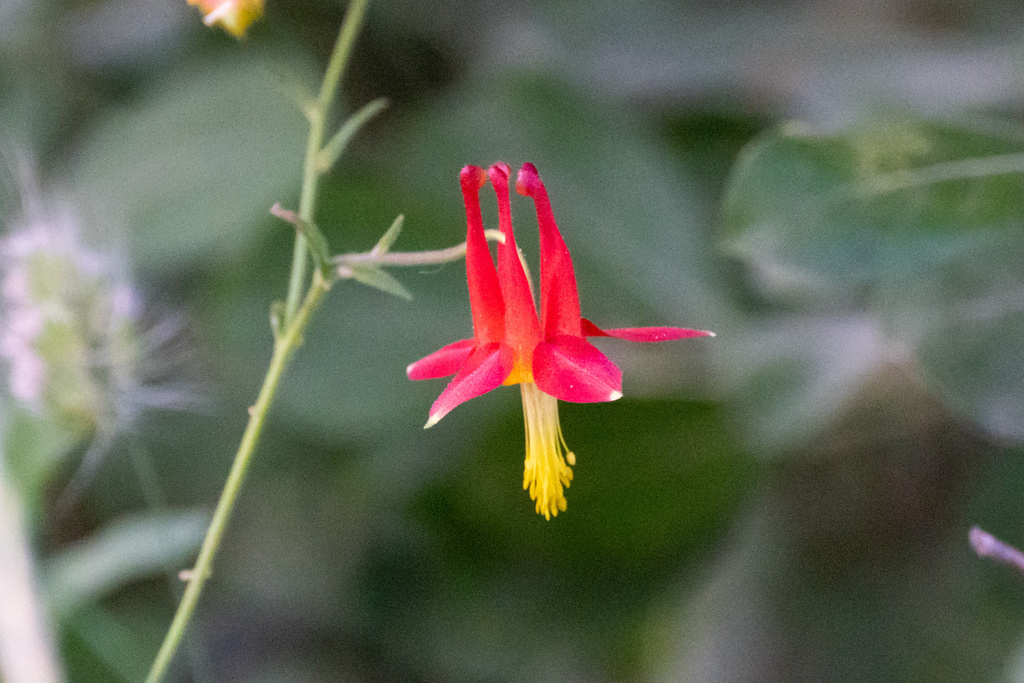
western columbine
Aquilegia formosa
Aquilegia formosa, the crimson columbine, western columbine, sitka columbine, or (ambiguously) "red columbine", is a common wildflower native to western North America, from Alaska to Baja California, and eastward to Montana and Wyoming.
From the article Aquilegia formosa on Wikipedia (CC BY-SA), quoted section by section
Description
Aquilegia formosa is a perennial herb that grows to 20–80 cm in height, averaging around 60 cm. Flowers, which can be seen from April to August (with some variation between regions), are about 5 cm long and red and yellow in color. The sepals and petal spurs are typically a reddish-orange color, attributed to the anthocyanin pigments pelargonidin and cyanidin, and carotenoids. Petal blades are yellow, pigmented by carotenoids. The primary pollinators are hummingbirds, although bees, butterflies, and flies will also visit flowers. Despite several floral adaptations to hummingbird pollination, at ~9,000-10,000 feet in elevation in the eastern drainages of the central Sierra Nevada mountains of California, A. formosa forms hybrid zones with Aquilegia pubescens, which is primarily pollinated by hawk moths. The flowers are edible, with a sweet taste—though the seeds can be fatal if eaten, and most parts of the plant contain cyanogenic glycosides.
Range & habitat
Within its range, the crimson columbine can be found in most kinds of habitat (chaparral, oak woodland, mixed-evergreen or coniferous forest). It is not found on desert floors, nor at altitudes above 3300 metres, and it is absent from the Central Valley of California. It prefers moist locations such as stream banks.
Wikipedia: “Distribution”
In human culture
Aquilegia is derived from the Latin word 'aquila', meaning 'eagle', or possibly from the Medieval German words 'Acheleia' or 'Akelei'; this name is in reference to its talon-like nectaries. Formosa means 'handsome', 'beautiful', or 'well-formed'.
Wikipedia: “Etymology”
Where it lives
Recorded sightings
—
geo-referenced records in GBIF, from museums, herbaria and field observers.
Drag the globe to turn it. Dots are where records exist, not a range map; darker means more records.
In the stacks
Searching the stacks…
Every page naming Aquilegia formosa in the Biodiversity Heritage Library →
This page is assembled live from iNaturalist, GBIF, Wikipedia, the Source Library and the Internet Archive. It is not yet part of the hand-edited codex. iNaturalist taxon 48244.