- Plants
- ›Vascular Plants
- ›flowering plants
- ›Dicots
- ›Soapberries, Cashews, Mahoganies, and Allies
- ›soapberry family
- ›Acer
- ›Acer
- ›Acer saccharum
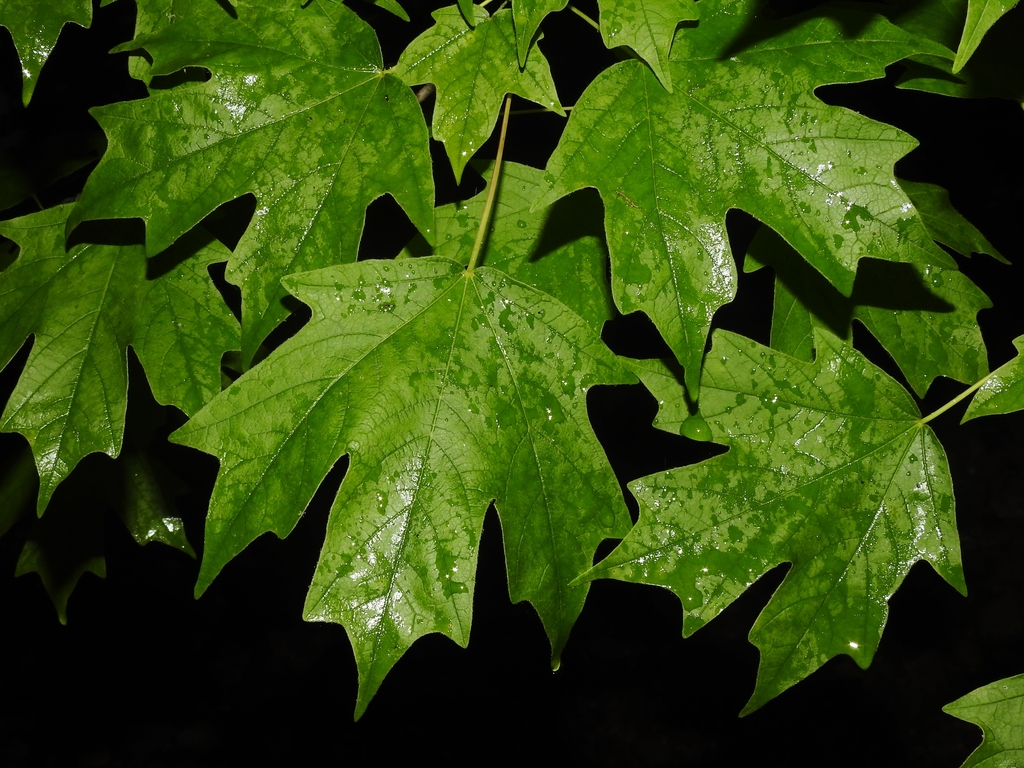
southern sugar maple
Acer floridanum
Acer floridanum (syn. Acer saccharum subsp. floridanum (Chapm.) Desmarais, Acer barbatum auct. non Michx.), commonly known as the Florida maple and occasionally as the southern sugar maple or hammock maple, is a tree that occurs in mesic and usually calcareous woodlands of the Atlantic and Gulf coastal plain in the United States, from southeastern Virginia in the north, south to central Florida, and west to Oklahoma and Texas and also common in south Illinois and Missouri
From the article Acer floridanum on Wikipedia (CC BY-SA), quoted section by section
Description
It is a medium-sized to large deciduous tree, growing to 15–25 m tall—exceptionally to 38 m—with an elliptical crown of moderate density with a smooth or rounded outline. The bark is a light gray with thick irregular curling ridges; as the tree matures, the bark tends to become plated. The twigs are slender, somewhat shiny, reddish brown. The terminal buds are sharply pointed, brown and pubescent. The leaves are opposite, simple, palmately lobed and veined, 3–9.5 cm long and 3.5–11 cm broad, with an entire margin and three or five somewhat rounded lobes, and a 2–8 cm long petiole. They are green above and paler and pubescent below. In fall they turn orange and yellow. The flowers are regular, pentamerous, and appear on yellow-green corymbs and are quite small. They hang from puberulent pedicels 2.4–5 cm long in clusters of a few flowers, appearing before or with the leaves in early spring. This is about two weeks prior to the maturation of the flowers of Acer saccharum. The tree is generally diecious, though they are often also polygamous, that is having bisexual and unisexual flowers on the same individual. The fruit is a paired samara 1.5–3 cm long. Acer floridanum can easily be confused in the field with the closely related Acer leucoderme and Acer saccharum. It can be best distinguished from A. …
Range & habitat
The distribution is discontinuous in the Piedmont and Atlantic Coastal Plain from southeastern Virginia southwest across North Carolina, South Carolina and Georgia, as well as into the Florida Panhandle. The range goes farther west across Alabama, Mississippi, Louisiana, into eastern Texas, and north through Arkansas and into eastern Oklahoma. The species also occurs in several isolated locations roughly halfway down the Gulf Coast of the Florida peninsula, and also in at least one location in central Oklahoma. The species is also found in isolated locations of Illinois, Missouri, Tennessee and Kentucky. The average annual rainfall within the native area ranges from 112 to 163 cm (44 to 64 in). The driest months average no less than 50 mm (2.0 in). The normal temperatures in January within the range vary from 11 to 18 °C (52 to 64 °F) maximum, and from −2 to 7 °C (28 to 45 °F) minimum, whereas in July normal maxima are 29 to 33 °C (84 to 91 °F), and minima are 21 to 24 °C (70 to 75 °F). The tree favours moist, but well-drained fertile soils, especially on stream terrace, in coves, and on adjacent bluffs and ridgetops. It grows best on soils containing calcareous material such as limestone or marl. It also grows well on the densely forested hammocks of Florida, hence its alternative common name hammock maple. It is most often confined to the understory.
Wikipedia: “Distribution and ecology”
At the table
While not an overwhelmingly popular tree in cultivation, it is sometimes employed in the Southern United States as a shade tree due to its round crown and its greater resistance to heat than that of its more showy relative the sugar maple. Several species of birds and especially squirrels make use of the tree as a nesting site and also consume its seeds as a food source. Despite the fact that of itself Florida maple is not employed as a commercial timber species, it is used with associated commercial species when the products are pulpwood, sawtimber, or wood veneer stock. It is considered a hard maple and as high quality individuals are suitable for producing furniture, flooring, paneling, and shoe lasts. However, its relative scarcity, small size, and fairly poor shape generally confine its use to only factory and box lumber, and even this is only an occasional occurrence. It has, however, been experiencing growing popularity as an ornamental or shade tree, especially in the Southern United States due to its high heat resistance. It is also a source of maple syrup, though again its size and rarity limit its use in this regard, especially in light of the sugar maple's established popularity within the business.
Wikipedia: “Cultivation and uses”
Where it lives
Recorded sightings
—
geo-referenced records in GBIF, from museums, herbaria and field observers.
Drag the globe to turn it. Dots are where records exist, not a range map; darker means more records.
In the stacks
Searching the stacks…
Every page naming Acer floridanum in the Biodiversity Heritage Library →
This page is assembled live from iNaturalist, GBIF, Wikipedia, the Source Library and the Internet Archive. It is not yet part of the hand-edited codex. iNaturalist taxon 48079.