- Animals
- ›Chordates
- ›Vertebrates
- ›Cartilaginous Fishes
- ›Sharks and Rays
- ›Sharks
- ›Galean Sharks
- ›Ground Sharks
- ›Hammerhead and Winghead Sharks
- ›Eusphyra
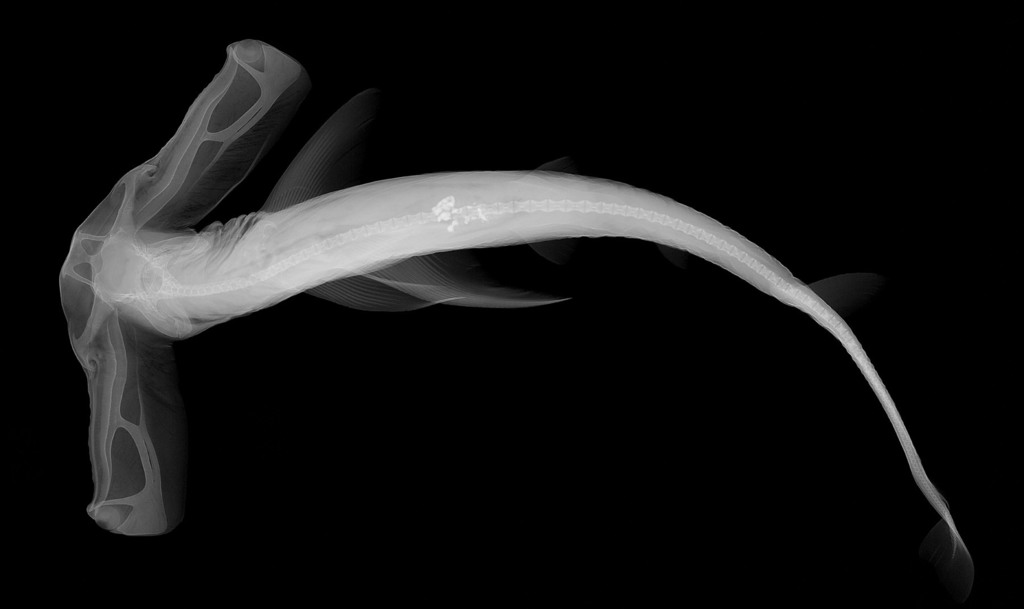
Winghead Shark
Eusphyra blochii
The winghead shark (Eusphyra blochii) is a species of hammerhead shark, and part of the family Sphyrnidae. It is the sole member of the genus Eusphyra. Reaching a length of 1.9 m (6.2 ft), this small brown to gray shark has a slender body with a tall, sickle-shaped first dorsal fin. Its name comes from its exceptionally large "hammer", or cephalofoil, which can be as wide as half of the shark's total length. The function of this structure is unclear, but may relate to the shark's senses. The wide spacing of its eyes grants superb binocular vision, while the extremely long nostrils on the leading margin of the cephalofoil may allow for better detection and tracking of odor trails in the water. The cephalofoil also provides a large surface area for its ampullae of Lorenzini and lateral line, with potential benefits for electroreception and mechanoreception, respectively.
Inhabiting the shallow coastal waters of the central and western Indo-Pacific, the winghead shark feeds on small bony fishes, crustaceans, and cephalopods. It gives birth to live young, with the developing embryos receiving nourishment through a placental connection. Females produce annual litters of six to 25 pups; depending on region, birth may occur from February to June after a gestation period of 8–11 months. This harmless species is widely fished for meat, fins, liver oil, and fishmeal. The International Union for Conservation of Nature has assessed it as endangered in 2016, as it is thought to have declined in some parts of its range due to overfishing.
From the article Winghead shark on Wikipedia (CC BY-SA), quoted section by section
Description
True to its name, the winghead shark's cephalofoil consists of a pair of long, narrow, and gently swept-back blades. The width of the cephalofoil is equal to 40–50% of the shark's total length. The front of the cephalofoil has a slight indentation in the middle and a gentle bump on each side in front of the nostrils. Each nostril is roughly twice as long as the width of the mouth and extends along almost the entire leading margin of each blade. The circular eyes, located at the forward outer corners of the cephalofoil, are equipped with protective nictitating membranes. The relatively small, arched mouth contains 15–16 upper and 14 lower tooth rows on each side, and sometimes also a single row of tiny teeth at the upper and/or lower symphyses (jaw midpoints). The teeth are small and smooth-edged, with angled triangular cusps. Five pairs of gill slits are seen, with the fifth pair over the pectoral fin origins. The body is slim and streamlined, with a very tall, narrow, and falcate (sickle-shaped) first dorsal fin that originates over the bases of the rather small pectoral fins. The second dorsal fin is much smaller and originates over the caudal third of the anal fin base. The anal fin is about half again as long as the second dorsal fin. A lengthwise groove is on the caudal peduncle at the dorsal origin of the caudal fin. …
Range & habitat
The winghead shark is found in the tropical central and western Indo-Pacific, from the Persian Gulf eastward across South and Southeast Asia to New Guinea and northern Queensland. Its range extends as far north as Taiwan and as far south as the Montebello Islands off Western Australia. This species inhabits shallow waters close to shore and has been known to enter estuaries.
Wikipedia: “Distribution and habitat”
What it does
Several nonexclusive hypotheses have been proposed to explain the extreme size of the winghead shark's cephalofoil. The placement of the eyes at the ends of the cephalofoil provides a binocular field of view of 48°, the most of any hammerhead and four times that of a requiem shark; this species thus has excellent depth perception, which may aid in hunting. This species also has proportionately the longest nostrils among the hammerheads; longer nostrils contain more chemosensory receptors and can sample more water at a time, increasing the chances of detecting an odor molecule. A winghead shark 1 m (3.3 ft) long is theoretically capable of sampling over 2,300 cm3 (140 in3) of water per second. Another potential olfactory benefit of the cephalofoil is increased separation between the midpoints of the left and right nostrils, which enhances the shark's ability to resolve the direction of a scent trail. Finally, the cephalofoil may increase the shark's ability to detect the electric fields and movements of its prey, by providing a larger surface area for its electroreceptive ampullae of Lorenzini and mechanoreceptive lateral line. The lateral blades seem too large to function in maneuvering, which has been suggested for other hammerheads. The winghead shark usually hunts close to the sea floor. Its diet consists mainly of small bony fishes, followed by crustaceans and cephalopods. …
Wikipedia: “Biology and ecology”
Where it lives
Recorded sightings
—
geo-referenced records in GBIF, from museums, herbaria and field observers.
Drag the globe to turn it. Dots are where records exist, not a range map; darker means more records.
In the stacks
Searching the stacks…
Every page naming Eusphyra blochii in the Biodiversity Heritage Library →
This page is assembled live from iNaturalist, GBIF, Wikipedia, the Source Library and the Internet Archive. It is not yet part of the hand-edited codex. iNaturalist taxon 48066.