- Plants
- ›Vascular Plants
- ›flowering plants
- ›Dicots
- ›Gentians, Dogbanes, Madders, and Allies
- ›Dogbane Family
- ›milkweeds
- ›Asclepiadeae
- ›Asclepiadinae
- ›Asclepias
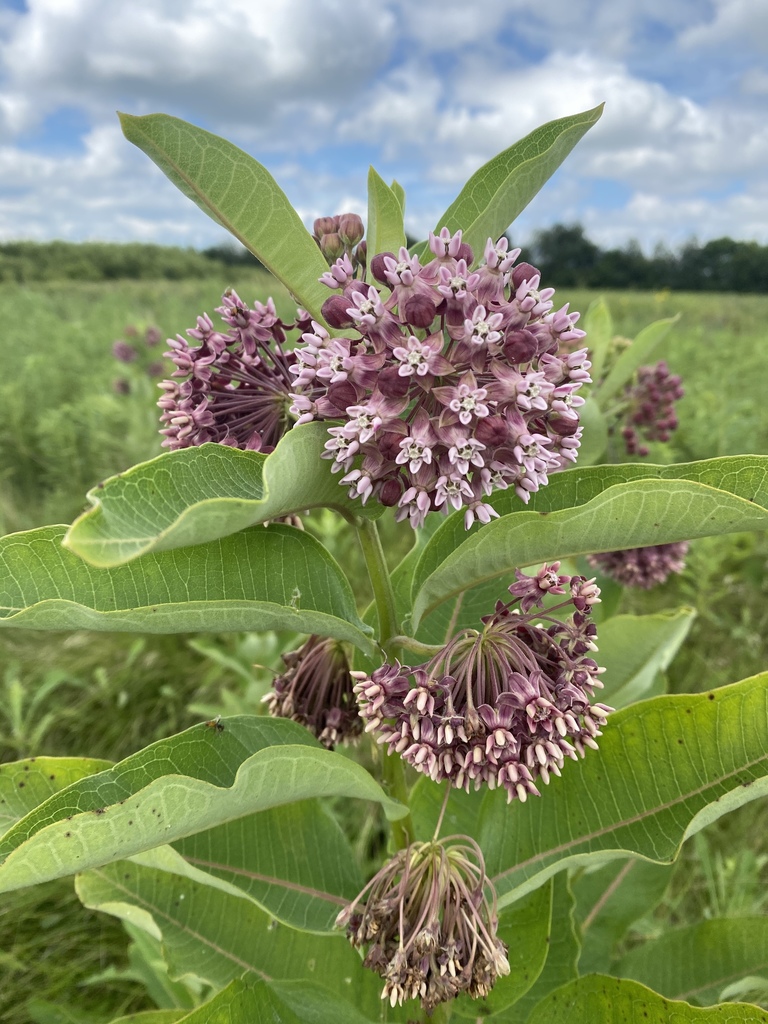
common milkweed
Asclepias syriaca
Asclepias syriaca, commonly called common milkweed, butterfly flower, silkweed, silky swallow-wort, and Virginia silkweed, is a species of flowering plant. It is in the genus Asclepias, the milkweeds. This species is native to southern Canada and of much of the conterminous eastern U.S., east of the Rocky Mountains, excluding the drier parts of the prairies. It grows in sandy soils and other kinds of soils in sunny areas. It was one of the earliest North American...
From the article Asclepias syriaca on Wikipedia (CC BY-SA), quoted section by section
Description
A. syriaca is a clonal perennial forb whose individual plants grow from propagative roots. All parts of the plants produce a white latex when cut. The plant typically grows to a height of 3 to 5 feet (0.91 to 1.52 m), but can reach 8 ft (2.4 m) in ditches and gardens. Its simple leaves are opposite, sometimes whorled, broadly ovate-lanceolate, and 1.5–4.75 inches (3.8–12.1 cm) wide, usually with entire, undulate margins and reddish main veins. Leaves have very short petioles and velvety undersides. The highly fragrant, nectariferous flowers vary from white (rarely) through pinkish and purplish and occur in umbellate cymes. Individual flowers are about 1 cm (0.4 in) in diameter, each with five horn-like hoods and five pollinia. The seeds, each with long, white flossy hairs, occur in large follicles. Fruit production from self-fertilization is rare. In three study plots, outcrossed flowers had an average of about 11% fruit set.
What it does
Within its range, A. syriaca can be found in a broad array of habitats from croplands, to pastures, roadsides, ditches, and old fields. More than 450 insect species feed on the plant, including flies, beetles, ants, bees, wasps, and butterflies. It is among the most important food sources for monarch butterfly (Danaus plexippus) caterpillars in the northeastern and midwestern United States and is one of only three milkweed species on which the eastern monarch migration largely depends. Using cardenolide fingerprinting analysis, investigators have found that 85-92% of monarchs overwintering in Mexico had fed on A. syriaca as caterpillars. In 2024, staff of the National Capital Planning Commission (the US federal government's planning agency for the National Capital Region) introduced a "Pollinator Best Practices Resource Guide". When discussing milkweeds, the Guide states that although more than 100 species of such plants are considered native to North America, Asclepias syriaca stands out and "is clearly an important species that is critical to the survival of monarch butterflies".
Other insects that feed on the plant include the red milkweed beetle (Tetraopes tetraophthalmus), the milkweed tussock caterpillar (Euchaetes egle), the large milkweed bug (Oncopeltus fasciatus), and the small milkweed bug (Lygaeus kalmii). …
Wikipedia: “Ecology”
At the table
The plant's latex contains large quantities of cardiac glycosides, making the leaves and stems of old tall plants toxic to humans and large animals. The young shoots, young leaves, flower buds and immature fruits are all edible raw. Euell Gibbons, the author of Stalking the Wild Asparagus (1962), wrote that milkweed is bitter and toxic. However, he may have inadvertently prepared common dogbane (Apocynum cannabinum), a poisonous somewhat similar-looking plant instead. Gibbons devised a method to remove the bitterness and toxicity by plunging the young shoots into boiling water and cooking for one minute, repeating the procedure at least three times to make the plant safe to eat. Some modern foragers consider the bitterness and toxicity issue a myth. The plants have no bitterness when tasted raw, and can be cooked like asparagus, with no special processing. The plant has been studied as a source of rubber from the latex of the plant, and as a fiber source from the seed fluff. The fluffy seed hairs have been used as the traditional background for mounted butterflies and other insects. The compressed floss has a silk-like sheen. The plant has also been explored for commercial use of its bast (inner bark) fiber, which is both strong and soft. U. S. …
Wikipedia: “Uses”
How it is grown
A. syriaca can become aggressive. It spreads from propagative roots and may not be suited to small gardens and formalized plantings. The plant is winter hardy in USDA zones 3–9; it has a preference for moist but well drained soils, but is tolerant of dry conditions and clay soils. Although A. syriaca grows best in full sun, it can tolerate light shade but may produce fewer flowers under such conditions. It is ideal in semi-dry places where it can spread without presenting problems for other ornamental species. Monarch Watch provides information on rearing monarchs and their host plants. Efforts to restore falling monarch butterfly populations by establishing butterfly gardens and monarch migratory "waystations" require particular attention to the target species' food preferences and population cycles, as well to the conditions needed to propagate and maintain their food plants. In the northeastern United States, monarch reproduction peaks in late summer when most A. syriaca leaves are old and tough. Plants that are mowed or cut back in June – August regrow rapidly from their roots in time for peak monarch egg-laying, when reproducing females have a preference for quickly-growing shoots whose foliage is tender and soft. A. syriaca can be grown from seeds and propagative root cuttings. A U.S. …
Wikipedia: “Cultivation”
Where it lives
Recorded sightings
—
geo-referenced records in GBIF, from museums, herbaria and field observers.
Drag the globe to turn it. Dots are where records exist, not a range map; darker means more records.
In the stacks
Searching the stacks…
Every page naming Asclepias syriaca in the Biodiversity Heritage Library →
This page is assembled live from iNaturalist, GBIF, Wikipedia, the Source Library and the Internet Archive. It is not yet part of the hand-edited codex. iNaturalist taxon 47911.