- Plants
- ›Vascular Plants
- ›flowering plants
- ›Dicots
- ›Heathers, Balsams, Primroses, and Allies
- ›balsam family
- ›Impatiens
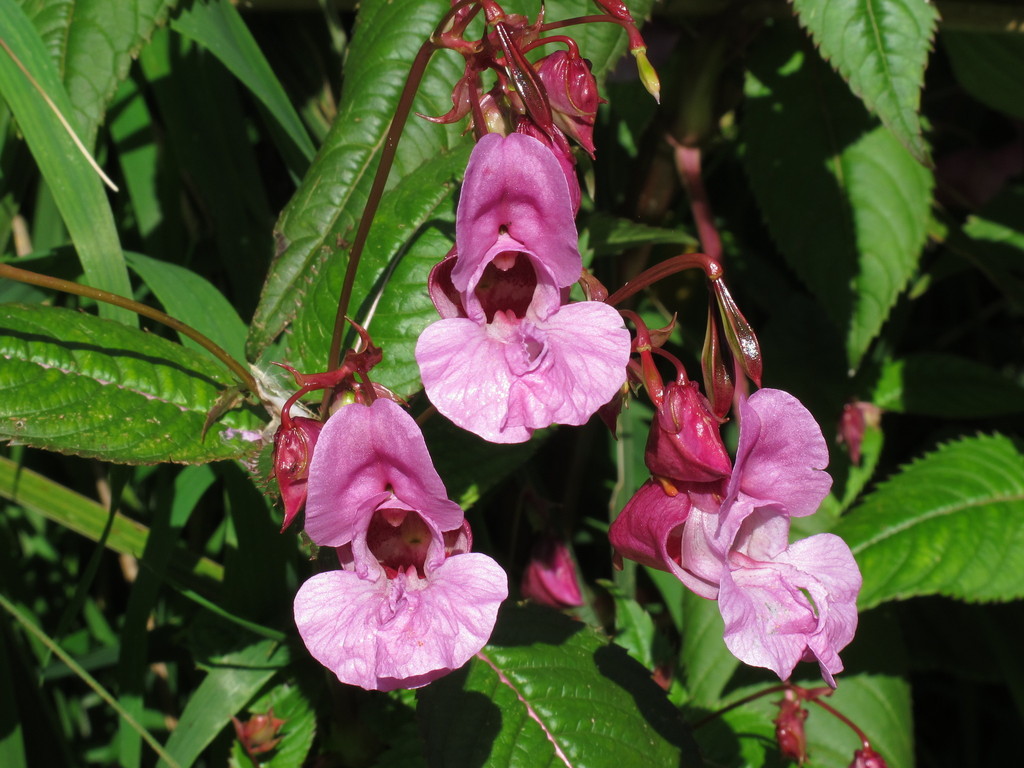
Himalayan balsam
Impatiens glandulifera
Impatiens glandulifera, Himalayan balsam, is a large annual plant native to the Himalayas. Via human introduction it is now present across much of the Northern Hemisphere and is considered an invasive species in many areas. Uprooting or cutting the plants is an effective means of control.
In Europe, Himalayan balsam has been included since 2017 in the list of invasive alien species of Union concern (the Union list). This implies that the species cannot be imported, cultivated, transported, commercialized, planted, or intentionally released into the environment in the whole of the European Union.
From the article Impatiens glandulifera on Wikipedia (CC BY-SA), quoted section by section
Description
It typically grows to 1 to 2 m (3.3 to 6.6 ft) high, with a soft green or red-tinged stem, and lanceolate leaves 5 to 23 cm (2.0 to 9.1 in) long. The crushed foliage has a strong musty smell. Below the leaf stems the plant has glands that produce a sticky, sweet-smelling, and edible nectar. The flowers are pink, with a hooded shape, 3 to 4 cm (1+1⁄4 to 1+1⁄2 in) tall and 2 cm (3⁄4 in) broad; the flower shape has been compared to a policeman's helmet. After flowering between June and October, the plant forms seed pods 2 to 3 cm (3⁄4 to 1+1⁄4 in) long and 8 mm broad (1⁄4 in), which explode when disturbed, scattering the seeds up to 7 metres (23 feet). The green seed pods, seeds, young leaves and shoots are all edible. The flowers can be turned into a jam or parfait. The plant was rated in first place for per day nectar production per flower in a UK plants survey conducted by the AgriLand project which is supported by the UK Insect Pollinators Initiative. However, when number of flowers per floral unit, flower abundance, and phenology were taken into account, it dropped out of the top ten for most nectar per unit cover per year, as did all plants that placed in the top ten for per-day nectar production per flower, with the exception of common comfrey (Symphytum officinale).
Range & habitat
Himalayan balsam is native to the Himalayas, specifically to the areas between Kashmir and Uttarakhand. In its native range it is usually found at altitudes between 2000 and 2500 m above sea level, although it has been reported at up to 4000 m above sea level. In Europe the plant was first introduced into the United Kingdom by John Forbes Royle, professor of medicine at King's College, London who became Superintendent of the Botanic Gardens, Saharanpur, India. It has now become naturalized and widespread across riverbanks. At present it can be found almost everywhere across the continent. In North America it has been found in the Canadian provinces of British Columbia, Manitoba, Ontario, Quebec, Nova Scotia, New Brunswick, Prince Edward Island and Newfoundland. In the United States it is found on both the east and west coast, seemingly restricted to northern latitudes. In New Zealand it is sometimes found growing wild along riverbanks and wetlands.
Wikipedia: “Distribution and habitat”
At the table
Himalayan Balsam is edible, but should be eaten in moderation as it contains oxalates
Wikipedia: “Uses”
In human culture
The common names Himalayan balsam and kiss-me-on-the-mountain refer to the plant's native Himalayan mountains. Ornamental jewelweed refers to its cultivation as an ornamental plant. It is also sometimes known as Policeman's helmet. The specific epithet glandulifera is a compound word from glándula meaning 'small gland', and ferre meaning 'to bear'.
Wikipedia: “Etymology”
Where it lives
Recorded sightings
—
geo-referenced records in GBIF, from museums, herbaria and field observers.
Drag the globe to turn it. Dots are where records exist, not a range map; darker means more records.
In the stacks
Searching the stacks…
Every page naming Impatiens glandulifera in the Biodiversity Heritage Library →
This page is assembled live from iNaturalist, GBIF, Wikipedia, the Source Library and the Internet Archive. It is not yet part of the hand-edited codex. iNaturalist taxon 47892.