- Plants
- ›Vascular Plants
- ›flowering plants
- ›Dicots
- ›Woodsorrels, Quandongs, and Allies
- ›Woodsorrel Family
- ›Oxalis
- ›Oxalis
- ›Oxalis
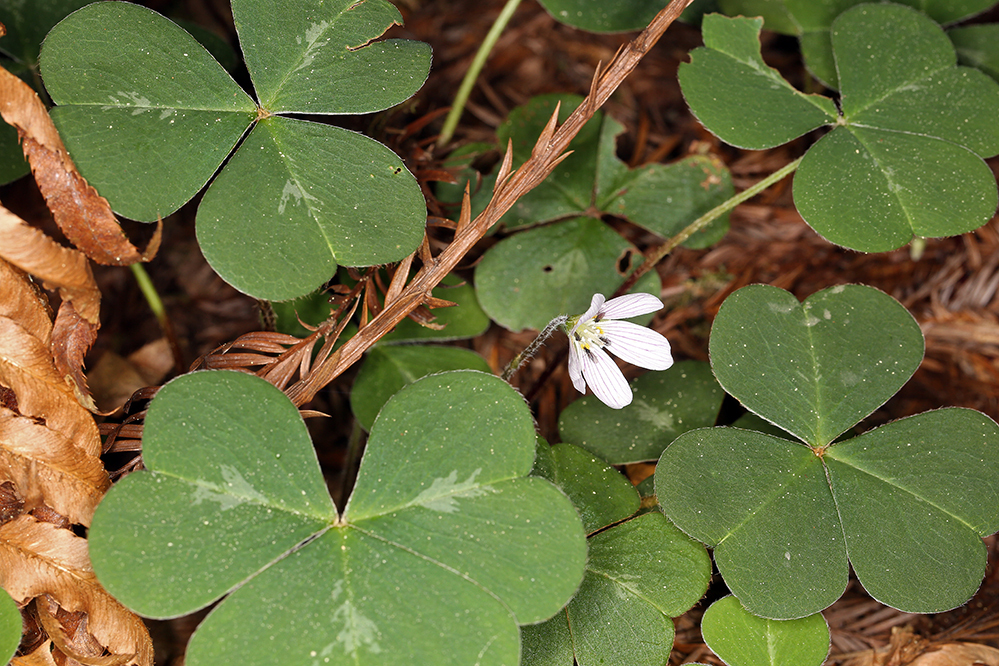
Oregon woodsorrel
Oxalis oregana
Oxalis oregana, known as redwood sorrel or Oregon oxalis, is a species of the wood sorrel family, Oxalidaceae, in the genus Oxalis native to moist Douglas-fir and coast redwood forests of western North America from southwestern British Columbia to Washington, Oregon, and northern California. The species is now recognized as distinct from Oxalis smalliana, with which it was previously conflated.
From the article Oxalis oregana on Wikipedia (CC BY-SA), quoted section by section
Description
Oxalis oregana is a short, herbaceous perennial with erect flowering stems 5–15 cm tall. The three leaflets are heart-shaped, 1–4.5 cm long with purplish undersides, on 5–20 cm stalks. The inflorescence is 2.4–4 cm in diameter, white to pink with five petals and sepals. The hairy five-chambered seed capsules are egg-shaped, 7–9 mm long; seeds are almond-shaped. It spreads by a scaly rhizome varying the size of patches. They can be seen throughout moist forest under-canopies. The species ranges from southern Humboldt County, California to southwestern British Columbia. Unlike its close relative Oxalis smalliana, O. oregana consistently has white flowers and shows typical single sequence haplotypes in genetic analyses. In areas where both species overlap, O. oregana reaches peak flowering approximately one month later than O. smalliana.
At the table
The leaves of Oxalis oregana are eaten by the Cowlitz, Quileute and Quinault peoples. Like spinach, they contain mildly toxic oxalic acid, which is named after the genus. They are safe to eat in small amounts for those with no oxalate-related conditions.
Wikipedia: “Leaves as food”
Where it lives
Recorded sightings
—
geo-referenced records in GBIF, from museums, herbaria and field observers.
Drag the globe to turn it. Dots are where records exist, not a range map; darker means more records.
In the stacks
Searching the stacks…
Every page naming Oxalis oregana in the Biodiversity Heritage Library →
This page is assembled live from iNaturalist, GBIF, Wikipedia, the Source Library and the Internet Archive. It is not yet part of the hand-edited codex. iNaturalist taxon 47757.